Learning Context/ Introduction
This lesson relates math to music by showing the relationship of musical rhythms to different kinds of fractions. This experience fits into the 8th grade math curriculum unit on decimals and fractions. I used it as an introduction to adding and subtracting fractions.
The objective for this lesson is to have students read musical notes and perform a basic rhythmic pattern. They need to add musical notes together to produce a real number (fraction), and create addition/subtraction problems with musical notes. Supporting activities would be reinforcing note values, clapping rhythms based on the value of a whole note, and adding and subtracting fractions as these values relate to musical notes and rhythms.
Students should be able to understand addition and subtraction of fractions beyond their textbook in real, practical terms. They should be able to understand the meaning of counting and note value when reading or singing music. They should also be able to see how playing different patterns together can make an interesting rhythm.
The lesson supports student progress toward attainment of the learning standards by appealing to a variety of learning styles, including: Logical-Mathematical, Bodily-Kinesthetic, Musical, and Interpersonal. It attempts to cultivate musical and logical-mathematical intelligence by appealing to them through a diverse set of instructional activities.
Duration
Cooperative planning between the music and math teacher took about one and a half hours. (This included discussing the roles each teacher would play.)
The worksheet was graded by both of the teachers, who checked answers after each section, and by students checking their own work as answers were read aloud. Corrections and explanations were made when incorrect answers were given. Students also switched papers and checked each other's work. An actual grade was not given; teachers tried to correct any mistakes or problems with understanding the material as the lesson went along.
Instructional/Environment Modifications
Instructional modifications that were used to accommodate the range of abilities in the classroom included using only measures in which the quarter-note gets the beat. We felt that including 6/8 time or any other time signature with a denominator not equal to four would be too difficult at that time.
Procedure
The music teacher presented an overview of the interdisciplinary lesson, which demonstrated a connection between music and math. He reviewed musical notes and their values with the students and then informed them that they would look at simple fractions as they relate to a measure of music. Students were encouraged to remember that notes represent specific values and to think of a whole note as equaling one measure.
The music teacher then suggested that students listen to the value of each note as he clapped for them. The math teacher joined the lesson by clapping the value of the whole note, while the music teacher clapped the value of half, quarter, eighth, and sixteenth notes. Students were asked to identify the fraction for each type of note.
The class was divided into two groups. One side clapped on the whole note (every four beats) and the other side clapped on the quarter note (once every beat of the four beat measure). The fractional equivalents of the half note, quarter note, eighth note, sixteenth note, and thirty-second note were demonstrated using this method.
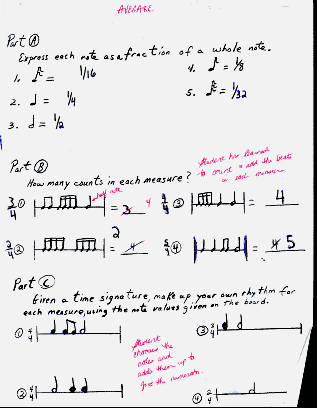
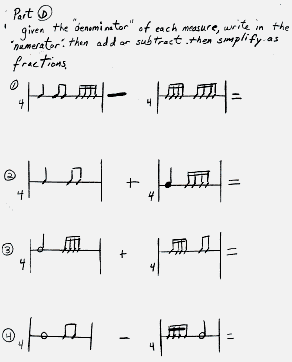
After this demonstration, a worksheet was distributed which included sections for: expressing specific notes as a fraction counting the values in a measure as represented by various notes in a measure, developing a time signature (numerator/denominator) for a measure with corresponding notes, and writing the numerator when given the denominator of a measure. Addition and subtraction of these values and simplifying the answers were included in the last section.
Students were guided by both teachers. As they progressed through the worksheet, students were called upon to answer questions. They also engaged in guided practice, worked independently, exchanged papers to check their work, and worked together to explain their answers.
As a follow-up assignment, the students were asked to write 5 examples like those found in Part D. They were also asked to solve the examples themselves and to put their answers in lowest terms.
Student Work
Resources
A person with a background in music to explain how math is used in music, Teacher-made worksheet, chalkboard (for notes).
Assessment Plan
Students checked their work after each section.
Student Work
Selected Examples:
Authors
Sharon Mosher and Eric Kelly, Perry Central School District
Reflection
In thinking about the notes that were on the board, I realized that if you simplify the 2 eighth notes, you get 1/4 (of a beat); 1/4 = 1/4; 2/8 = 1/4; 4/16 = 1/4; and 8/32 = 1/4. This can be brought to the attention of the students as they go through the worksheet. This is important when dealing with quarter notes that get one beat, as they did in all of our examples.
This lesson was developed to relate math and music and to show the students the interconnectedness between math and music. It was an interesting, concrete way to understand the breakdown of fractions in music. Both musicians and non-musicians alike had an enjoyable experience.
I learned that different topics can be introduced and discussed in relation to other disciplines. The same positive results can be obtained through many different methods, and it is often more interesting to the students to learn the material in novel ways. I will definitely do more interdisciplinary lessons in the future!
This lesson was observed by the building principal, who suggested that we send it to you! He was very excited and pleased with the lesson and encouraged us to do more like it in the future. He commended our efforts to teach cooperatively and he thought that our lesson was developmentally appropriate, utilized a variety of delivery systems, and encouraged active participation. All in all, he thought it was a very productive and enjoyable lesson. Several of our peers thought that the lesson was very innovative and were pleased our efforts. They heard from the students that it was very enjoyable and helpful to them.
I have tried to utilize a variety of delivery systems and novel applications to teach mathematics. This lesson appealed to students regardless of their like or dislike of mathematics, and it made the introduction of adding and subtracting fractions fun and interesting.
Please Note
Although the description references a connection to the 8th grade math curriculum, New York State has updated the math standards, including when some content, such as adding and subtracting fractions is covered. Thus, NYLearns.org team revised this lesson to include this new information and modified it for grade where the introduction of adding and subtracting fractions is now covered based on the new 2005 math standards.