Assessment
Student will be assessed by the accuracy of their answers to the document based questions and their products from the Putting it All Together Activities.
Learning Context/ Introduction
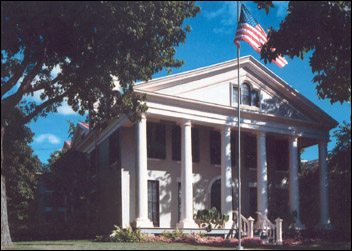
This lesson is based on the National Register of Historic Places registration file for the "Theodore Roosevelt Inaugural National Historic Site" (Ansley Wilcox House) and other source material.
Theodore Roosevelt Inaugural Site was written by Ann Marie Brogan-Linnabery, former Chief of Interpretation, Theodore Roosevelt Inaugural National Historic Site. The lesson was edited by Fay Metcalf, education consultant, and the Teaching with Historic Places (TwHP) staff.
TwHP is sponsored, in part, by the Cultural Resources Training Initiative and Parks as Classrooms programs of the National Park Service. This lesson is one in a series that brings the important stories of historic places into the classrooms across the country.
Duration
One full week.
Essential Question
Procedure
How To Use a TwHP Lesson Plan
Teaching with Historic Places (TwHP) lesson plans provide a rich opportunity to enhance learning by bringing historic places across the country directly into your classroom. Students experience the excitement of these special places and the stories they have to tell through carefully selected written and visual materials.
Each TwHP lesson plan contains teacher material and teaching activities. Teacher material includes the following sections: Introduction, Where it fits into the curriculum, Objectives for students, Materials for students, and visiting the site. Teaching activities consist of the following sections: Getting Started (inquiry question), Setting the Stage (historical background), Locating the Site (maps), Determining the Facts (readings, documents, charts), Visual Evidence (photographs and other graphic documents), and Putting It All Together (activities). The lesson plan format was designed to allow flexibility but works best if the material in each lesson plan is presented to students as described below:
1) Getting Started
Begin each lesson by asking students to discuss possible answers to the inquiry question that accompanies the Getting Started image. To facilitate a whole class discussion, you may want to print the page and use it to make an overhead transparency. The purpose of the exercise is to engage students' interest in the lesson's topic by raising questions that can be answered as they complete the lesson.
Rather than serving merely as illustrations for the text, images are documents that play an integral role in helping students achieve the lesson's objectives. To assist students in learning how to "read" visual materials, you may want to begin this section by having them complete the Photo Analysis Worksheet for one or more of the photos. The worksheet is appropriate for analyzing both historical and modern photographs and will help students develop a valuable skill.
2) Setting the Stage
Next present the information in Setting the Stage. This material may be read aloud to students, summarized, or photocopied for students to read individually or in small groups. Setting the Stage material provides background information necessary to acquaint students with the topic of the lesson they will be studying.
3) Locating the Site
Next provide students with copies of the maps and questions included in Locating the Site. Have students work individually or in small groups to complete the questions. At least one map familiarizes students with the historic site’s location within the country, state, and/or region. Extended captions may be included to provide students with information necessary to answer the questions.
4) Determining the Facts
Then provide students with copies of the readings, documents, and/or charts included in Determining the Facts. Again, allow students to work individually or in small groups. The series of questions that accompanies each of these sections is designed to ensure that students have gathered the appropriate facts from the material.
5) Visual Evidence
Next distribute the lesson’s visual materials among students. You can print these images straight from the Web or display them on a computer screen. Have the students examine the photographs and answer the related questions. Note that in some of the lessons two or more images are studied together in order to complete the questions. Extended captions may be included to provide students with important information.
Rather than serving merely as illustrations for the text, the images are documents that play an integral role in helping students achieve the lesson's objectives. To assist students in learning how to "read" visual materials, you may want to begin this section by having them complete the Photo Analysis Worksheet for one or more of the photos. The worksheet is appropriate for analyzing both historical and modern photographs and will help students develop a valuable skill.
6) Putting It All Together
After students have completed the questions that accompany the maps, readings, and visuals, they should be directed to complete one or more of the activities presented in Putting It All Together. These activities engage students in a variety of creative exercises that help them synthesize the information they have learned and formulate conclusions. At least one activity in each lesson plan leads students to look for places in their community that relate to the topic of the lesson. In this way, students learn to make connections between their community and the broader themes of American history they encounter in their studies.
Reflections and Feedback
By looking at The Theodore Roosevelt Inaugural Site: Birthplace of the Modern Presidency, students examine the circumstances under which Theodore Roosevelt first became President of the United States and how his policies and actions modernized the presidency.
Related Resource
Theodore Roosevelt Inaugural Site: Birthplace of the Modern Presidency-- Supplementary Resources
Theodore Roosevelt Inaugural National Historic Site
The Theodore Roosevelt Inaugural National Historic Site is a unit of the National Park Service. Visit the park's web pages for information on Ansley Wilcox as well as exhibits on the 1901 events that made this house nationally significant.
Theodore Roosevelt Birthplace National Historic Site
Theodore Roosevelt Birthplace National Historic Site is a unit of the National Park Service. Located in Manhattan, New York, this site preserves his childhood home that he occupied from his birth on October 27, 1858 until he reached 14 years of age. Visit the park's web pages for more information about this site.
Sagamore Hill National Historic Site
Sagamore Hill National Historic Site is a unit of the National Park Service. Visit the park's web pages for more information on this residence of President Roosevelt from 1886 until his death in 1919. The home was also the site of presidential activity as it was the "Summer White House" throughout both of his terms.
Theodore Roosevelt Association
The Theodore Roosevelt Association organization has a wide range of sources and publications relating to the life and works of Theodore Roosevelt. The website includes everything from quotations, to reviews on biographies, to his family tree. Some kid-friendly links include "Theodore Roosevelt and the Teddy Bear" and "Teddy & The Children's Room," both featuring answers to children's questions about the life of our 26th President.
National Archives
Search the National Archives website for a number of primary documents regarding Theodore Roosevelt and details about his presidency.
American Presidents, Life Portraits
In this series, C-SPAN explores the life stories of the men who have been president by traveling to presidential homes, museums, libraries, and gravesites and speaking with presidential scholars. Included is on the website is information about the American President, Theodore Roosevelt.
The Smithsonian
The Smithsonian has an online exhibit entitled "Theodore Roosevelt: Icon of the American Century." This feature breaks down his life into three parts: first his early childhood and early political life, his presidency, and finally his post-Presidency personal and political adventures. Also included is a brief chronology of his major accomplishments and links to biographies of other key contemporary figures.
Library of Congress: American Memory Collection
Search the American Memory Collection Webpage for a variety of historical resources on Theodore Roosevelt. Included on the site are documents, photographs, and other materials on the life of this extraordinary man. Also search on Theodore Roosevelt Inaugural National Historic Site for architectural documentation of the site by Historic American Buildings Survey/Historic American Engineering Record.
For Further Reading
Students (or educators) wishing to learn more about Theodore Roosevelt may want to read: A. E. Campbell, America Comes of Age: the Era of Theodore Roosevelt (New York: American Heritage Press, 1971); Hermann Hagedorn, The Boys' Life of Theodore Roosevelt (New York: Harper, 1922); Theodore Roosevelt, A Bully Father: Theodore Roosevelt's Letters to His Children (New York: Random House, 1995).
Author
The Theodore Roosevelt Inaugural National Historic Site