Assessment
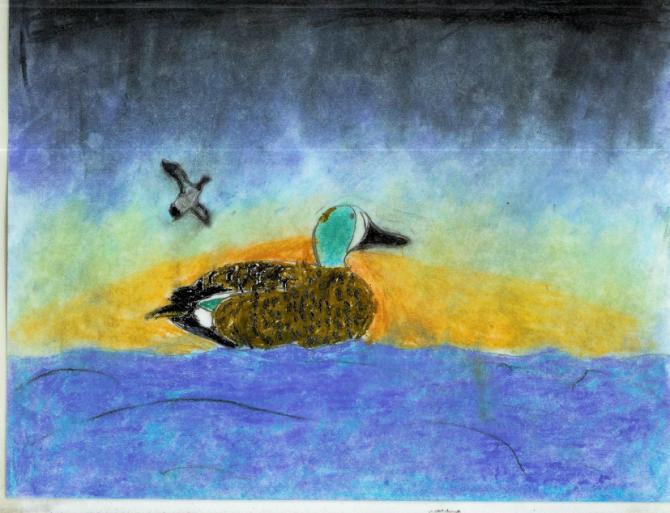
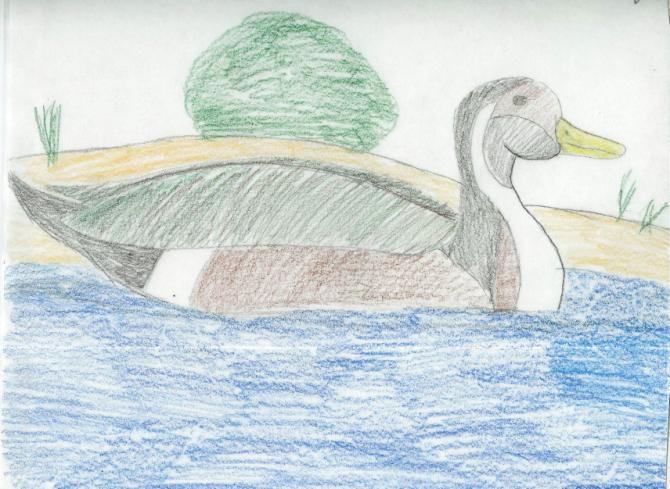
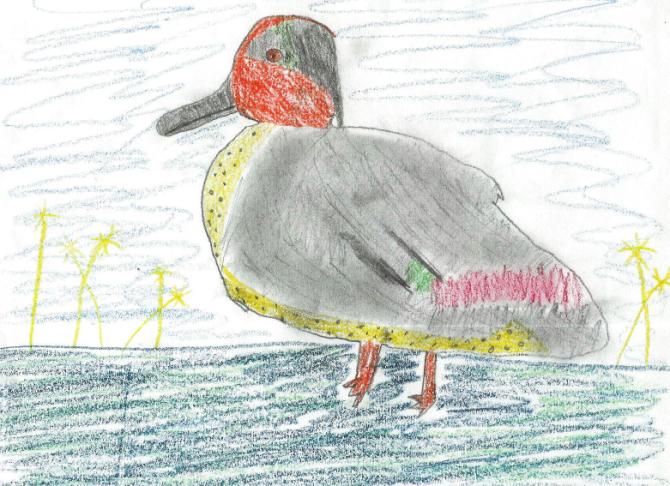
Here are some finished student works and the rubric for the unit.
Learning Context/ Introduction
Since the Renaissance, many artists have employed graphs to enlarge a drawing and to solve the problem of proportion. I use this graphing process to help with a duck drawing.
My seventh grade art class spends some time studying wetlands wildlife. I use the Junior Duck Stamp Contest as a model to encourage students to consider nature, and challenge them to understand how species are dependent on their environment. As part of the research, we view a 13-minute VHS tape produced by the Federal Junior Duck Stamp Contest Public Relations Department. For more information, please visit the Federal Duck Stamp website.
Duration
The complete unit takes approximately two weeks. The graphing lesson can be completed in 3-4 periods of 42 minutes.
Essential Question
How does proportion control the image of a drawing?
Instructional/Environment Modifications
Note: The final works are laminated. We label the work on the back with the artist's name and the name of the species. If time permits, we have a contest and the judges will view the displayed ducks spread out on a table and will vote for their favorites by placing a penny or some such coin on the work. The chosen works (with the most coins) will receive a ribbon and/or a money award. One work may be submitted to the regional or state level.
Procedure
Graphing Lesson
As a class activity, I draw two identical graphs on the board, side by side. I label the axis, working from the lower left corner 0,0, horizontally (X axis) and vertically (Y axis). A number is assigned to each line or space. (For the purposes of this lesson, I number the spaces.)
We discuss the order of identifying a coordinate. That is where the order XYZ comes in. The X number is first, and the Y number is second.
I draw a simple line picture on one of the grids. I ask a student to take my 'magic marker' and choose a coordinate of my drawing. We identify the square (X,Y), and then we find the same coordinate on the other grid. When the student has made this connection, a duplicate line or shape is be drawn on the second or "copy" graph.
Points to consider:
- If the box is too complicated, it can be subdivided, dividing it into four parts. This helps to further analyze a coordinate.
- If a student seems overwhelmed by the grid, a mat can be cut to show only the square that is being viewed.
- When drawing more that one square, a series of points can be plotted and then an extended line can be drawn.(It is of interest to note that artists often visualize an imaginary grid when judging distance, size, location or pattern.)
One by one, each student takes the 'magic marker' and draws in a square until the new 'identical' drawing is completed.
When finished, one student is asked to become the "Quality Control' person and make any adjustments. The group, as a whole, has a chance to participate in the judging process.
Others may volunteer or come forward and fix or correct a section of the graph.
Extended knowledge: The students are also reminded that a grid can be squeezed or inflated to warp an image.
After this demonstration, the students are ready to begin their own graphed drawing.
To prepare, I photocopy their ducks with a pre-determined grid overlay transparency. A number sequence has been included. I have preprinted enlarged graph paper with the same number sequence for the students to use.
The students will need two or three days to complete their drawing. Some may take it home to work on. If the drawing is oversized, it may be reduced on the photocopy machine. After the graphing is completed, we trace the graphed duck on a new piece of 81/2" by 11" paper, using a light table or the window. We add details using their original photograph as a resource.
Students may need to look up a colored version of their duck on Goggle Images or use other reference materials. I have nature magazines for suggested backgrounds. The students use their own ideas for their background. The work is the finished in a chosen medium. Colored pencil, chalk, pastel, paint, oil pastels and watercolor are all interesting variations. Mixed media works well also. The color rendering takes about 2-4 class periods.
Reflections and Feedback
I find that this process works very well. The students graph the basic shapes of the ducks and can observe and add textures and colors to complete the rendering.
In addition, if the graph is manipulated, for example it is squeezed or inflated, the image can be distorted. Hence, in the high school I can refer to this 7th grade project when we explore how to abstract an image.
Student Work
Student Graphs

Canadian Goose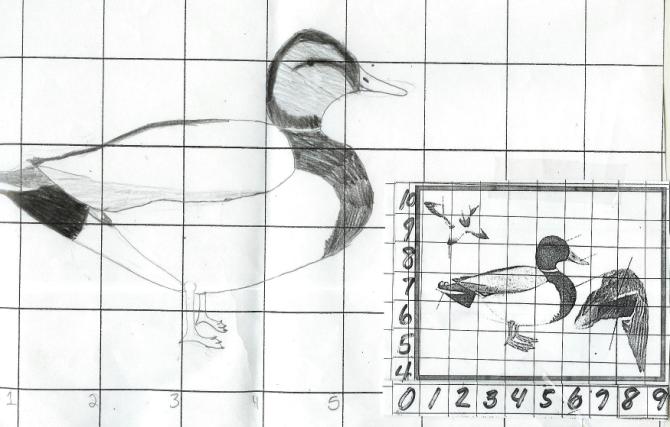
Related Resource
Junior Duck Stamp Contest Website
Federal Duck Stamp