Assessment
The rubric shows how the semantic map will be graded. See attached rubric. Print rubric for clearer version.

Learning Context/ Introduction
This learning experience helps students to create connections with their prior knowledge. Students can utilize technology in order to help them learn the material covered in class. Students have learned the four major classes of organic compounds. Previously at the end of each section of a particular class of compounds, students have created a hand written semantic map. This map allows students to show similarities and differences among these compounds. This learning experience is a culminating activity on biochemistry. Students will create a semantic map using Inspiration, which will encompass all of the compounds that were learned. Students choose a picture of each compound and place it appropriately in the map. The student creates their own unique map based on the information that they learned.
Duration
This project of creating the semantic map took four 40-minute periods. The first day was going over the project and the requirements stated in the rubric. This day also allowed the students to experience the Inspiration program and learn how to use the software. The second day gave students time to begin to create the project. Students printed out a copy of their semantic map in black and white and handed this in to their teacher. The teacher viewed the maps and made comments and corrections. The teacher handed this back out to students the next day (third day). Students used the suggestions, and comments to improve their project. The fourth day was given for students to create final touches to their project, saving it to their documents folder and printing their project to a color printer.
Essential Question
What do students list as classes of organic molecules?
What can students create to show similarities and differences among classes of organic molecules?
Instructional/Environment Modifications
Need use of computer lab and color printer. Most students in this class are general education students and do not require special services. One student in the class is a special education student and has an individualized education program (IEP). This student needs a separate location for tests and receives additional services throughout each school day. This student was allowed to work on their presentation during these times. This student has previously been in a separate classroom and participated in minimal general education classrooms. Students can create semantic map on their own or with a partner. There is a lot of flexibility with this lesson.
Procedure
Introduce and teach students the concepts of organic molecules.
Students study carbohydrates, lipids, proteins, and nucleic acids. These are 4 individual sections of a biochemistry unit. Students are given lecture, guided notes, crosswords, fill-in sheets, homework sheets, and quizzes for each section of organic molecules. Materials include my own notes, crosswords, homework sheets, quizzes and fill-in sheets as well as a newly purchased textbook - Biology, New York State by Miller and Levine.
Students create graphic organizers by hand for each class of molecules after they have been taught.
At the end of the unit on biochemistry, students will be asked to create a semantic map that connects all of the classes of organic molecules.
A rubric is used to let students know how their map will be graded.
Reflections and Feedback
Students liked that they had choices when creating their concept map. I would have liked for the students to each come up with their own semantic map. Due to the limited number of computers, most students needed to be grouped into pairs. I would have liked to have been able to allow students a choice of creating an individual project or be grouped as a team. The most difficult part of the project was printing to a color printer. Students had to save their work during the printing process as a PDF in one computer lab. Students then had to go to another computer lab and print off their project. The semantic map teaching strategy is appropriate for this level of course (mostly Grade 10 students). This will build knowledge of organic molecules by tying the entire unit of biochemistry together. Students will also be able to build a skill of learning another software program to use in other courses - Inspiration 7.
Student Work
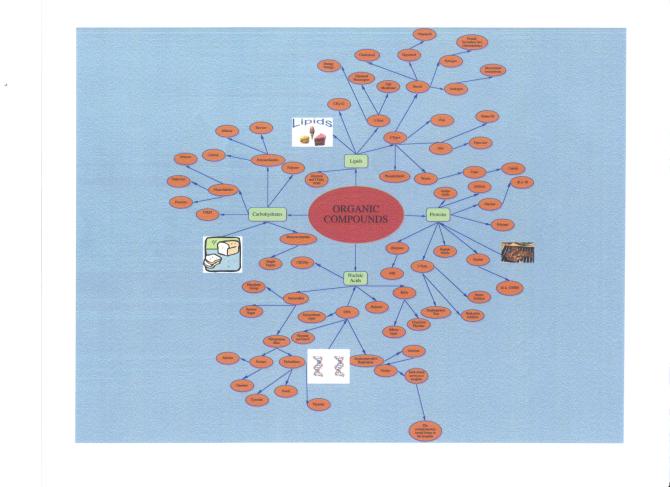
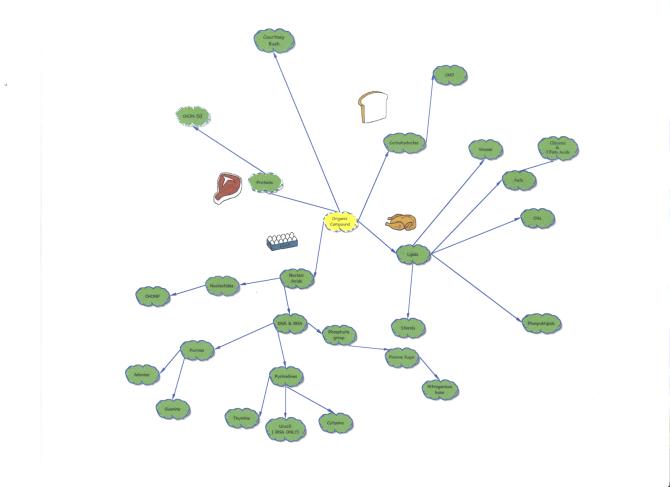
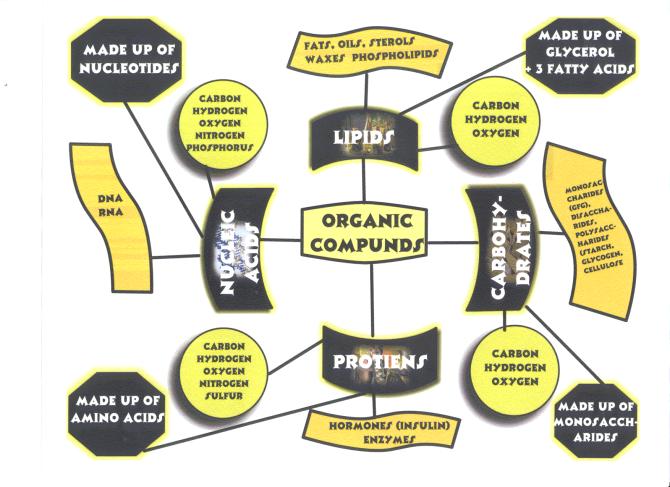
Student work composed of 3 pieces - excellent, good and fair.
The excellent piece of student work shows a variety of similarities and differences that connect each of the organic molecules.
The good piece of student work shows a moderate amount of information for each compound. This piece is simple yet still fulfills the requirements in the rubric.
The fair piece of student work is a great semantic map, yet the student chose to do their project at home using "Photoshop" software. He was grouped with a partner and the partner was unable to participate in the process.
Related Resource
Inspiration software
computer
color printer