Learning Context/ Introduction
Students use Latin roots to figure out the meaning of English works, and create a Word Tree poster.
This continuing series of lessons attempts to help students increase both their Latin and English vocabularies by carrying over their knowledge of one language to the other. By using already familiar English words with Latin roots, students can better remember the meanings of Latin words. By using the meanings of Latin words, students can figure out the meanings of English words. The goal is to train students to see and to use Latin roots.
Duration
The time commitment is as varied as the time teachers want to devote. The development of worksheets takes place over the course of years. However, prefixes, roots, suffixes can be a part of every vocabulary learned. Each project is a result of student work both in and out of class. Younger students need more teacher guidance whereas the more advanced students have the benefit from their beginning Latin endeavors to set up their efforts.
An exemplary sample of time needed:
40 minute class periods daily account for the time listed below:
- worksheets, games, magazines/newspapers = 1/2 to 1 period each
- create a word and number project = 2 to 3 class periods and outside of class time between these periods
- word tree project: 2-3 weeks outside of class time. Teacher spends 1/2 a period explaining the assignment and showing several quality examples of what is expected. The day the project is collected, the entire period is used having students display and talk about their work; the class votes on favorites and awards prizes.
Assessment for each homework, quiz, and poster project is individual and done in the way all activities are. They take no unusual preparation. The projects tend to use two to three class periods so that students can present and explain their work to others.
Instructional/Environment Modifications
No instructional modifications are necessary.
Procedure
Instruction on derivatives is ongoing from the time a student begins Latin. The greatest amount of time is spent in Latin I or its Latin 7 and Latin 8 equivalent. Beginning with their first Latin vocabulary, students are asked to see the similarities between the Latin roots and their English derivatives by underlining the letters common to both and discussing the meaning common to both. Next, students examine both English and Latin words to discover how the root meanings are affected by the addition of prefixes and/or suffixes.
Throughout the year, students complete a variety of teacher-developed worksheets correlated to chapters of the text ECCE ROMANI. They identify the Latin roots, categorize words by their Latin roots, define words underlined in English sentences using their Latin roots, and complete sentences by filling in appropriate meanings according to the Latin roots. They play games using derivatives such as Derivative Tic Tac Toe. They create a new word by putting together a prefix, root, and suffix, define it, and then illustrate it in a small poster. They identify derivatives containing Latin roots in newspaper headlines and magazine ads. Near the end of the year, they produce their biggest project, a word tree poster that visually represents the Latin root they have chosen and its English derivatives.
Teaching strategies include
- helping students learn Latin vocabulary by showing how to memorize; make associations to other words in any language; create ways to remember word meanings (the crazier the better! e.g. Take the TUM and then, at that time you feel better.)
- providing worksheets, lists of derivatives, sentences using derivatives for practice working with Latin roots
- directing students to find and underline common letters in root words and their English derivatives
- guiding discussion of common meaning of root words and English derivatives
- explaining orally the meaning of each part of a word-prefix, root, and suffix-to arrive at an overall literal definition of a word
- explaining shifts in spelling or meaning from root as well as any connotations in English
- removing fear of being wrong by admitting the teacher does not know the etymology of many words and by frequently checking etymologies in the dictionary
- showing high quality student examples of assigned work
- clearly explaining the grading standards or rubrics when the assignment is given
Student work includes
- devising ways to remember or help each other remember the meanings of Latin vocabulary
- learning prefix and suffix meanings
- completing worksheets relating Latin roots to English derivatives
- practicing word building and unbuilding skills
- locating derivatives in newspapers, magazines and any English material including textbooks
- creating a new word and its definition using a prefix, root, and suffix
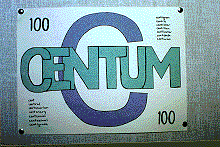
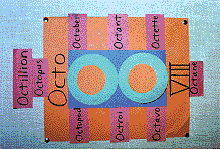
- creating a poster illustrating English derivatives from Latin numbers
- designing a derivative word tree poster
Student Work


Resources
Students:
textbook
list of prefixes and suffixes and their meanings
derivative worksheets (teacher developed)
notebook in which to keep lists and completed worksheets
Teacher:
textbook
miscellaneous magazines and newspapers
blank transparencies and overhead projector
teacher-developed worksheets (derivatives and sentence practice)
some art supplies if projects are completed in class
rubric for grading projects
Assessment Plan
- Worksheets, recognizing Latin roots, newspaper and magazine derivatives: Students rate themselves, looking for ease of understanding and improvement in word building skills as the year goes on. Credit is given for completion of homework/classwork, not a letter grade.
- Posters and projects: These are major evaluations of student performance and culminating efforts. Students receive an A-F grade based on the rubric below which was developed with student/teacher effort. In addition, they vote in class on the three best posters using the rubric AND their personal preferences. The three winning students receive a prize.
Rubric
Student Work
Using the rubric, the Centum poster received a B, and Octo, Mittere, and Flos posters received A.
Reflection
These derivative lessons are designed to show a direct relevance to all of their other school classes as well as their daily life and contemporary American culture. I constantly bring in examples as a kick off activity for class and I ask them to share as well. Before long, they also are bringing in examples from other classes and from outside school. Discussion about the word or expression leads us into many interesting discussions about issues in society or current events and provides a perfect opportunity to compare the modern to the ancient Roman way of thought or life. This sharing generates an excitement that carries over to their enthusiasm for learning the language itself.
I have designed and used vocabulary worksheets with my Latin 7 and 8 students as well as my Latin I, II, and III classes, which are a mixture of 9th through 12th graders of various abilities. The time spent on the worksheets can easily be adjusted for brief lessons or in depth work. Students especially enjoy the projects, voting on the winners of prizes, and seeing their work displayed in the classroom and around the building. They also respond with the "Aaah" experience to many of the derivatives. "So that's what that word means! Cool!" Or "So that's where that word comes from!" They can find immediate value and application of their studying.
Author
Lorraine Whittington, Penfield Central Schools