Learning Context/ Introduction
Students take on the role of a European explorer and create a resume, or personal data sheet.
This lesson is designed for use in grade seven, Unit Two: Exploration and Colonization of the Americas, of the core curriculum: United States and New York State History. This activity proves to be an encounter for the students as they travel back in time and take on the role of a European explorer. It serves as a review of the major explorers of New York State as studied at the fourth grade level as well as an introduction to other European explorers.
The explorer's resume is closely connected to the school-to-career program in that students are introduced to a personal data sheet. The students are required to clarify life experiences and organize them into an orderly manner, thus learning the processes that will one day help them to secure employment.
Learning Objectives:
The resume project helps the students to:
- List, in reverse chronological order, the achievements of one of the European explorers whose voyage was made to open the world to trade markets whether it is around or through the Americas.
- Draw a map showing one of the journeys of exploration.
- List what one explorer did to add to Europe's knowledge of the New World.
- Learn how to write a personal data sheet/resume.
Prior Knowledge:
It is most helpful if the students know how to use the resources available to them in the school's library media center but it is not necessary. A list of websites is included if students have access to a computer center/lab. Students should have previously studied Unit One, Section IV. European Conceptions of the World in 1500.
Duration
Planning Time:
It will take considerably more time to organize this activity the first time than when used the following year. Planning time will also vary depending upon the working relationship one has with the library media specialist. Taking this into consideration, planning time could vary from thirty minutes to three hours to discuss strategies with the library media specialist, gather resources, and locate sites on the Internet. If using the Internet, it is suggested that Internet web sites are book marked for efficiency.
Instructional Time:
This activity is based on forty-three minute class periods. It generally takes one day to introduce the concept of resumes and have the students write their personal data sheet/resume. One day is needed to explain the directions and introduce them to the reference materials available for this activity and review researching strategies. Time is also taken to review citation writing. The library media specialist provides the students with small slips of paper geared to the specific reference sources. It has been drilled into the students that it is imperative to promptly write down the information required on these slips of paper.
The students need approximately two to three days to gather and take notes on the pertinent information needed to complete the resume. It will take the students one day to take the information from their notes and apply it to the rough draft of their resume. This step could be accomplished as a homework assignment but the students often need help. Many students will use outside class time whether is be at home, at the public library, during after school library study time, or in study hall, to work on this assignment.
Assessment Time:
Once the rough draft has been completed, students should be able to copy their explorer's resume by the next class. Teacher grading time depends on the number of students in the class.
Instructional/Environment Modifications
The explorers resume project is an activity geared to student of all ability levels. Inclusion students do find researching a challenge. The classroom teacher, special needs/inclusion teacher, and the consultant/resource room teachers are available to assist the students in meeting success. Research materials for the special needs students could be put together in packets beforehand so that the task of research is not overwhelming to these students. If the teacher feels uncomfortable gathering the information beforehand and wants the students to do some of the research, one might want to have a specific list of books and note pages that have appropriate information for these students. Let the special needs students know beforehand that using one reference is fine for this activity while requiring the other students to use two of three references. Rather than simply handing over the list, a teacher assists the students in finding the information.
This lesson works best if the teacher has access to a library media center and/or a computer lab. However, neither of these is essential as long as reference books are available for the students.
Procedure
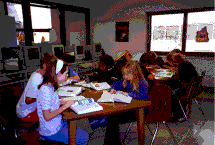
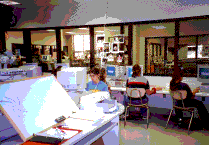
Prior to beginning research, the library media specialist and/or the teacher reviews the materials available to the students. It is often necessary to review simple researching skills, such as using an index, with the students. Students are given class time to use the materials in the library media center as well as selected Internet sites, in order to discover as much as they can about the assigned explorer. The teacher's job, with the assistance of the library media specialist, is to help the students with their research. In doing this research, students are asked to organize, interpret, explain, and evaluate the information from the reference materials. Often times, the teacher needs to remind the students to look for key dates, dates that tell about the explorers' journeys.
Begin by introducing the students to the concept of personal data sheets/resumes and their use/importance in securing employment. Employers today expect that the school prepare workers with more than reading, writing, and arithmetic. What better way of introducing the concept of resume than through a research based activity?
Make sure to take the time to review the concept of chronological order:
- Write some years on the board and ask the students to write the dates in chronological order.
- Then ask them to write them in the reverse order.
- Tell the students that when writing a resume, dates are to be written in the order of the date closest to today and backwards to the date farthest away from today.
Review the components of a resume: date of birth, education, experiences, notable accomplishments, goals and aspirations, and references. The students write their own personal data sheets. The students will have the most difficulty with the notable accomplishments. Ask them to consider the following questions:
- What are you best known for at this time in your life?
- Have you won any awards?
- Are you a stand out in sports, drama, scouts, community activities, and/or church activities?
The students also have problems with what to write for goals and aspirations. If the teacher asks the students to seriously think about what type of job they would like have in ten years, they generally will think of a goal or aspiration. Sometimes one needs to be simplistic and ask, "What would you like to be when you grow up?"
Modeling: Depending on the group of students, time might be wisely spent doing one explorer as a group. Select one explorer that can be found in the students social studies textbook and create his resume together. This is often a nice transition from the student's resume to the research portion of this activity.
Individual Research: Students are then "taken back in time" and asked to imagine what is would be like to be an explorer. In order to do this; they must apply for an explorer's job. Each student is then assigned one European explorer whose journey of exploration opened or attempted to open the world to trade markets. Students are given a direction page, a scroll page to be used for a map, a resume skeleton page to be used to write the rough draft, and the resume rubric. Class time is taken to carefully review the expectations. It is always helpful to show the students examples of previous student work so that they have a template or an idea of what they are able to create! Students will need to learn how to write a bibliography if they have not been exposed to writing citations.
The lesson instruction sheet and research template for the students are below:
Student Work
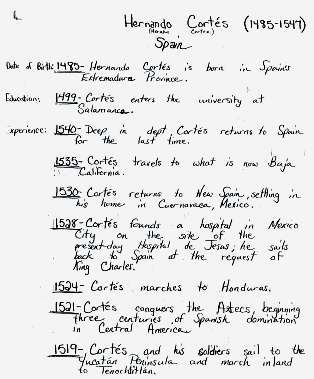
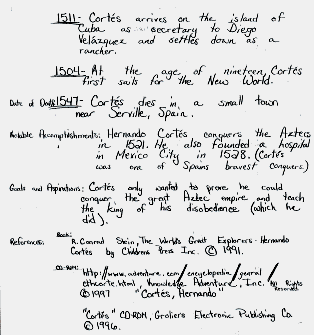
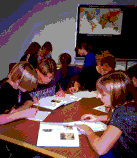
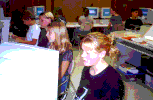
Website(s)
The Age of Exploration Curriculum Guide
The Native Americans
The Lewis and Clark Expedition and the USGS
Assessment Plan
The students are given the Resume rubric on the first day. It serves as a student guide to the activity. Time is spent reviewing what each student needs to do in order to have an exceptional rubric. Examples of exceptional resumes are shared with the student so that can set their sights high! Students are also shown the Explorer Resume Evaluation Sheet.
In the formal assessment, the teacher completes the Explorer Resume Evaluation Sheet and assigns a grade on the Resume Rubric.
Throughout the course of the research as well as resume writing, the teacher observes the students' progress. By watching this process, the teacher sees whether the student has gathered the information about important achievements and contributions of individuals and groups living in New York State (Social Studies Standard 1 - History of the United States and New York). Rough draft deadlines are clearly established so the teacher can monitor student progress. Teachers may have to collect and "grade" some students' rough drafts, while in other cases, teachers can clearly see the correct progress without having to collect rough copies.
- The assessment piece is the end product, the explorer's resume. It shows if the student has organized the information about the important achievements and contributions of individuals and groups living in New York State and the United States (Social Studies Standard 1- History of the United States and New York).
- The experience portion of the resume shows how the students develop a timeline by placing important events and developments in World History in their correct order (Social Studies Standard 2 - World History).
- By creating a map, the students have presented geographic information in a variety of formats including maps, tables, graphs, charts, diagrams, and computer generated models (Social Studies Standard 3 - Geography).
Resume RubricEvaluation Sheet
Author
Constance A. Miller, Groton Central School District
Reflection
Generally, the students enjoy this activity. Their biggest challenge is the research. Students often have a hard time determining what they do need to include on the resume and what is superficial information. The director of curriculum and instruction as well as our school-to-career coordinator are extremely pleased with this activity. Both feel that by having the students write a resume, they are learning a viable skill. The school-to-career coordinator sees this as a way of incorporating her program into the content area. This lesson was also shared at a countywide meeting of school-to-career coordinators and it was extremely well received. At the Statewide Peer Review, teachers at different grade levels agreed that it can easily be adapted to different historical time periods.
Resources
Listed below in the Website(s) section are some of the resources for both the teacher and students to use.