Learning Context/ Introduction
In this Learning Experience, students create poetry and compose a sound composition using instruments, sounds, and pictograph notation. Creative writing and original sound compositions are two methods of responding expressively to music. Students should experience an integration of both forms of creativity by second grade.
For this exercise, students need music learning experiences and writing skills commensurate with second grade ability.
Duration
Planning - one half hour (maximum)
Implementation - two half hour music periods (one for poetry writing and one for the sound composition)
Assessment - one half hour per class (fifteen minutes to read/score poetry; fifteen minutes to judge audiotape/pictograph score)
Instructional/Environment Modifications
Modifications required are:
- a portable chalkboard if one is not available in the music area
- a lap desk if students are not seated with writing surfaces
- adequate light
- adequate space for free movement
- assistance required for challenged students
Procedure
This learning experience involves two creative activities - poetry writing and composing a sound composition using instruments/sounds and pictograph notation.
Poetry Writing (Grade 2)
Students will:
1. Listen to a piano rendition of "Snow is Dancing" from the Children's Corner Suite by Claude Debussy.
2. Brainstorm a vocabulary of snow words that the teacher writes on the chalkboard
(see Student Work: Brainstorming - Snow Vocabulary)
3. Respond to a second listening with creative movement.
4. Add additional words to the vocabulary list.
5. Use snow vocabulary for Poetry by the Number.
| Form: |
|
|
|
|
|
Example: |
| Line |
1 |
= |
1 |
word |
|
Write |
| Line |
2 |
= |
2 |
words |
|
A poem |
| Line |
3 |
= |
3 |
words |
|
With five lines |
| Line |
4 |
= |
4 |
words |
|
and fifteen words. Remember, |
| Line |
5 |
= |
5 |
words |
|
Add a word each line. |
(See Student Work: Grade 2 - Poetry Samples)
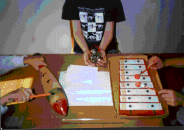
Sound Composition (Grade 2) - based on the listening, brainstorming, vocabulary, movement, and poetry writing, students will work in groups of two or three to create a sound composition reflecting the snow motif. The composition will
1. Have an appropriate title
2. Be at least one minute in length
3. Use at least two different instruments/sound sources
4. Be notated in pictograph so others can play from the score.
Student groups will perform for each other. Performances will be taped.
Assessment Plan
The techniques and tools used to collect the writing and sound composing samples are outlined under Procedure and Resources.
Holistic ScoringHolistic Rating ScaleSound Composition Scoring Rubric
Student Work
Included are copies of student vocabulary, writing samples by second grade students, pictograph score and taped performance of sound composition by second grade students (taped performance not available at this time).
Author
Dr. Margaret Charboneau, Lakeland Central School District (retired)
Reflection
Written verbalization and creating/performing skills enable students to function at higher intellectual levels than those required for fact recall or rote skill response. It is also important that students realize early on that academic subject areas such as the Arts and English Language Arts are not mutually exclusive, but interconnect in interesting and expanding ways.
The development of the life skills of discussion, shared decision making, conflict resolution, cooperation, and creativity are embedded in this lesson.