Learning Experience/Unit

The Cathedral Project by NYSATL
Subject
English Language Arts (NYS P-12 Common Core)
Grade Levels
Elementary, 2nd Grade
Learning Context/ Introduction
Students, divided into cooperative research groups, visit St. Mary's Church to study questions about the design, capacity, art, history, and other aspects of this historical building.
My goals for this project were to make mathematics "real" to my second grade students and to make connections to other subject areas. I decided to have the students do research in the community to collect information they would need for specific tasks. I organized a field trip to St. Mary's Church, a Cathedral with great history and art, which is across the street from the school.
Realizing that it is important for students to find math in their neighborhoods, this lesson plan took place in and around a nearby church. It can take place in any local historical building or even the school building where your students attend. Modify the groups and problems to solve as needed.
Duration
One Week:
- Planning-1 hour
- Field trip-2 hours
- Mathematical Problem Solving- 2 to 3 hours
- Extended and Related Activities- 6 hours
- Performance- 2 hours
Instructional/Environment Modifications
Teacher and students would be able to visit any local church or historical building in the vicinity of the school if a cathedral is not available. Teacher and students could adapt problems to solve in the school building rather than on a field trip. This lesson plan could be adapted and used on different grade levels.
Procedure
Students will brainstorm, with teacher guidance, questions regarding the cathedral (or church).
Students will be assigned to cooperative groups based on interest areas and be given certain questions to answer by the end of the week. (Prior cooperative group work is essential for this project.) Students will make some predictions and estimations regarding questions.
Group 1:
• Tight Squeeze. How many people fit in this church? Develop a plan to estimate the number of people that could fit in the church at one time. Show your steps. Implement the plan and show a solution.
Group 2:
• Tally-Ho. What can you tell us about the stained glass windows? Tally the patterns, the colors, the shapes and the sizes of the stained glass windows. Make a graph. What is the purpose of these windows in the church?
Group 3:
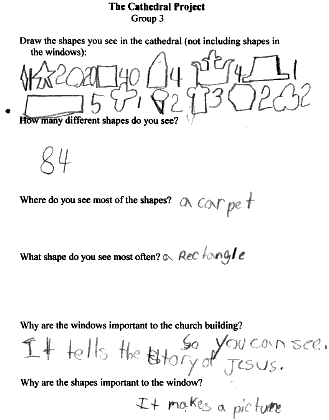
• Go on a Shape Hunt. What shapes do you find? You may observe all aspects of the church except the glass windows. Are there more of one kind of shape than another? Show how you came to your conclusions.
Group 4:
• Go on a Number Hunt. What do the various dates in the church mean and what do they tell us? Which building is older, the church or the school? Where do you see numbers in the church? Find them, read them, and tell us about them.
Group 5:
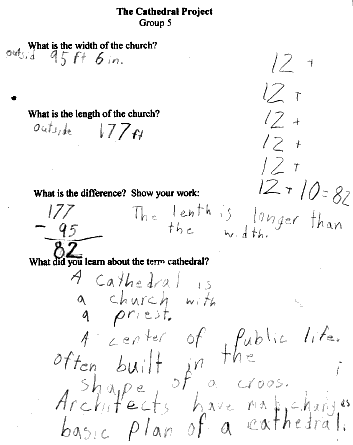
• Skinny or Fat? Is the church longer than it is wide? Why is it called a cathedral?
Group 6:
• If I was a church mouse.... Is it farther to walk to the church or to Pudgies Pizza from our school?
Students will walk to the church bringing with them their questions and materials needed to do on-site observations.
Six parents will accompany students on the field trip to the church. Each parent will be responsible for three to four students. Parents will be prepped beforehand concerning expectations of the trip.
The teacher will circulate inside the church to facilitate the questioning, observation and research processes.
Students will record their findings using the worksheets, which appear at the end of this lesson plan.
Calculations and problem solving will occur next. The teacher will use parent volunteers or 5th and 6th grade "learning buddies" to facilitate problem solving back in the classroom. Tasks involved in problem solving are recorded as performance indicators in Mathematics at the beginning of this lesson plan.
Students make journal entries throughout the week to record impressions of the experience of the field trip, the tasks and mathematics involved, and further inquiry questions.
Students, in cooperative groups, will present information gathered during the week to the whole class on Friday. Parents and other visitors will be welcome.
Student Work
Student Work - 1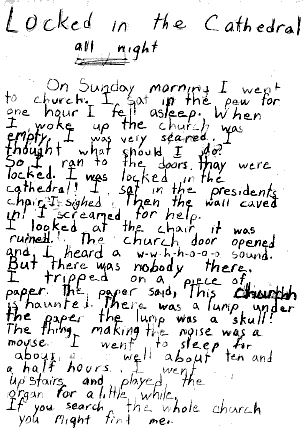
Resources
- clipboards
- pencils
- plain paper
- notebook paper
- graph paper
- calculators
- base ten sets
- measuring devices (rulers, yardsticks, meter sticks)
- parent volunteers
Assessment Plan
- Journal writing as Informal Assessments
- Performance Checklist for Group Work
- Group Presentation Rubric
Student Work
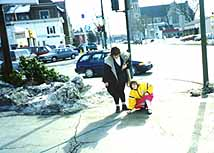
The project begins with the students taking their problems to the church and neighborhood to collect information towards problem solving. These students are measuring from the school to the church (See Image - A Below).
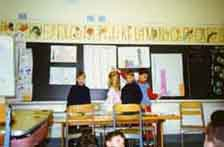
These students have put together presentation pieces and are sharing how they solved their problem with the class (See Image - B Below).
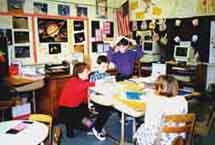
These students are back in the classroom putting together information and working with the teacher to reach solutions to their problems (See Image - C Below).
The students created a newspaper and began creative writing assignments (See Student Work - 1 and 2).
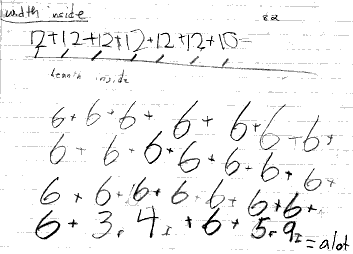
Additional Student Work (See Student Work - 3, 4 and 5).
Student Work - 1
Author
Erin Peppel, Dryden Intermediate School
(Formerly at St. Mary's School at the time this learning experience was authored)
Reflection
Comments from Erin Peppel:
Click Here to Read Author's Reflection