Learning Context/ Introduction
In this learning experience, students practice talking on the telephone in French.
This learning experience is designed to provide students with the practice they need to develop effective global listening comprehension strategies and to introduce the basic communicative elements needed for talking on the telephone in French. Students are required to listen to " one-sided telephone conversations" and to demonstrate comprehension by filling out authentic French message forms in French. It is an excellent activity for beginning students because it provides them the opportunity to discover that, despite their novice status, they can understand simple telephone conversations in French if they focus on the structure inherent in the message form, and that "real-life" written communication can be accomplished at the novice level.
Because the skill of talking on the telephone is more fully developed at Checkpoints B and C (the skill is extended to two-way interactions), the simple design of this activity seems to work well in getting the novice student off to a good start.
Prerequisites for this learning experience to be successful:
- Familiarity with basic French telephone expressions:
Allo. Ici___________________
Je voudrais parler a _________________________
Qui est a l'appareil?
Ne quitte(z) pas.
Je peux laisser un message?
Je vais rappeler plus tard.
- A thorough understanding of the components of the standard French telephone message form. The message form components are:
| 1. Who is the message for? |
a
__________________________________ |
| 2. What is the date and time? |
date___________heure_______________ |
| 3. Who is caller? |
M./Mme/Mlle_______________________ |
| 4. What is the caller's phone number? |
A telephone________________________ |
5. What action should be taken?
6. What is the main idea of the message? |
A passe vous voir ____________________
Desire vous voir ____________________ Veuillez rappeler ____________________ Rappellera
A repondu a votre appel |
| 7. What are the details? |
Message:
|
| 8. Who is recording the message? |
Telephoniste_______________________ |
Nota bene: This learning experience works best for students who have studied French for at least one full year. In my school, it is presented toward the end of the seventh grade course, after students have had about thirteen months of French.
Duration
Classes in my school are one hour long. We meet three times a week, so I have time for other activities. I prepare approximately ten conversations. Generally, two and a half weeks are required to complete a set of ten conversations.
Approximately three hours are required to compose ten conversations and to photocopy the blank message forms.
The first two conversations proceed slowly and require about thirty minutes to accomplish (including time for assessment). Eventually, the conversations can be done in 15-20 minutes.
Assessment is accomplished quickly because students evaluate themselves based on the rubric.
Instructional/Environment Modifications
This learning experience is ideal for all advanced beginners, including those with learning disabilities. Due to space limitations on the message form (teacher-made), the best telephone messages are short and to the point. Therefore, students are encouraged to avoid writing complete sentences when composing their messages. This requirement tends to "level the playing field" for those with special needs. If a student absolutely cannot write anything at all in French, he/she may fill out the message form in English to demonstrate comprehension of the message. In this rare situation, the student could still use the rubric to evaluate his/her work, but the notation "modified" would be entered in the teacher's gradebook.
No physical modifications of the classroom setting are necessary.
Procedure
- Review basic French telephone expressions.
- Explain the various components of the standard French telephone message form.
- Do two conversations daily for about four or five days. At first, it is necessary to repeat each conversation. After a few rehearsals, conversations should be attempted without repetition.
- Discuss each conversation. Have students share their work with the class.
- Let students evaluate their own work using the rubric.
Current research suggests that languages are best acquired through listening (Krashen and Terrell). Students need a considerable amount of comprehensible input and "real-life" practice in developing the listening skills. This learning activity provides such practice. It is also learner-centered (students discover independently, which cues to listen for when deciphering messages), performance-based, and reality-based; In addition it involves assessment that is appropriate for performance-based learning. A follow-up activity requires students to leave and to understand, messages in French using the teacher's school voice mail.
Student Work
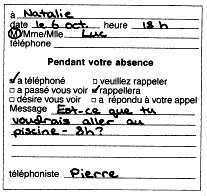
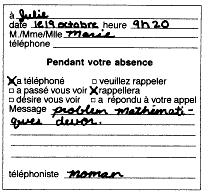
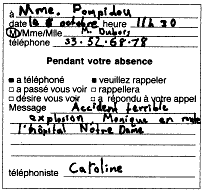
Resources
- Standard French telephone message forms (including the basic information as listed in Learning Context).
- Voice mail (for follow-up activity). Voice mail provides students with a unique chance to listen to messages created by the teacher in the target language and to practice learning student-generated messages in a private, non-threatening context.
Assessment Plan
In my school, students are required to place samples of their work in their portfolios to document proficiency of the appropriate benchmark.
The rubric is central to the assessment plan. It was designed to provide a means to evaluate listening comprehension. Completed message forms (from this particular learning experience) can usually be evaluated by the student.
Rubric
Student Work
The student phone messages that I have submitted were scored using the rubric.
NOTE Example 3: Good work, but student neglected to mention the accident occurred in school and that Mme. Pompidou’s daughter was hurt.
Reflection
In my opinion, listening is the most basic of all skills. When students learn to comprehend the target language early in their careers, fluency ultimately follows. However, the listening skill must be developed. We cannot assume that students can comprehend language just because they can produce it. This learning experience represents the kinds of listening activities students must be engaged in to develop the listening comprehension strategies needed to acquire a second language.
Here are some random comments from my students:
I liked this activity because….
it's a real life thing and if there's an important message, it needs to be understood.
it was kinda fun to see if you could understand what was said and write it down on the first try.
you never know when you'll need this.
I did not like this activity because…
I'm still learning how to write in French.
Sometimes it was kind of hard to remember what was said the first time.
This Learning Experience was reviewed by Jill Crooker, LOTE consultant, Statewide Peer Review
Author
Robert Johnson, Rush-Henrietta CSD