Learning Context/ Introduction
In this Learning Experience, students explore the works of Pablo Picasso and select one style to create self-portraits.
Students will:
- Learn how to use the Internet to explore the art world and use virtual exhibition sites to expand their knowledge of art and increase their awareness.
- Understand Pablo Picasso's contributions to the art world and place his work in historical perspective.
- Compare, contrast and analyze the various styles of Portraiture that Pablo Ruiz Picasso created.
- Select one style to use as an inspiration in the creation of their own portraits.
- Analyze the proportions used by the artist to divide his canvas, and use the same proportions in their own work.
- Create a portrait in the style of the Picasso portrait using mixed media on paper.
This Learning Experience is part of integrated 5th and 6th grade art curriculums. It closely parallels the Social Studies curriculum, which includes a study of the Renaissance. Students learn about the contributions of The Renaissance artists and discover how this group of artists changed the way people looked at art. After learning about Leonardo da Vinci's proportion theories of the human head, students apply this knowledge to a ‘map' of their own head. The connection to the Math and Science curriculums is made with the practical application of measurements taken of the head and its features in centimeters and then dividing using decimals. When the students are finally ready to discover the proportions in Picasso's portraits, they will use their knowledge of fractions to divide the paper into halves, thirds or quarters. The inclusion of computer technology serves to broaden the students' creative capabilities and has far-reaching application possibilities. The connections made across the curriculum areas in these groups of lessons form a foundation for learning that is firmly based in the New York State Learning Standards for the Arts.
Prior Knowledge
An ongoing art curriculum that ensures students' knowledge of the elements and principles of art.
Knowledge of the contributions made to art by other civilizations and cultures as well as of various styles and periods of art, and their relationship to each other.
Knowledge of Leonardo da Vinci's classical proportion theories of the human body and his influence on the world of art.
The significance of the Renaissance as it relates to the students Social Studies curriculum and their study of art.
The mechanics of measurement (ability to use a centimeter ruler).
Division of numbers using decimals (6th grade).
An understanding of fractions as parts of a whole (5th grade).
An understanding of how artists use proportions in their artwork.
Knowledge of Pablo Ruiz Picasso, his contributions to the art world, and the impact history had upon his work and vice versa.
Vocabulary: Portrait, still life, landscape, perspective, point of view, proportion, fraction, decimals, The Renaissance, Abstract, Cubism, Realism, sculptural, texture, patterns, contour lines, linear, shape, color block, monochromatic, local color, contrast.
Procedure
What the Teachers and Students Do:
Before the lesson begins that will lead the students to discover how they will determine what proportions Picasso used in each of his artworks the students need to make some inquiries.
The students will:
- Discuss Picasso's life and the significance of his work.
- Place him into historical perspective.
- Read some account of his own views about art and the artist's role as a portrait painter.
- Look at reproductions of his artwork.
- Compare and contrast some of his portraits with other periods of art (The Renaissance).
- Use the Internet web site to view images of Picasso's portraits.
- Compare, contrast and analyze the many styles of Picasso's portraiture.
- Discover the proportions used by Picasso in a selected portrait.
- Create a portrait using the same proportions.
The teacher will:
- Lead the class discussion by asking relevant questions about the life and work of Pablo Ruiz Picasso.
- Show students reproductions of a variety of portraits by Leonardo da Vinci and Picasso.
- Read excerpts of biographical accounts of Picasso's life to students.
- Direct students in the use of the Internet to enter the virtual exhibition of Picasso and Portraiture.
- Lead class discussion in comparing, contrasting and analyzing the many styles of portraiture the students will find in the exhibit.
- Discuss how world travel and exposure to African art and the sculpture of The Renaissance artists influenced Picasso's art.
- Show students evidence of this influence.
- Discuss the ways Picasso used different proportions in various portraits.
Period 1
Fifteen to twenty minutes: A class discussion will lead the students into an understanding of certain terms and help to place Picasso in historical perspective. In order to understand Picasso and his art some question must be asked by the teacher. After showing the students some of his artwork and reading about his life the teacher will ask questions to insure student understanding:
- What do you know about Pablo Picasso?
- What were his contributions to the world of art?
- When did he paint?
- How did his styles change through time?
- Why do you think this happened?
- What were Pablo Picasso’s own thoughts about what a portrait of someone should or shouldn’t be?
- How do students perceive each other? (Ask a few students to write a description of a specific student or of himself or herself. How do they differ?
- Why do you think this is so?
- What is abstract art?( Show examples and discuss)
Twenty minutes: Students will do a very quick drawing of themselves or someone else making sure that they include one strong identifying characteristic.
Three minutes: At the end of this lesson, the teacher will collect some of the drawings, hang on the chalkboard and have students guess whom the persons are and why they think so.
Two minutes: Clean up
Periods 2, 3 and 4 (in computer lab)
Period 2: The teacher will direct the students in the use of the Internet and its search engines. The students will log onto websites related to Picasso.
Period 3: The teacher will download any pictures from the Internet for the students’ use. The students will be told to visit all of the galleries in the exhibit. The teacher will ask questions that will lead students to observe the various styles in which Picasso painted. The students will be asked to compare and contrast Picasso’s portraits and make evaluations based upon their observations such as:
- In what style was the portrait painted?
- How many points of view does the portrait represent?
- How do you think Picasso felt about the particular person?
- How does this picture make you feel?
Period 4: Students will then be told to select a single painting or drawing in a specific style that they feel strongly about. They will be given a printout of that work of art to be used in the classroom as inspiration for their own creations.
No more than 2 students from each class may select the same artwork.
Period 5: The Lesson: Proportions in Picasso’s Portraiture
The teacher has taped three sheets of 8 x 12 white paper, with and without lines, onto the chalkboard one next to each copy of three of Picasso portrait prints that the students selected (each one should represent a different style). Share copies of the Rubric.
While student monitors are handing out supplies, the teacher gives the students their printouts of the Picasso selections that were made in computer lab (the first three steps will take approximately 4-5 minutes).
The students will be asked to look at their large paper and the small printout on their desks and tell the class how they think they will begin their pictures. They will be asked to explain what they know about proportions and how they think they can apply it in this task.
After some suggestions (that may or may not be correct), the teacher asks the students to explain how much of the printout picture page the student thinks the head takes up using a fraction. The teacher directs them to estimate the proportion of the head to the picture, and then to estimate the proportion of the background, or space around the image to the whole picture. How important is that ratio? (5 minutes)
One suggestion that helps the students is to direct them to place their pencils under the chin of the person in the portrait and look at the size of the resulting space above the pencil. The teacher should demonstrate this using the three printouts on the board. If the space is very large (sometimes three fourths of the picture), the students could be directed to observe the space below the pencil. (5 minutes)
They are instructed to locate important body parts or objects that form other divisions. The teacher should demonstrate this on each of the printouts on the board. In order to facilitate the task the students can draw light horizontal lines on their printout to help them visualize the proportions.
Students soon discover that all of Picasso’s portraits are very simply divided into halves, fourths or thirds (sometimes sixths and eighths).
Students will now divide their paper either by folding or lightly drawing lines to divide their papers into the correct proportions for their print. (3 minutes)
Students are now ready to draw a light contour of the head, and any other reference points that fall within or on the lines of division. Using a mirror for a self-portrait, or by carefully observing a student at their table, the students are instructed to freely change any contours that they need to. The teacher should demonstrate this on all three prints since it is a difficult concept. (10 minutes)
After they have completed their contour drawing in pencil, they are instructed to look carefully at their print and select the appropriate colors and sizes of markers that they will need to use to outline their drawing over the pencil lines. (10 minutes NOTE: If it seems as though time is running out (depending upon class size, ability and other factors) students can complete the outlining in marker on the following day.)
The teacher needs to go slowly and walk around the room to check for understanding. Students may need to be reassured about the choices they have made before they can go on. Stress that the process is a unique way of looking at art and may feel strange at first.
Closing (5 minutes): Teacher holds up some students’ work and asks students:
- to explain the process they used to discover the proportions in their portrait
- to reflect upon any difficulties that the students might have had
- to discover ways that the students solved their problems
- to discuss what they discovered about Picasso’s use of proportions in his art
- to describe the style that is represented in the portrait the students selected
- to reflect upon the way the student hopes to interpret the Picasso style
- to evaluate the progress of their own work
Do not judge the art or comment on the quality, but stress the process that the student used to interpret a style of Picasso.
Clean up: (3 minutes)
At the conclusion of this series of lessons, the students will be able to:
- Divide a human head into classical proportions by using measurements.
- Distinguish various styles of painting and drawing.
- Analyze the influence other world cultures have upon art and artists.
- Reflect upon the artist's point of view in each work of art.
- Access the Internet to view art exhibitions.
- Identify several Picasso portraits.
- Visually determine how an artist used proportions in a portrait.
Instructional/Environment Modifications
Both of the sixth grade classes that participated in this learning experience were heterogeneously grouped, having a range of abilities. In one class of 27, three of the four special educators students had an aide working with them. In the other class of 22, six were students with low English proficiency whose primary language was Spanish. Some students volunteered to be mentors and, in some cases, bilingual instructors.
Students sit at large tables of four, two students on each side facing each other. This arrangement facilitated and encouraged looking at and drawing another person. All of the students were able to participate in varying degrees in the Learning Experience, and felt successful. Stress the vocabulary, knowing Picasso, and creating art.
Students will need to have access to several computers so that they can work individually or in groups of 2-3 to complete the Internet portion of the Learning Experience.
Duration
Planning: (See the Procedure section for further details.)
- Note that two classes were involved in this Learning Experience.
- One half hour in the school library locating books about Picasso for the students to use.
- Two hours to read through and select appropriate passages.
- Four hours to view internet websites and make some printouts for classroom use.
- One hour planning the presentation of the proportional elements.
- Thirty minutes collecting the necessary materials.
Implementation:
- One 45-minute class period for introduction to Picasso.
- Three or four 45-minute periods in the computer lab viewing the exhibit on the Internet and making color printouts of each student's selected Picasso portrait (depending upon class size).
- One 45-minute period for the implementation of the learning experience, "Proportions in Picasso's Portraiture".
- Any where from five to eight 45-minute periods to complete the portrait.
Assessment:
- Six hours reviewing the work of the 49 students (in two classes), their self-evaluations, and in making my own evaluations.
- 10 minutes per student was spent discussing self-evaluations and teacher's rubric.
Resources
- Computer access to Internet
- Selected library books that give some biographical information along with visuals
- Board or easel to demonstrate with print-outs and varying size papers
- A place to hang student work for evaluation/class discussion
- Dark drawing pencil that students can see easily
- Various colored markers to demonstrate outlining
- Computer access to Internet
- A print-out of a Picasso portrait of choice (printed from the Internet by students)
- 18"x 24" white drawing paper
- Pencils for drawing
- Markers for outlining and/or coloring in areas
- Oil pastels and crayons for coloring
- Water color for painting in areas and for the effects of wax resist painting
- Various colored papers for collage
- Glue
- Internet websites from which student selected portraits are printed out for students' reference in class.
- Library book list: Masters of Art Series,: Pablo Picasso by, Stefano Loria
- Art for Children Series: Picasso, A Day in His Studio by, Veronique Antoine
- Pablo Picasso by John W.Selfridge
Assessment Plan
Assessment is an ongoing process in the art classroom. For approximately 5 minutes at the beginning and end of each period (or as needed), students engage in an open dialogue with the teacher and the class about their concerns. The teacher and students look at various pieces of student work in progress (different ones each time) and critically evaluate them using a positive approach.
Since the students have their computer-generated printout of the Picasso portrait they selected, the discussion and evaluation is based upon observation of both the print and the work in progress. The discussion focuses on the way each student has attempted to solve the problems inherent in the lesson. Suggestions are made which may or may not be taken by the student whose work is being critiqued.
Many times students are asked questions about their work by other students and by the teacher. This encourages reflection by the artist and also helps the viewer to understand the artist's point of view. Since self-evaluation as well as evaluation by others is always a part of the learning context, when students must engage in reflection upon completion of their work they do not feel uncomfortable, but express themselves freely.
The Rubric helps students to understand the dynamics of the learning experience. It becomes more than a measure of achievement, it serves as a teaching tool, a way for students to evaluate and understand other works of art besides their own. Students are introduced to the rubric prior to beginning the lesson so they are aware of expectations. The rubric clearly examines the students' work within the context of the Learning Standards for Art Education in a way that makes the Standards understandable to the sixth grader who is reading the rubric. The wording covers the entire vocabulary that the students used in the learning context as well as in their own daily oral evaluation process. When vocabulary needs to be clarified, questions are asked to check for understanding. The entire process helps students understand what art is all about.
The ‘reflective' questions, that the students responded to in their own words at the end of the learning experience, serve to evaluate the success or failure of the experience for each child. The questions asked were:
- What did you learn from looking at Pablo Picasso's portraits?
- How did you solve the problem of drawing in a ‘Picasso' style?
- Which ‘Picasso' style did you choose for your portrait?
- Do you think you were successful in your interpretation?
- Rubric
Student Work
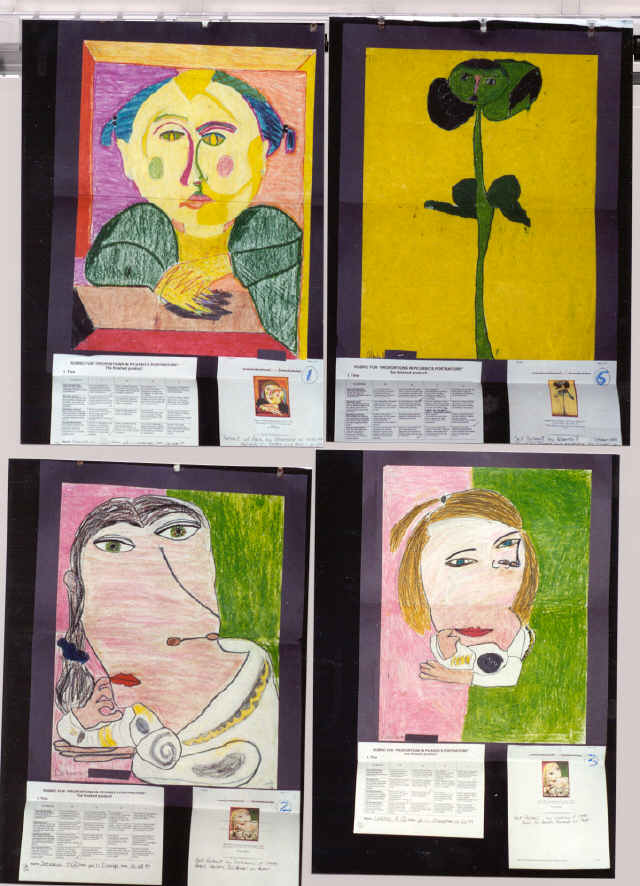
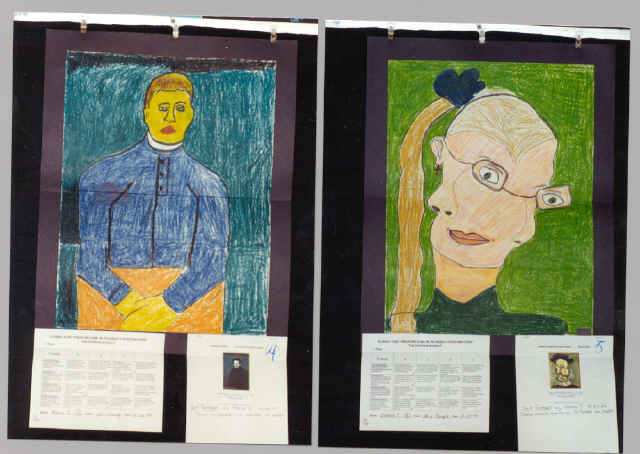
All of the original 49 artworks were displayed throughout Port Chester Middle School as well as in the Superintendent’s office wing. In the lower right hand corner of each student portrait was the computer printout of the Picasso original.
In addition, attached to each portrait was a copy of the student’s X Reflection Sheet and the Rubric, which clearly defines the criteria for evaluation. The rubric really serves as a teaching tool to help students understand what to look for in artwork and how to evaluate a piece of artwork on their own.
Photos of Student Picasso Artwork:
Reflection
Comments from Ida Lucia Esposito Tino:
Click Here for Comments
Author
Ida Lucia Esposito Tino