Learning Context/ Introduction
The purpose of this unit is to give the students the opportunity to increase their skills related to balance through individual and small group activities. By understanding and improving the balance of their own bodies in space and in relation to others, students may increase their physical skills in other areas of movement. Additionally, a student with increased body control and awareness developed through balance activities will contribute to a safer environment during all physical activity. By utilizing a spotter, students will demonstrate care, consideration and respect for themselves and others during physical activity. Students will use their decision-making skills and work constructively with other students to successfully complete group balance activities.
Duration
The following is an outline of the approximate planning time that may be required by a teacher who would be using this learning experience for the first time.
Teacher's prep time:
- Copy balance cards during a planning period.
- Lamination of balance cards. (Assuming that this can be done in school, one planning period.)
- Gather balance equipment and set it up in stations, 20 minutes.
- Put students with appropriate peers according to size, 5 minutes with the help of the students. Pairing students only needs to happen once. The students can stay with their same partners and in the same groups for each lesson.
Implementation time:
- Four classes, 42 minutes each.
- The length of time required for the introduction, teaching and demonstration segments of class will depend on the teacher's method of teaching. Be sure to engage the students throughout the lesson. In addition, continuous verbal feedback provides constant demonstrations throughout the lessons.
- Time for safety/spotting discussion, approximately 4 minutes.
Assessment time:
- Continuous feedback provides on going assessment, therefore separate time is not necessary.
- Discussion of successful elements of the balances should be on-going.
- Review videotape, 20 minutes.
Instructional/Environment Modifications
The range of abilities that may exist within a class is easily accommodated for with these activities.
- Students may choose to progress to more challenging balances.
- Students may increase the time of their balances or choose their non-dominate side when appropriate.
- Students may choose to add height or locomotion to the balance task.
- Students may choose to be a "low person" or a "high person" or "spotter" in the group activities.
- Students may utilize a peer spotter to insure safety and to assist in the successful completion of the balance tasks.
- Special needs students may choose less challenging balances or may choose from a variety of equipment (beanbag, peacock feather, balloon, etc) to balance on their own body parts for a modification.
Procedure
Students will be given many different opportunities to develop, discover and practice balance activities and skills. They will be given the chance to work individually, with a partner/spotter and in small groups. Students will be provided with equipment that will enable them to attempt balance tasks at different levels of difficulty and in different body positions. They may choose to locomote while practicing their balances. Students will have the option of working with a spotter. This spotter will help to keep the student safe and will also assist the student in the completion of the balance task where needed.
- Students will participate in a fitness game at the beginning of each lesson as a warm-up activity. These fitness games may include teamwork tasks to enhance cooperation among the students.
- Prior to the initial balance practiced, safety issues will be addressed. Students will understand both how to utilize a spotter correctly, and how to be an effective spotter.
- The spotter's responsibility will be to assist the student in performing the balances, if needed, and the spotter will keep the environment safe. Additionally, all students will be shown how to initiate a roll properly from a fall. A demonstration and sufficient time to practice these techniques will be given before any balances are attempted.
- A brief explanation of the spotter's role will be given. The organizational directions for the lesson will be given.
- The progression of learning experiences for the unit:
- Students will be shown individual balances and will have the opportunity to practice and maintain these balances. Ideas for variations will also be encouraged. For example, a student may try to use their non-dominate side to balance on.
- Students will be shown partner balances and will have the opportunity to perform and maintain these balances.
- Students will be provided with a selection of equipment and various opportunities to practice balance tasks. Students will work with partners of similar size for spotting purposes.
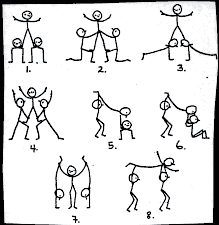
- Students will work in small groups (3's, 4's & 5's). The group will select the balance that they would like to perform. Choices will be provided on task cards with pictures of different balances. When the group has mastered the balance, they will call for the teacher to videotape their group balance.
Important teachers note:
The following equipment and teaching aids are provided in class to assist the student to achieve the performance indicators as noted in the context of this learning experience.
- Plastic dome/bowls - used to practice balance and balance combined with locomotion.
- Stilts - used to practice balance, balance combined with locomotion, and balance at different heights.
- Eight different balance boards - used to practice balance tasks on feet, sitting, kneeling, one foot, etc.
- Two balance beams, one high and one low - used to practice balance and locomotion at different levels
- Tumbling mats - used to practice inverted balances, headstand, handstand, tripod, etc.
Student Work
Resources
The resource for this unit was the text Ready to Use P. E. Activities for grades 5-6 by Joanne M. Landy and Maxwell J. Landy.
Assessment Plan
Teacher feedback, as well as peer (partner, small group) feedback, is given throughout the learning experiences. The following rubric may be used for the teacher to assess the students' progress:
Students/partners will count aloud for 5 seconds to evaluate the success of the designated balance. Groups that are not successful in maintaining the balance for 5 seconds may try again, reevaluate, and possibly switch personnel (different students in different positions), or make other modifications. The teacher will videotape the small group balances. Students will view their own work and discuss the success of their activities. Students will be able to communicate what worked and what didn't work, as well as possible suggestions/modifications in order to make the task more successful. Students will be able to hear from classmates with comments, suggestions and compliments.
Student Work
The attached are copies of student work that reflect different levels of performance and the basis of the teacher's assessment.
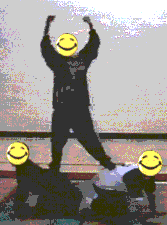
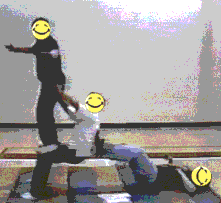
The attached photographs of students performing the various balances represent student work. They were reproduced from the assessment videotape taken by the teacher during physical education class. The student's faces were covered to protect their anonymity.
The students were placed in small groups. They were allowed to choose the group balance that they wanted to complete together. After practicing, the students would call the teacher for videotaping when the group could hold the balance for five seconds. The group then chose another balance to complete. Additionally, the students were allowed to create their own balance combinations.
Important note:
The group balances that the students attempted to complete were on laminated cards that came from the reference text.
Reflection
This unit plan was developed by trying to focus on the specific redeeming qualities of more traditional gymnastics/tumbling unit. A means to develop the skill of balance is being targeted because of the tremendous carry over to other areas of movement. Accomplished balance skills can help a student to improve their physical skills; and, therefore, give them an opportunity to practice physical activities that provide conditioning in each fitness area. Additionally, students will be able to increase their physical skills in relation to space, in relation to others, in lifetime activities, and in team and individual sports. An increase in body control and body awareness developed through balance activities will enhance a student's ability to contribute to a safe environment during all physical activity.
On a personal note, the students really seemed to enjoy the different challenges presented to them. They loved watching the videotape of their own accomplishments. I was so pleased with the outcome of this learning experience, I gave the videotape to my principal to look at "just for fun." When she returned it to me, she complimented the student's work and commented "What a hoot!"
Author
Mary T. Fraser, Sherburne-Earlville Central School District