Procedure
What The Student Does:
BACKGROUND: The students have learned that water can be found on the earth in three different states; as a solid, a liquid, and a gas or water vapor. The movement of water through the earth's atmosphere or hydrosphere is called the water cycle. This cycle provides all living things with a constant supply of fresh water. Each day the sun heats water on the earth's surface and this causes water to evaporate, or change into water vapor. Evaporation takes place from oceans, lakes, rivers, puddles and any other source of water. Plants give off water vapor, too. When the air cools and water condenses, it forms clouds containing many millions of water droplets. When these droplets grow or come together and become heavy, they fall to the ground in some form of precipitation and the water cycle begins again.
Students are asked to think about the water cycle and how water enters and leaves each object, e.g., water is taken into a cloud as water vapor and precipitates as a liquid or ice; in a plant it is taken in as a liquid and emitted as water vapor.
Students will enhance their understanding by completing the booklet entitled: "Discover the Wonder of Water". Students will observe and record data on evaporation, condensation, and precipitation. They will observe changes in water from a liquid to a solid, a solid to a liquid, and a liquid to water vapor. They will be expected to illustrate or find pictures that show each of the three states of water. They will create a mini water cycle as described in the worksheet associated with this lesson. They will create a water cycle wheel to further demonstrate their understanding of the concepts they have learned. The culminating activity in the booklet will be to write a descriptive story about a rain drop and its journey as it changes through the three states of matter. This project will be divided into the following sessions:
Session 1: Students will discuss and explore the three states of water. Students will cut pictures out of magazines that represent the three states of water. Pictures will be selected to glue on the front of the booklet or illustrations will be done to demonstrate understanding.
Session 2: Students will conduct simple experiments. The first experiment will be "What Makes Wet Spots Vanish?" Students will manipulate variables to observe what factors affect the rate of evaporation. The class will be divided into teams. Each team will make a wet spot on the chalkboard with a sponge and then watch it disappear. Each group should have the same size and type of sponge with the same amount of water saturation. Allow groups to add one variable to the experiment; such as use of a fan, use of a hair dryer, etc. Students will record the rates of evaporation in their water booklets.
Session 3: Students will heat a pan of water. The teacher will point out that the steam that they observe is condensed water vapor. Teacher will ask questions such as the following: What lies between the water and the steam? Answers may vary, but it is an invisible layer composed of molecules of water vapor that have not yet condensed into steam. Students will illustrate and design a bathroom showing condensation of water on a bathroom mirror in their water booklets. Students will fill a glass jar one-half full of water. They will place saran wrap over the top of the jar. The jar will then be placed in a sunny spot. Students will observe that water droplets form on the saran wrap - condensation, and record this in their booklets.
Session 5: Students will illustrate pictures of a solid, a liquid and water vapor. Students will describe the water cycle by working in groups and creating posters that show the water cycle. They will diagram the cycle in their booklet.
Session 6: Students will complete the worksheet entitled: "The Mini Water Cycle". Students will demonstrate the processes of evaporation and condensation within a miniature water cycle inside a plastic bag. Students will create a very simple water cycle in a closed baggie and observe how water invisibly evaporates from a clear plastic cup, as it does from the ocean. They will observe condensation on the sides of the baggie, as it occurs in clouds in the atmosphere. Water will accumulate in the bottom of the baggie as it does in lakes, rivers and ground water. Students will tape the baggie to a sunny window at an angle, like a diamond shape, so that the sides will slant down from the top, allowing the droplets to slide down and collect in the bottom of the baggie. Students may need to tape the cup to the inside of the baggy so that the cup will not tip over and spill its contents. They will place two ounces or 62.5 mLs of water into the cup. Students will observe and record the changes over a 4 day period. They will illustrate the changes in their booklets.
Session 7: Students will complete the worksheet entitled: "Moving Raindrops In the Water Cycle!" Students will be making a water wheel. They will demonstrate what changes occur in water molecules as they go through the water cycle. Students will discuss how the water cycle occurs on earth with evaporation of water from oceans, lakes, and the earth's soil, and the cooling of water vapor or condensation to form clouds. The teacher will review the terms "precipitation" as it pertains to water accumulating in lakes, rivers and streams. The discussion will culminate in students understanding how water moves down through the ground to make up the ground water. They will realize that eventually some of this ground water will find its way to the ocean. The teacher will remind them that the same water molecule might have gone through millions of changes over the years. One way is to explain the fact that the same water molecules that they drink today may have been in the Nile River or part of a glacier during the last Ice Age. Students will assemble and use the "Water Cycle-Raindrop Wheel". Note: The wheel will be more durable if it is copied on heavy paper such as oak tag. A tongue depressor should be taped to the back of the top of the disk to act as a handle and stabilizer. Make sure to have the students color the wheel, and then place it in the pocket of their booklet.
Session 8: Students will complete the writing task which asks them to write a descriptive story from the point of view of a rain drop or water molecule. They are to explain the journey that it has had as it changes from one state to another in the water cycle. Students' work will be scored on the basis of a simple rubric.
Sessions 9-11: Students will be given the performance task entitled: "Dead or Alive". Explanation accompanies this lesson.
Sessions 12-13: Students will present their work to the class which will include a discussion of the results of their experiments in their water booklets, and the results of their performance task project.
Student Work
Procedure
What The Student Does:
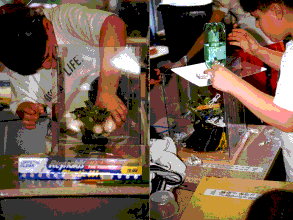
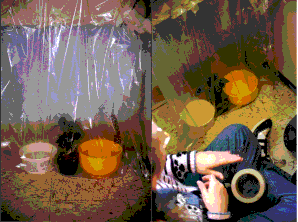
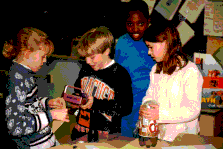
The student is asked to work in groups to create an apparatus that will water the classroom plants over Spring Vacation using their understanding of the water cycle. Their task will be to design and build a watering plant container that will self-water the plants in the classroom while they are away for vacation. After the model is built and tested, each student will be responsible for writing a report on how the group built the container. The group will then present and explain the model to the entire class.
The performance task groups will work together to:
- brainstorm various designs that might be used to accomplish the task
- using their prior knowledge of the water cycle, the group will decide on what factors they must consider when they design their water container
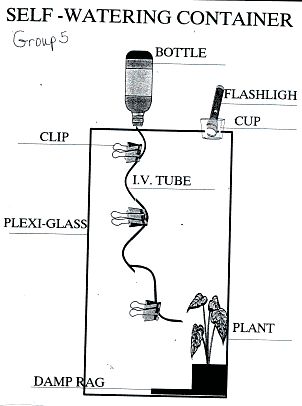
- the group will make a drawing, diagram or sketch of possible designs
- they will determine the best design to use
- each group member will be responsible for bringing in materials needed for the design
- the group will then use these materials to build the working model of the self-watering container
- after the model is completed, students will place a plant in the container to test it
- students will observe, analyze and record the results in their water booklets
- they will ask the question: Did the plant live or die and why?
- the group will plan a presentation for the class which will include a demonstration of their model and how it worked; each group will share what they have learned from the task and what they would change about their container if they had to do the task again
- students will illustrate, explain and record the materials needed, how their model works, label each part of the model, and write down any changes that they might need to make
What The Teacher Does :
In this performance task, the students will be working in groups in order to design, build and test their self-watering plant containers based on what they have learned about the water cycle. Students are expected to ask questions, make observations, perform simple experiments, record data and results in their water booklets, as well as draw conclusions. An individual assessment grade will be taken from the water booklet and a group assessment grade will be taken from the performance task.
In order to complete the task, students will need different materials to build their models. In their groups, they will brainstorm ideas on what materials they think they will need to create their container. Each student is expected to bring in materials. The teacher will provide basic materials that are on the materials (resources) list. Students will be encouraged to discuss their project at home in order to generate more ideas.
Instructional/Environment Modifications
Students were grouped heterogeneously with regard to ability. The students who were concrete learners were placed with students who were capable of analyzing a situation and interpreting the more abstract concepts. Individualized instruction was provided to the students who needed one-on-one clarification and explanation. Peer tutoring and sharing was encouraged throughout all aspects of the task. Input from the students was encouraged in order to further explain and clarify concepts that were demonstrated.
Students were placed in group seating arrangements during the task in order to facilitate group work. Spaces were opened up on the floor, hallways, etc. in order to allow children to work together and share information.
Time Required
The background sessions to prepare for the performance task took approximately 13 class sessions as outlined in the procedure. Each class session lasted approximately one hour.
The performance task took three groups approximately 1 and one-half hours to build their watering containers. Several of the other groups spent more time, and completed their task needing about 45 minutes more time.
Presentation of students' work took several class periods of approximately 45 minutes each.
Assessment, both student and teacher, took approximately 30 minutes.
Resources
For The Student: Any materials that they choose to use for the task
For The Teacher:
- plants
- window boxes
- tape, scissors, glue
- pencils, markers
- water
- plastic containers
- cardboard
- saran wrap
- plastic tubing, rulers and thermometers
Assessment Plan
See Documents Below:
Self AssessmentRubric - Individual PerformanceRubric - Group Performance
Reflection
In order to provide for the needs of all learners, the teacher must thoroughly assess the prior experience of each student and background knowledge of each learner. The teacher must encourage peer tutoring and develop a climate of sharing and trust for each learner. The teacher must continue to work with students on cooperative grouping skills and techniques to enhance the learning process. Incorporation of mathematics concepts that are interrelated; data graphs, tables, etc. must be encouraged.
In retrospect, I would change from a large plant to a smaller plant such as ivy and begin the project two weeks before the vacation in order to provide time for adjustments and changes that need to be made.
Author
Jude Carlini
Union-Endicott Central School District
715 Paden Street
Endicott, NY 13760
(607) 757-2137