Learning Context/ Introduction
Purpose of the learning experience:
"Professionals can teach young females how to feel more competent in leading active lifestyles by giving them the skills to avoid potentials hazardous situations." (JOHPER 1993).
Students will be able to identify, understand, and put into practice various actions that will make them recognize threats to them in their environment. The students will understand the physical and environmental dangers associated with a variety of activities in the home, school, workplace and community. They will demonstrate proper actions to safely participate in and out of the classroom and beyond the school environment.
Duration
- The overall unit is four weeks long.
- The classes meet twice a week for forty minutes.
- This learning activity is given one period to make the poster.
- Assessment and selection of posters to be displayed is completed the first half of the period immediately following the activity.
Instructional/Environment Modifications
- This activity is suitable for a wide variety of students and fits any classroom setting with no instructional modifications needed. This activity may be taught coed or single sex.
- Special needs students are encouraged to participate and the lesson is designed to meet their needs as noted in the IEP's.
- The teacher assists groups that have students with limited ability to verbal and written skills.
Procedure
In previous lessons, the teacher has introduced the unit to the students, outlined the goals and objectives, and shown a videotape on sexual harassment with a follow up discussion on increasing students' awareness to eliminate sexual harassment in the school environment. Students are encouraged to report any problems they may be having with sexual harassment to the administration and faculty. In this lesson, the students brainstorm situations on sexual harassment and situations that they might need to increase their safety self-awareness i.e. home alone, driving alone, dating someone for the first time, leaving work alone after dark, jogging alone or attending college as a freshman.
- The students are divided into equal groups. Special needs students are integrated into each of the groups.
- Each group is given poster paper and a variety of colored markers.
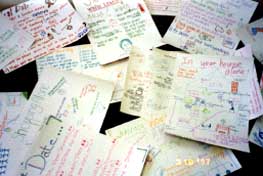
- Each group is asked to design a poster listing safe practices pertaining to one of the above situations.
- The students are encouraged to add artwork that reflects their written work.
- The teacher moves from group to group while they are working to answer and clarify any questions.
After the posters are finished:
- Each poster is placed on the wall and a spokesperson from each group explains the safety practices listed.
- The other groups can add to each poster and ask questions regarding the safe practices.
- When the posters are being explained, the teacher can add any suggestions the students may not have included.
- The teacher collects all of the posters.
Closure to the class:
Students are given a homework assignment that allows the students to reflect on the activity with regard to their own personal safety practices (see Sample 1 and 2).
Displaying posters in the hallway:
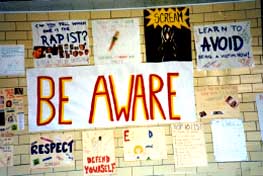
When all the classes have completed the activity, students select the best poster based on pre-established criteria (see rubric in Assessment Plan) for each of the various situations. Those posters are displayed in the hallway.
Reflections and Feedback
In previous lessons, the teacher has introduced the unit to the students, outlined the goals and objectives, and shown a videotape on sexual harassment with a follow up discussion on increasing students' awareness to eliminate sexual harassment in the school environment. Students are encouraged to report any problems they may be having with sexual harassment to the administration and faculty. In this lesson, the students brainstorm situations on sexual harassment and situations that they might need to increase their safety self-awareness i.e. home alone, driving alone, dating someone for the first time, leaving work alone after dark, jogging alone or attending college as a freshman.
- The students are divided into equal groups. Special needs students are integrated into each of the groups.
- Each group is given poster paper and a variety of colored markers.
- Each group is asked to design a poster listing safe practices pertaining to one of the above situations.
- The students are encouraged to add artwork that reflects their written work.
- The teacher moves from group to group while they are working to answer and clarify any questions.
After the posters are finished:
- Each poster is placed on the wall and a spokesperson from each group explains the safety practices listed.
- The other groups can add to each poster and ask questions regarding the safe practices.
- When the posters are being explained, the teacher can add any suggestions the students may not have included.
- The teacher collects all of the posters.
Closure to the class:
Students are given a homework assignment that allows the students to reflect on the activity with regard to their own personal safety practices (see Sample 1 and 2).
Displaying posters in the hallway:
When all the classes have completed the activity, students select the best poster based on pre-established criteria (see rubric in Assessment Plan) for each of the various situations. Those posters are displayed in the hallway.
Student Work
Resources
For Teachers:
- County Sheriff Department
- Local Police Department
- Local Bar Association
- County Human Rights Division
- Planned Parenthood
- Large Corporations: Sexual Harassment Policies
- School Administrators
- Women in male dominated occupations
- Former victim from Rape Crisis Centers
For Students:
- "Fear as a Constraint to Active Lifestyles for Females", Karla A. Henderson, M. Deborah Bialeschki, JOPERD/January 1993.
- Missing Children Report, Printed with permission of Child Find Canada.
- "Sexual Harassment in Our Schools, Putting the Pieces Together for Prevention and Response", an information packet from the NYS Occupational Education Equity Center.
- New York State Penal Law, Appendix C.
- "Rape Prevention", Rape Crisis Center.
- Videos:
"Sexual Harassment and How to Stop It"
"Playing the Game"
"Violence Against Women"
"Taking Responsibility: Standing Up for Yourself"
Self-Defense Guide for Women"
Assessment Plan
Student Centered: Each group presents their posters to the class and the other members of the class rank the posters based on the following rubric:
Poster RubricAssignment - 1Assignment - 2Assignment - 2 (Answer Sheet)
Student Work
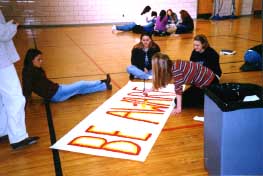
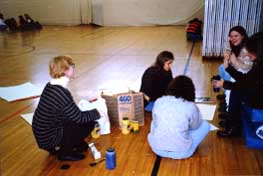
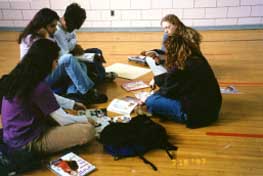
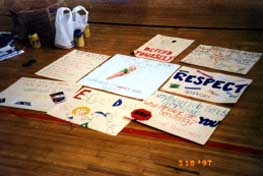
Photographs of students engaged in the learning and final selected posters displayed in the hallway.
Authors
Toni Hagerman, Pittsford Central Schools
AND
Sharon Along, Fairport Central Schools
Reflections and Feedback
Violence among young people in our society is increasing and statistics show it is becoming commonplace in many communities and schools. The FBI estimates that one out of every three women will be sexually assaulted at some time in her lifetime and one of every eight boys. This lesson makes students aware of safe practices in their daily lives and makes them aware of the precautions they need to take to avoid potentially dangerous situations. This lesson also realistically and thoughtfully reflects the safety challenges that face many our students. It allows students an opportunity to express their thoughts on safety practices through small group discussions, pictures and words. This lesson could fit into health, home economics or physical education classes. The unit has tremendous possibilities to be articulated and integrated with Social Studies, Law Enforcement and the Judicial System.