Lesson Plan
Turn-of-the-Century Child
Grade Levels
Intermediate, 6th Grade, 7th Grade, 8th Grade
Objectives
To put students in the role of historians and develop strategies for applying methods in historical inquiry:
- develop visual literacy skills (observation, deduction) to understand artifacts
- use the primary record, including digital libraries, to formulate historical questions
for further research
Procedure
Focus Activity
To model objective photo analysis, use the photograph
cataloged as "Joseph
Burkholder family moving to their new house : leaving the sod house," from The Northern Great Plains, 1880-1920: Photographs from the Fred Hultstrand and F.A. Pazandak Photograph Collections, part of American Memory. Limit your description of this digital
artifact to what can be learned from the image itself, observing what is in the photograph
without interpretation (feelings, beliefs, predictions, prior knowledge).
Description
In this lesson from the Library of Congress, students will use primary source photographs of young children of diverse backgrounds to learn and practice the skills of observation and deduction to build student understanding of 1900-1923, the "first generation" of the 20th century. From the initial stimulus, a digitized photograph taken during the period, students develop a richly realized "persona" from the same geographic region and ethnic background as the child pictured. Much as an historian fits a particular artifact into an assemblage of evidence for the purpose of constructing a model of the past, students identify, place, and interpret these images as part of their scrapbooks of an imagined child born in 1900.
In a parallel series of exercises students examine personal photographs, in order to reinforce visual literacy skills, experience the process of historical inquiry, and recognize that their own lives are part of the historical record. The goal is a full understanding of how knowledge of the past is constructed from evidence interpreted by historians.
Activity One - Elements of a Photograph
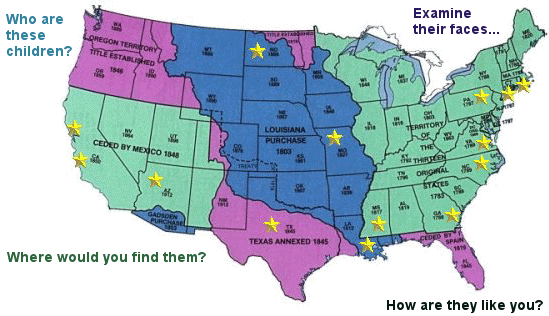
- Using the opening web page "Examine their Faces,"
tell students that they are to become historians and objectively examine a digitized
artifact. Have them click the stars to examine the unlabeled images.
- Based on class size, divide students into pairs or triads. We do not recommend
that students work alone, since they will benefit from group brainstorming and
discussion. Each pair or triad examines a digital photograph. Invite students to use
the map to select a region or an ethnicity about which they have some interest. Or,
students can select a photograph solely on its visual appeal.
Continue with
"Examine the Historical Record" by using the
photographs and directions for activity one:
- Students discuss their responses to the questions on their photograph's web page. They should help each other avoid injecting feelings or personal interpretations during
the discussion.
- Students record their individual observations on Data Sheet 1 - Elements of a photograph. From the data sheet notes, each student
writes an objective observation describing what he or she sees in the artifact. The
description should help someone who has not seen the image to visualize it.
- Students from different groups exchange and read each others' written
descriptions. Then students compare the image mentally created from the writing with
the digital image, and suggest additions or deletions to clarify the description.
- Next, students transfer their learning to a personally relevant artifact. Give the
following instructions for a homework assignment called Objective Observation of a
Personal Photograph:
Locate the oldest photograph owned by your family or by another important person in
your life. Using the techniques of objective observation that you
practiced in class, write an objective description of your personal
photograph. Use clarity, specificity, and vivid vocabulary to help your reader
visualize the image. Be prepared to share your writing and photograph with a class
member.
- In class, students exchange their written description of a personal photograph with a
classmate. Allow students to choose their own partners because of the personal
nature of this exercise. Each student is to comb a peer's writing in order to
eliminate words which make inferences, rather than describe, their artifact. Then
the student compares the writing to the actual photograph and makes a list of elements
which need inclusion or elaboration.
- For homework, or in class if there is time, students revise their writing to incorporate
the peer editor's suggestions. The revised writing is an assessment of each
student's ability to apply the visual literacy skill of objective description without
distortion of interpretation (feelings, beliefs, predictions, prior knowledge) to a
personally relevant artifact. The revision also demonstrates what each student
understands about clarity and specificity in language.
Activity Two
- Using the original demonstration photograph, the teacher now demonstrates deductive observation. Deductive observations draw logical inferences based on prior knowledge of the people and
what they are doing, the time, and the place.
While listening to the teacher,
students should be encouraged to raise their hands if they hear any inferences which do
not appear to be logically deduced from the digital artifact. The resulting
discussion will help clarify the distinction between observations and inferences. Additionally, the teacher should invite speculation as to why the photograph was
taken. On a large pad of paper or on the board, the class should create and record a
list of questions which are still unanswered.
- Students return to their original pair or triad and reexamine their digital artifacts,
paying close attention to the areas for examination suggested below the image. Further, they should brainstorm logical inferences based on their growing knowledge and
research about the period.
Continue with "Examine the Historical Record using the
photographs and directions for activity two:
- Working in their groups, they reexamine the digital photograph and their revised
objective descriptions.
- They identify, compile, and record these clues in the first column of Data Sheet 2 - Making deductions.
- Then they discuss deductions (inferences) from these clues and record them in the second
column of their sheets.
- From these deductions, they brainstorm questions that need further investigation and
record them in the third column of their data sheets.
- Finally, they speculate as to why the picture might have been taken.
- At this point, students reconsider their personal artifact. Give the following
instructions for a homework assignment called Deductive Observation of a Personal
Photograph:
Revise the description of your family photograph to include logical inferences about
your artifact. Use any family history you can uncover through oral accounts, memoirs, and
diaries, or other photographs and artifacts. Be prepared to share this written
description and photograph with a class member.
- In class, students return to their personal partner and exchange written
descriptions. Encourage these personal partners to respond with genuine interest to
these stories from their friends' lives. Then they analyze each others' writing,
following the reasoning used to develop inferences about the image. As peer editors,
they are to identify areas for revision in which the logic or writing is unclear.
- For homework, or in class if there is time, students revise their writing incorporating
their peer's suggestions. The revised deductive observation is an assessment of each
student's ability to use the visual literacy skill of observation in combination with
prior knowledge of family history to create logical and plausible inferences about a
personal artifact.
Activity Three
- This is a good time to explicitly create the analogy between sources of historical
information within the students' families and in other primary source collections. Introduce students to interviews and diaries in the American Life Histories: Manuscripts from the Federal Writers' Project, 1936 - 1940 Students can read
through "Voices from the Thirties: An Introduction to the WPA Life Histories Collection" for an overview
of the collection. Like family albums or archaeological digs, objects in a collection gain
meaning from their proximity to each other.
- This creates a logical bridge to a final examination of the artifacts in which students
trace the artifact to its digital library collection. Students work in their original
pairs or triads to investigate the collection and answer the questions below the digital
image and on Data Sheet 3 -Using the cataloging
record. The goal is an understanding of the information that can be gained from the
cataloging record, from related artifacts and from the scope of the collection itself.
Terms such as cataloging record, subject headings, scope, and collection
are formally defined on the data sheet.
Continue with "Examine the Historical Record"
using the photographs and directions for activity three:
- A class discussion on the similarities and differences among the collections will
naturally include comparisons of the purposes and depth of the collections, as well as the
reasons for the creation of individual artifacts, and how this affects the online
presentation (organization, search interface, visual elements, word choice).
See Digital Libraries under Resources for more information.
Extension
"Through photography each family constructs a portrait of
itself, a kit of images that bears witness to its connectedness."
-- Susan Sontag. On Photography.
- The personal photographs, accompanied by the Objective Observation of a Personal
Photograph and Deductive Observation of a Personal Photograph, are displayed
for a student-parent tour of this "personal museum."
- These exercises began a semester-long study of America at the
turn-of-the-century. Beyond a working knowledge of the events, ideas, and persons of the
century, students were expected to construct an understanding of the major
"themes" of the period and how these might impact a child born in 1900. Following a structured set of assignments, they gradually assembled both a physical and
digital scrapbook of letters, oral histories, artifacts, diary entries, narratives, and
images based on an invented child within a family. From their investigations students
learned to describe the past through the eyes of those who were there, and create
hypothetical, historically-plausible narratives for their individual character.
Duration
Approximately 4 1/2 - 5 hours, plus homework:
- Activities one and two can be split into two 45 minute classes apiece, plus
homework. Or the objective and deductive portions can be extracted from these two
activities and completed together in 90 minutes, omitting the family photographs sequence.
- Activity three extends from 60-90 minutes, depending on how deeply students investigate,
analyze, and compare the digital libraries.
Evaluation
Evaluation will be based upon:
- Completed Data Sheets 1, 2, and 3
- Peer evaluation of individually written Objective Observation of a Personal
Photograph and Deductive Observation of a Personal Photograph
- Revised Objective Observation of a Personal Photograph and Deductive
Observation of a Personal Photograph
- Observation of small group and whole class discussions
Source
Reproduced from the Library of Congress web site for teachers. Original lesson plan created as part of the Library of Congress American Memory Fellows Program.