Learning Experience/Unit
Debate in the Middle School
Subject
English Language Arts (2005), English Language Arts (NYS P-12 Common Core), Literacy in Science and Technical Subjects (NYS 6-12 Common Core)
Grade Levels
Intermediate, 8th Grade
Learning Context/ Introduction
In this unit, eighth grade students form opinions about a topic based on facts and present them persuasively in the form of an organized debate. To be successful in this unit, students first read and discuss ethical issues related to animal experimentation present in the play "Let Me Hear You Whisper" by Paul Zindel. Then, students distinguish the differences between facts and opinions. Students then use this knowledge to take the stance of either a proponent or opponent of animal experimentation and research their side of the topic. Articles from both points of view are shared with students as they take notes to build their cases. They also utilize the school's database for individual research. The project culminates in the format of a formal Lincoln-Douglas style debate.
Essential Question
Is it ethical to conduct experimental research on animals?
What is the difference between fact and opinion?
Assessment
Below is the rubric used to assess students for the debate performance.
Debate Rubric
Student Work
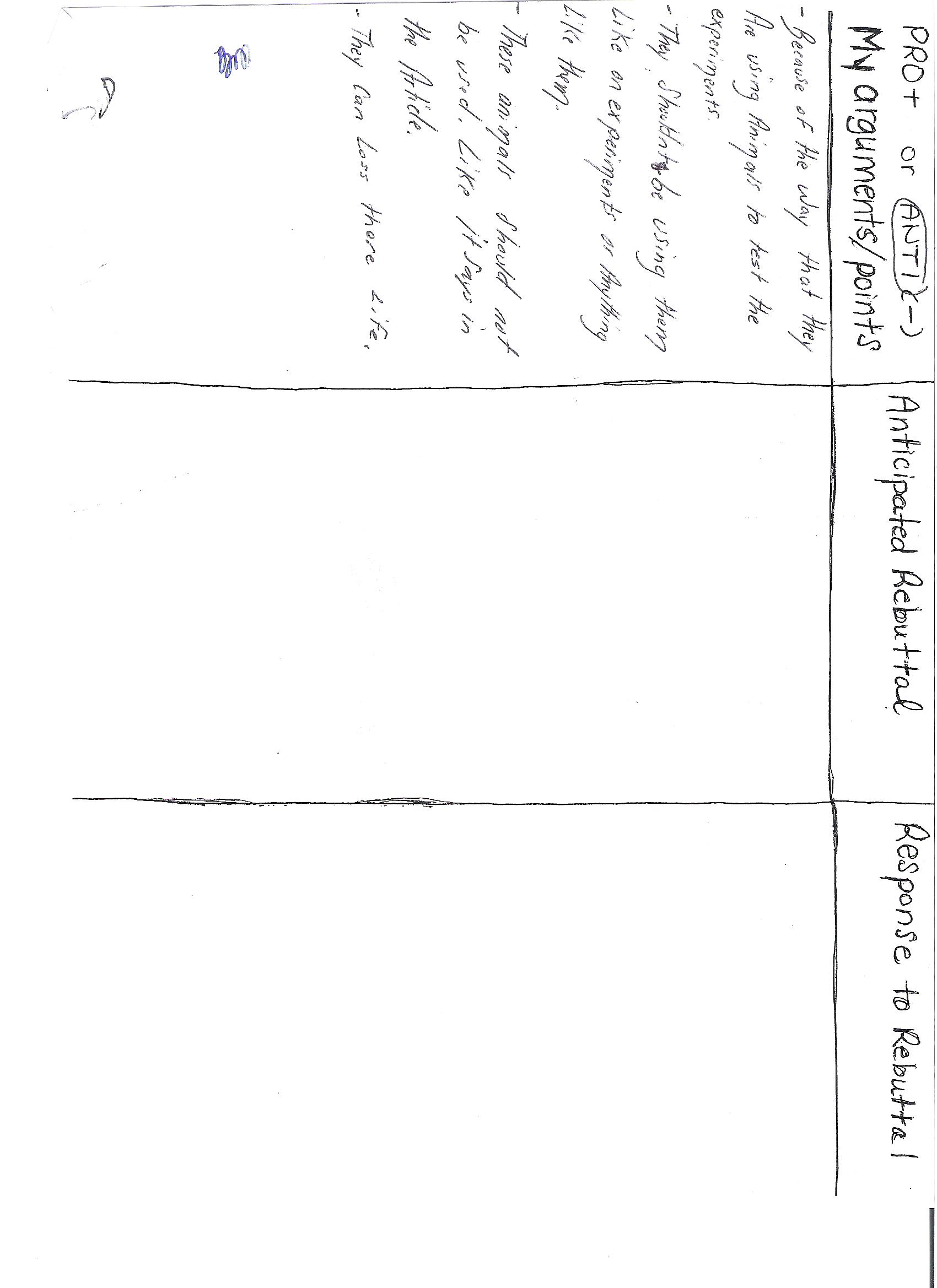
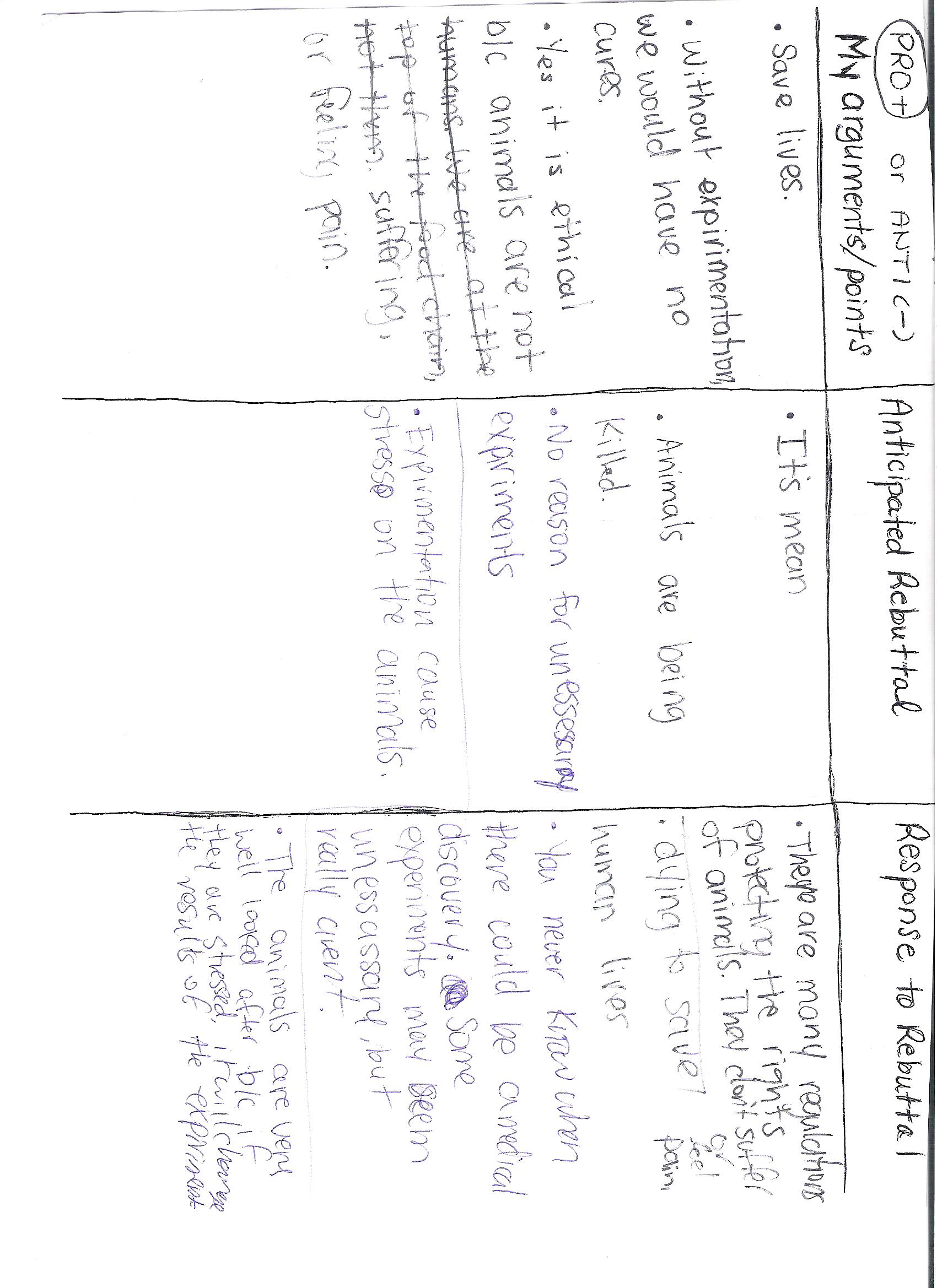
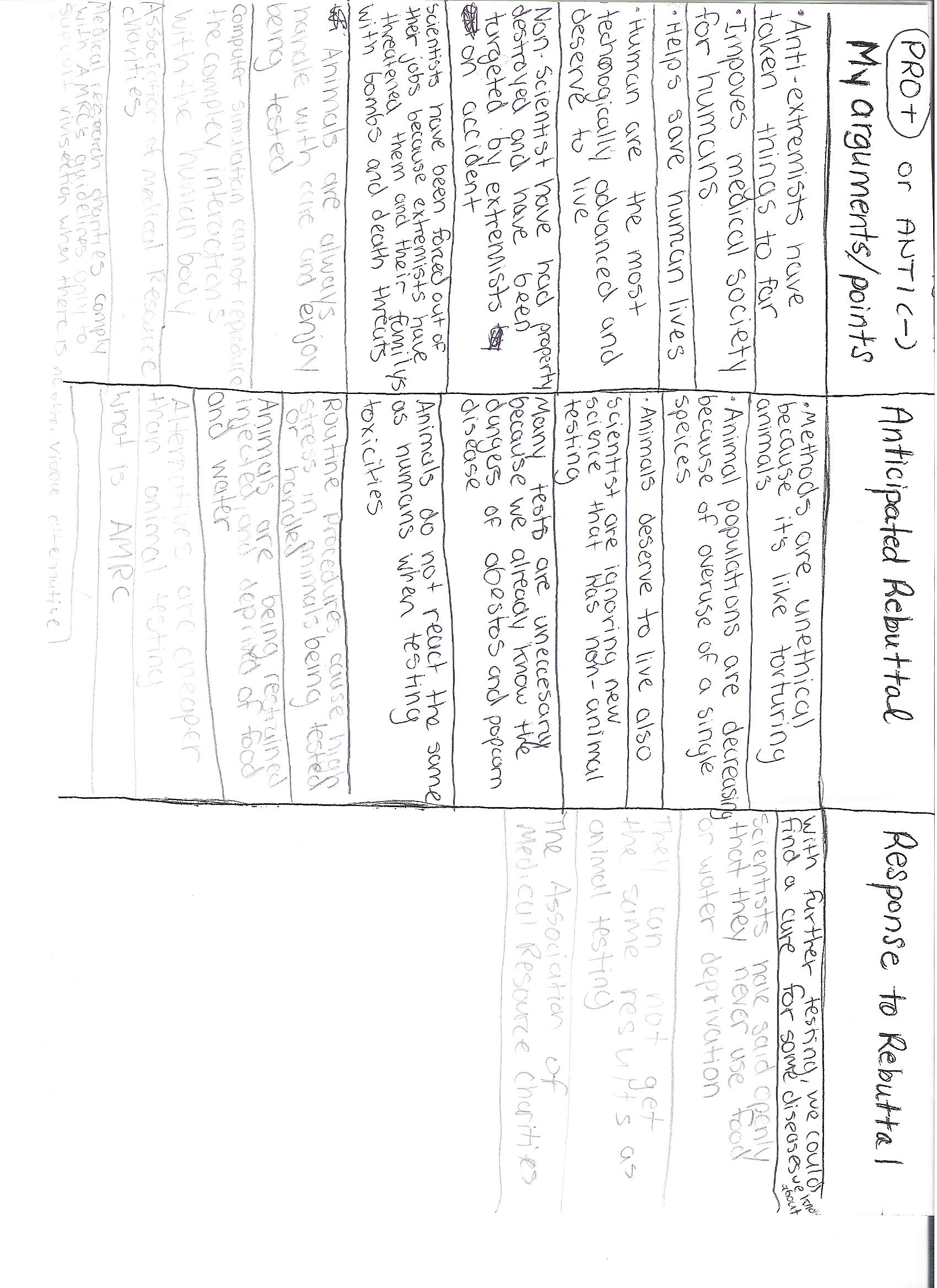
Below are some samples of student work completed in preparation for the debate.
Procedure
- First, the class is introduced to the controversial topic of animal research and experimentation as they read the play "Let Me Hear You Whisper" by Paul Zindel. The play is about a woman named Helen who develops sympathy for a dolphin that is part of a research experiment in the laboratory where she works as a third shift janitor.
- At the conclusion of the reading, students decide whether they feel for, against, or neutral about the topic. They are introduced to debate through both teacher facilitated discussion and by reading "The Power of Words" article in READ magazine. This article outlines the basic procedure of a formal debate and explains the concept of rebuttal. Rebuttal is further explored as students are asked to think of ways in which they anticipate and address rebuttal in their daily lives (reasoning with parents or teachers, working through problems with friends, etc) Students will learn to differentiate between facts and opinions and be able to check their understanding with the SMART fact and opinion organizer sort.
- They are then split into two groups, a proponent group and an opponent group. They are given a graphic organizer on which to record their arguments and anticipated rebuttal. The teacher should take into consideration the students' declared stance about the topic when forming the two groups. If at all possible, allow students to debate on the side that they feel most strongly about. For an extra challenge, teachers may also choose to assign students to the side they are most opposed to. This may challenge students to consider opposing points of view.
- The teacher reads aloud four articles to students; two articles are from proponents' perspective of animal research and experimentation, and the others are from opponents' perspective. Students must decide which side the author is on, and record useful information from the articles onto their organizers.
- Students are given time in class to individually research the topic and record new information on their organizers. A guided interactive handout is available as a starting point for them, if desired.
- Each side meets as a group to compile their research, plan their debate speech, and build arguments against the anticipated rebuttal. Each student prepares an index card to guide his or her part in the debate speech.
- A formal, timed, Lincoln-Douglas style debate is held. The teacher is the mediator, timer, and records the debate, if possible (with student and parent permission).
- The teacher reviews the tapes and announces the winner. Students also review the tapes and reflect on their points of strengths and challenges.
Related Resources
- Play "Let Me Hear You Whisper" by Paul Zindel
- READ magazine Volume 58, No. 4 "The Power of Words"
- Varied research articles from both proponent and opponent perspectives. Titles include:
- "Caring or Cruel" by James Randerson
- "Anything but Routine" by Jonathan Balcombe, Ph.D.
- "Scientists' Blinders Cost Human and Animal Lives" By Jessica Sandler and Kate Willett
- "Terrorizing Medical Research" By Michael Conn and James V. Parker
- "Why I Use Animals in My Research" By Edythe London
- "Ask the Doc: What Are Alternatives to Animal Testing?" By Neal Barnard, MD
*All articles were accessed via Proquest database subscribed to by school district
SMART Fact Opinion SortAnimal Interative Sheet.doc
Instructional/Environment Modifications
One class of eighth grade is co-taught with a special education teacher. In this class of sixteen, seven students have special needs, three of whom are more severe than others. These students received additional assistance and support in all lessons throughout the unit.
Duration
The reading of the play lasts approximately for three (3) forty-five-minute class periods. The review of facts, opinions, and debate procedures are approximately two more periods. The teacher's reading of the articles and students' preparation of arguments lasts approximately two and a half periods. Individual research is one class period. The planning of the debate is one class period. The debate itself is one class period. The review of the tape and reflection is one class period. Therefore, the total number of forty-five-minute class periods to complete this unit is approximately ten and a half periods, or roughly two to three weeks depending on student needs and available resources.
Reflections and Feedback
Although students are all required to prepare and share in a part of the debate, less outgoing students will hold back after their piece has been spoken. This puts pressure on more outgoing, confident, or stronger students to present the group's argument. As the debate ensues, some students will participate fully while others will only share what is required. To ensure that quieter participants have an understanding of their side's main points and plans for rebuttal, an individual writing assignment or student interview may be beneficial. The best time in the unit to do this would be right before the actual debate to avoid students' merely parroting what their peers asserted during the debate.
Professional speech and conduct should also be addressed before the actual debate.
If time allows, it would also be helpful for students to practice their arguments, or role play with one another before the formal debate takes place.
Vocabulary
- Fact
- Opinion
- Debate/ Formal Debate
- Lincoln-Douglas Style
- Rebuttal
- Persuade/ Persuasive
- Proponent
- Opponent
- Resolution
- Vivisection
- Ethics/ Ethical