Assessment
Attached is my rubric.
Learning Context/ Introduction
Even elementary age students can be made aware of how to make healthier food choices and why it's important in their lives. The importance of movement will also be addressed in this unit.
Duration
This unit will take one month of daily lessons of varying length. However, good eating habits are something that should be reinforced throughout the year.
Essential Question
How do the foods you eat effect your health?
Instructional/Environment Modifications
In addition to traditional methods, the students will be using SMART Board technology, ELMO, CDs, hands-on materials, as well as using their reading and writing skills.
Procedure
Students will be introduced to a daily ten minute yoga practice as a movement program that can be practiced in a confined space (as in a classroom). See "Yoga for Young People" (reprinted with permission of presenter), and Yoga Kids in the related resources section for ideas.
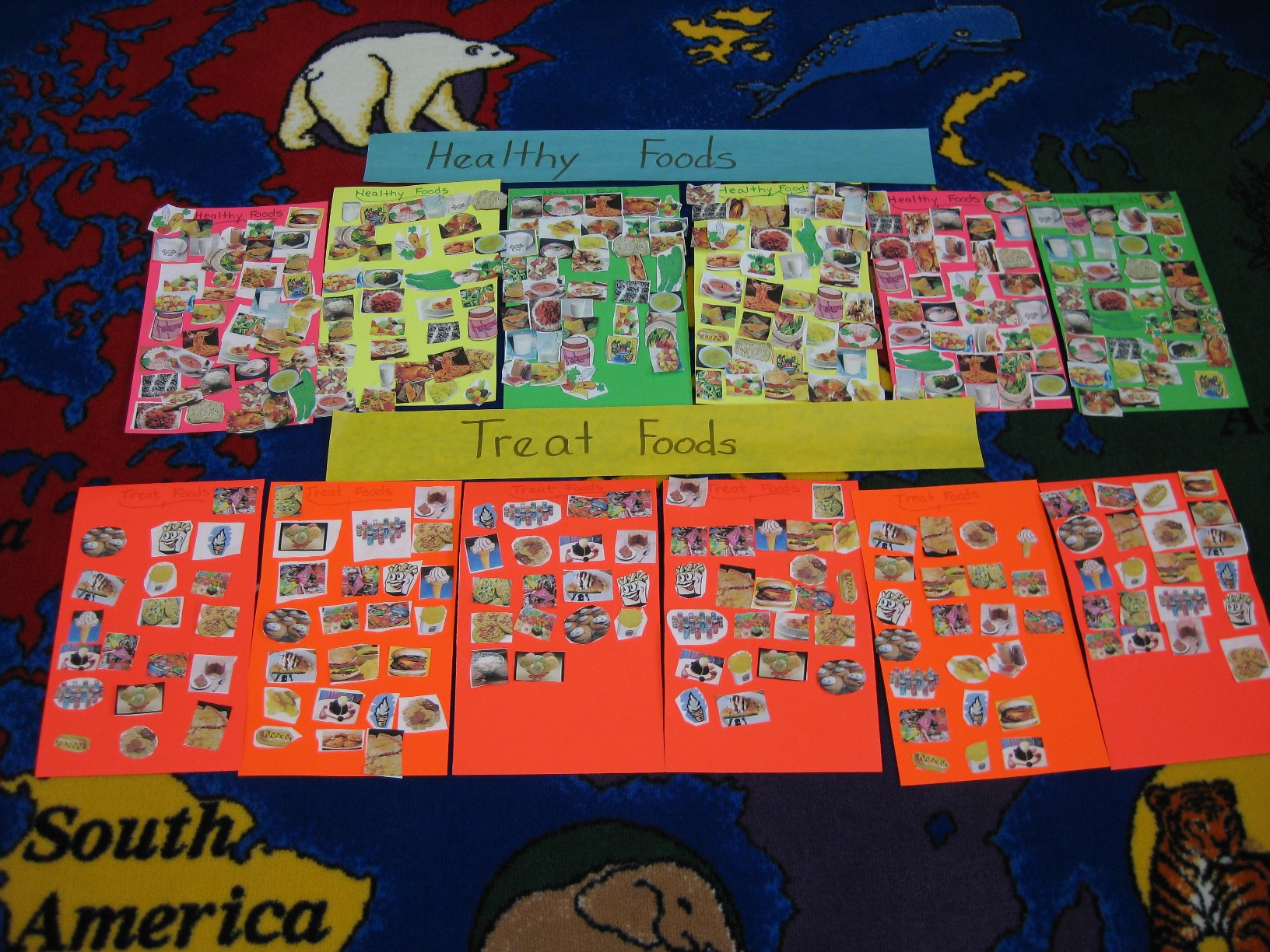
Step One - Students will be placed in small groups. Each group will be given pictures of various foods. They will then group them according to whether they think they are "healthy" foods or "treat" foods that should only be eaten once in a while. The teacher will then read a kid friendly book on nutrition to the class (suggested titles given in related resources section). The groups will then decide if they want to change any of their selections and create two posters- one for healthy and one for treat foods. Each group will then share their posters with the class and explain their choices. While the groups are working, the teacher should be walking around the class listening to the students' thinking processes as they decide which group to put the foods in. This will take approximately two 30-minute sessions, depending on the group and nutrition book(s) used.
Step Two - Using the USDA free publication "My Pyramid for Kids" Lessons for Grades 3 and 4 (see related resources section), the students will learn about "My Pyramid for Kids" with the food groups of grains, fruits, vegetables, dairy, and meats, beans, and nuts. Teacher should utilize the free CD - My Pyramid Blast Off Game - from the USDA. Introduce the game from the CD on the SMART Board, then students can later play it independently. They will also decide on how to create a healthy menu for breakfast, lunch, dinner, and snack by using food math and portion sizes. (6 oz. grains, 2.5 cups veggies, 1.5 cups fruit, 3 cups milk, 5 oz. meat or beans) Finally, they will learn the importance of fruits and vegetables as steps to a healthier you. This step will take approximately five 30-minute sessions.
Step Three - Using the New York State free program "Think Breakfast", the students will complete selected pages either independently or in groups, to emphasize the importance of breakfast. Using the ELMO, do pages 1, 2, and 6 together. They can do pages 3,4, 8, and 9 independently (see related resources section for information on this program). Use the NYS "Think Breakfast" CD - Music video (play and show on SMART Board). Introduce the "Think Breakfast" game on the SMART Board which the students can later play independently. This step will take approximately three 30-minute sessions.
Step Four - Either the school nurse or the head of food service talks to the class about how menus are created (about 20- to 30-minutes). Students will then record everything they ate for one day. Then they will rate themselves on how healthy they ate that day and what if anything they could do to improve it. (Rating system = 4 - Healthy, 3 - Getting Healthy, 2 - So-So, and 1 - Junk Food Junkie) They will also wear their free pedometers from “Think Breakfast” and record how many steps they took that day (about 2,000 average steps = 1 mile, and about 10,000 average steps = 5 miles). This part will take one day to record and one day to discuss how they could eat better and walk more.
Step Five - Grab ‘N Go: While children have little say in many food choices, they can help with snack choices. The class will collaboratively (by either think-pair-sharing their ideas or brainstorming as a whole group) come up with ideas for healthy snacks. In order to do this, students will be using critical thinking skills as they discuss their choices which are recorded and saved on the SMART Board. (Examples: bagel, dried fruit, graham crackers, raw veggies, cereal, granola bars, trail mix, pretzels, cheese sticks, fresh fruit, rice cakes, nuts, whole grain bread/peanut butter, whole grain crackers, water, juices (with no added sugar).)
Step Six - Eating Out Healthier: Students will look at various fast food restaurant menus as well as the school cafeteria menu and decide what the healthiest choices would be. The following websites contain menus and nutritional information: www.mcdonalds.com, www.arbys.com, www.burgerking.com, www.wendys.com, www.kfc.com, www.tacobell.com.
The web sites can be viewed on the SMART Board and choices can be highlighted and saved for comparisons later. ELMO can be used to view the school cafeteria menus to decide the healthiest way they can eat in the school cafeteria. Students who bring their lunches can be included by voluntarily sharing what they bring for lunch and their health value. This step can be done in one to two 30-minute sessions.
Step Seven - Assessment: Using the provided Kidspiration assessment, students will drag foods to the plates for breakfast, lunch, and dinner. They will then click on the pencil and paper icon and write why what they chose was the healthiest choice. They will be graded using the provided rubric. This will take two 30-minute sessions for most students.
Step Eight - In small groups, students will work collaboratively to write a "Food Pyramid Rap." Each group will have three lines to describe one area of the food pyramid in rap form. The lines will be compiled to create one rap, which the students will then perform in a photostory with the accompanying appropriate food pictures. (See Student Work: Food Pyramid Rap)
Step Nine - As a fun and tasty culminating activity, the students (with the teacher’s and food service department’s assistance) will make their own fruit salads as a reinforcement of the idea that healthy foods can also taste good! To provide for food allergies and individual tastes the fruits will be placed in separate large bowls. The students will then take their own individual bowls and choose their own combination of fruits for their salads.
Reflections and Feedback
Nutrition is a topic that should be continuously taught and reinforced. After all, we do eat every day!
Student Work
Attached is the student work.
Related Resources
- "Yoga for Young People" presented by Marchell Scarano (certified yoga instructor) used with permission of presenter (attached below)
- Yoga Kids (Educating the Whole Child Through Yoga) by Marsha Wenig. Stewart, Tabori, and Chang: A Company of La Martiniere Groupe. New York, NY: 2003.
- Burp! (The most interesting book you'll ever read about eating) by Diane Swanson. Scholastic, Inc. New York, NY: 2001.
- The Monster Health Book (A Guide to Eating Healthy, Being Active, and Feeling Great for Monsters and Kids!) by Edward Miller. New York, NY: 2006.
- "Nutrition" Kids Discover. Ed. Stella Sands. New York, NY: 2006.
- United States Department of Agriculture Food and Nutrition Service FNS - 385 Sept. 2005 Level 2: My Pyramid for Kids- Lessons for Grades 3 and 4. Free materials upon request, available at: http://www.choosemyplate.gov/
- NYS Education Department www.thinkbreakfast.net: site offers lesson plans, activity and agenda booklets, CDs - breakfast games, music, pedometers, key chains, free upon request.
- www.NutritionExplorations.org
- www.HealthierGeneration.org
- Yoga for Young People Page 1.pdf
- Yoga for Young People Page 2.pdf
- Yoga for Young People Page 3.pdf
- Yoga for Young People Page 4.pdf
Vocabulary
nutrition, food pyramid, healthy foods, treat foods, grains, vegetables, fruits, dairy, meats, beans, nuts