Objectives
At the end of this lesson, students will be able to:
- Explain how wetlands can help reduce the affects of a hurricane.
- Describe the changes a hurricane imposes on a wetland.
- Describe how the different meshed materials represent the function of different wetlands.
- Describe the model's strengths and weakness in representing hurricanes and the effect of wetlands.
- Explain the results of human impact on wetlands.
Essential Question
How can wetlands help to deprive a hurricane of its energy?
Procedure (from NOVA Teachers with modifications)
PRE-LESSON INSTRUCTION
- Review hurricane formation with the students
- Have the students watch the on-line video Hurricane Katrina: Wetland Destruction and record all their observations regarding the changes related to Hurricane Katrina. Ask students to share what changes they observed and if any of these changes could have been prevented.
ACTIVITY
- Have students locate the tropical zone south of the equator on a map (the regions between 5° and 20° north and south of the equator are the belts where hurricanes can form). Review with students how hurricanes develop.
- Choose the materials you would like to use. Make sure you use at least three materials of different mesh densities (see Activity Answer on page 5 for sample results.) Organize students into teams. Distribute copies of the "Wetlands and Hurricanes" handout to each student.
- Boil the water in the kettle. (You can make the steam more apparent by placing the kettle against a dark background.) Safety note: Steam scalds! Wear protective gloves. When placing materials over the spout tip of the kettle, as instructed below, hold the materials so your hands are below the spout tip. Stretch the materials taut over the spout's opening so steam goes through the materials instead of being channeled out to the sides where it can scald your hands.
- As the water heats, tell students that the water in the kettle represents the ocean, the hot plate represents the heat from Earth's tropical zone that warms ocean water, and the steam plume represents a hurricane.
- Ask students to record their observations about the plume of steam.
- Ask students to predict how the different materials will affect the plume when you place them in its path. Have them record their predictions and reasoning.
- Put on the protective gloves and place one of the materials across the tip of the spout. Have the class observe and record the effects on the plume of steam. Repeat the demonstration using the remaining materials. Explore how students' predictions compare to what actually happened.
- Have each student answer the questions on his or her handout. Work with students to find answers to any additional questions they may have about wetlands.
- Have students read the information presented in the following web-page. Historical Pictures of Mississippi Delta Wetlands
-
As an extension, have students research where the nearest wetland area is to their school. Consider with students different types of wetlands such as swamps, marshes, and bogs, and have students find on a local map the wetlands (and their size) that are closest to their school. Have them estimate the size of the wetlands and find during which months the wetlands are most likely saturated with water. Ask students to research the dominant soil type(s) and the names of some of the plants and animals that inhabit the wetland.
Student Work
"Hurricanes & Wetlands" student handout; Student lab notebooks
Resources
Environmental Defense Fund. (2008). Restore Our Coasts, Protect Our Cities. Retrieved March 25, 2008, from Environmental Defense Fund. Web site: http://www.edf.org/page.cfm?tagID=500
NOVA Teachers. (2008). Storm That Drowned a City. Retrieved March 25, 2008, from NOVA Teachers. Web site: http://www.pbs.org/wgbh/nova/teachers/activities/3218_orleans.html
Teachers'domain. (2008). Hurricane Katrina: Wetland Destruction. Retrieved March 25, 2008, from Teachers'domain. Web site: http://www.teachersdomain.org/resources/ess05/sci/ess/watcyc/katrinawet/index.html
Description
Hurricanes need two basic ingredients to begin: a source of energy (warm tropical ocean waters) and a disturbance in the atmosphere (such as a thunderstorm). Most Atlantic hurricanes start as storm systems off the coast of West Africa. These storms move westward over warm, tropical ocean waters. A hurricane forms when warm, moist air rises from the ocean surface and begins to condense into storm clouds and rain. As the water condenses it releases heat, which warms the air around it. This warm air begins to rise; as it does so it is replaced by more warm, moist air from the ocean below. This cycle starts the hurricane's spinning motion. As a hurricane travels over the warm water it can gain more energy and increase in strength (a hurricane starts as a tropical depression before developing into a tropical storm and then a hurricane). A hurricane's strength diminishes as it moves over land and is robbed of its warm water energy source.
Dense wetlands can help weaken a hurricane by breaking the connection between the hurricane and warm ocean water. Wetlands can also act as a physical barrier, slowing and reducing the force of the waves that reach the shore.
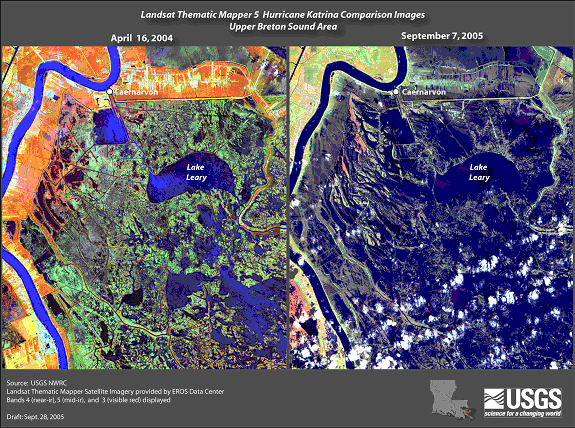
Before Hurricane Katrina hit in 2005, the rate of loss of wetlands along Louisiana's coast had been about 75 square kilometers per year, a loss that had been occurring for several decades. Some of this was due to natural processes such as tides and storm surges. Other losses resulted from dredging canals for sources of oil and the use of heavy commercial and recreational boat traffic through the wetlands. In addition, the construction of levees and concrete channels to control the Mississippi River starved the coastal marshes of the fresh water and sediment necessary to restore and preserve them.
As a general rule, about a kilometer and a half of marsh can reduce a coastal storm surge by about 30 centimeters. The surge that hit the Gulf Coast when Katrina hit was close to nine meters—the highest ever recorded. The surge in Lake Pontchartrain was about three meters. Some scientists believe that a few kilometers of marsh could have lessened Katrina's impact on Louisiana's coast.
In this lesson, students examine how wetlands can deprive a hurricane of some of the warm, moist air that supplies its energy. The steam represents the hurricane and different types of meshed materials represent dense and sparse wetlands. Students will record what happens to the plume of steam (hurricane) when different materials are placed in its path.
Materials and Resources
Hurricanes&Wetlands_wksht.doc
Hurricanes&Wetlands_key.doc