Learning Experience/Unit
Photo Story - The Importance of Railroads on our Community by St. Lawrence-Lewis BOCES
Course, Subject
Social Studies, United States History and Government, Social Studies
Grade Levels
Intermediate, 8th Grade
Assessment
A rubric will be used for assessing the culminating project.
Learning Context/ Introduction
As part of our eighth grade curriculum, this lesson will focus on the relevance of the railroad and the effect that it had on the local community and the local paper mill. Using PhotoStory 3 we will create a photo story illustrating the significance of the Norwood-St. Lawrence Railroad and the impact that it had on the local residences and local businesses, such as the Norfolk Paper Mill.
Duration
Day One: Approximately 15-20 minutes for introduction to the lesson.
Day Two: Approximately 3 hours to attend Field Trip.
Day Three: Approximately 40 minutes for modeling and starting their Photo Story.
Day Four: Approximately 40 minutes to complete Photo Story Projects.
Day Five: Approximately 40 minutes to present Photo Story Projects to the class.
Day Six: Approximately 40 minutes to finish presenting Photo Story Projects to the class.
Essential Question
What can we learn from the past? Why was the local paper mill and railroad located in our community?
Instructional/Environment Modifications
Due to the fact that the class includes AIS, 504 or CSE students whose language, writing skills are not as proficient as their classmates, either the CSE support staff or the classroom teacher worked with those students on completing their task.
Procedure
Day One:
- Prior to this lesson the students will have read and completed an outline
and questions for Chapter 20 section 1 from class textbook, The American Nation . This section focuses on how American
industry benefited from the widespread railroad building.
- Class discussion on the importance of the local railroad and the impact
that it had on the surrounding businesses and the community.
- The teacher will discuss with the students the purpose and expectations of
their upcoming field trip. The teacher will hand out the task worksheet to the students. The students will be creating a PhotoStory from
pictures that they will be taking on their field trip to assist them in
explaining the significance of the Norwood-St. Lawrence Railroad and the
impact that it had on local residences and local businesses, such as the
Norfolk Paper Mill.
- Using a computer and projector the teacher will introduce PhotoStory to
the students by showing an example of a completed PhotoStory. As the story is previewing the teacher will point out key points such as:
1. How the pictures are arranged so that they will form a story
2. How words/sentences are used to create a story
3. How music helps tell the story
Day Two:
- The students will take a class field trip to the local museum, paper mill and to see an old engine. The students will be split into 3 different groups. Each group will spend 45 minutes at each location. Each student will be given guided questions to answer at each site. Each group will be responsible for taking digital photos at each site that will assist all students in creating a
PhotoStory.
- For Homework, the students will need to finish their questions and complete a paper copy of the written portion of their
PhotoStory.
- Collect and compile all student images. Share collection with
students through means that is available to you. (ie. shared public
folder on your network, on a teachers website or burn to CD's)
Day Three:
- The student will be in the computer lab for class.
- The students will share answers to their guided questions.
- The students will be given a copy of the Instructions for Photostory 3 . The teacher will model using computer and projector how to access PhotoStory, how to import and arrange pictures into their PhotoStory, how to add titles and effects to their story.
- The students will use their written PhotoStory organizer to assist them with beginning their story.
Day Four:
- The students will return to the computer lab.
- The teacher will model using computer and projector how to narrate their story, how to customize motion and duration for their photos, how to customize transitions between photos, adding background music and how to save their projects.
- The students will complete their PhotoStory.
Day Five and Six:
- The students will be in their regular classroom.
- The students will present their PhotoStory to the class using computer and projector.
Day One Task HandoutDay Two Guided QuestionsDay Three Instructions for Photostory
Reflections and Feedback
The students were highly motivated throughout the entire lesson. Many students commented on how they could utilize this software program in other aspects of their academics. This same group of students will be constructing a second photo story for technology class this school year.
A shared folder needs to be created so students could submit their finished project to the teacher. Next year a shared folder would also be beneficial to compile all their digital photos that they take on their field trip so that they may have access to them at any time. Students should create a storyboard for homework after the field trip. This may help students to create a story and then add pictures to enhance their story.
Student Work
Photostory project, see attached samples
Photostory Sample One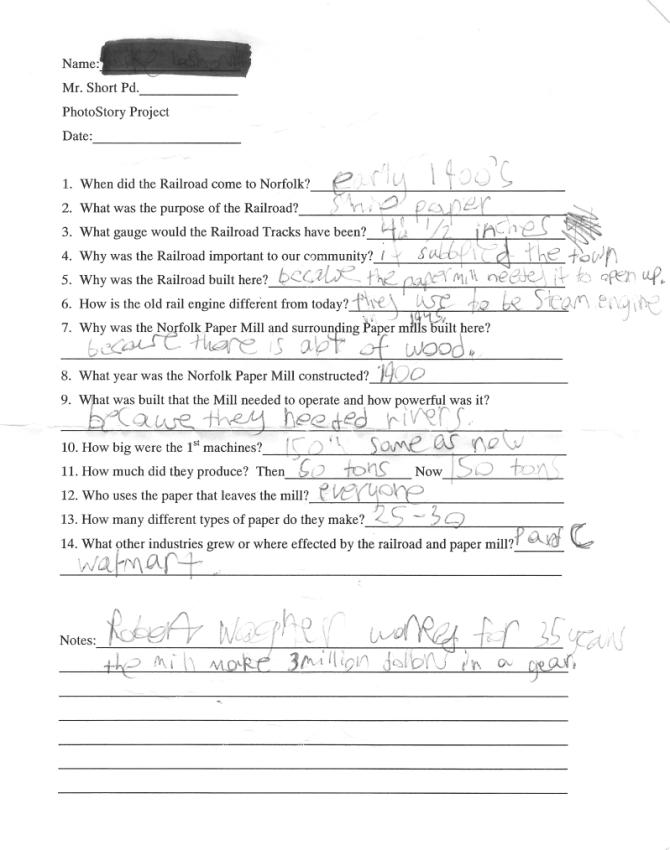 Photostory Sample Two
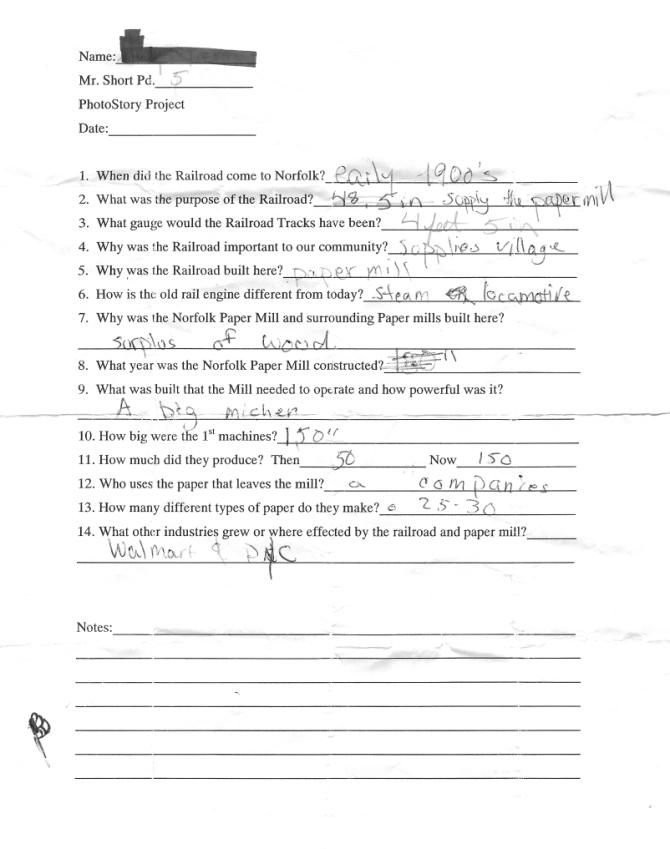 Photostory Sample Three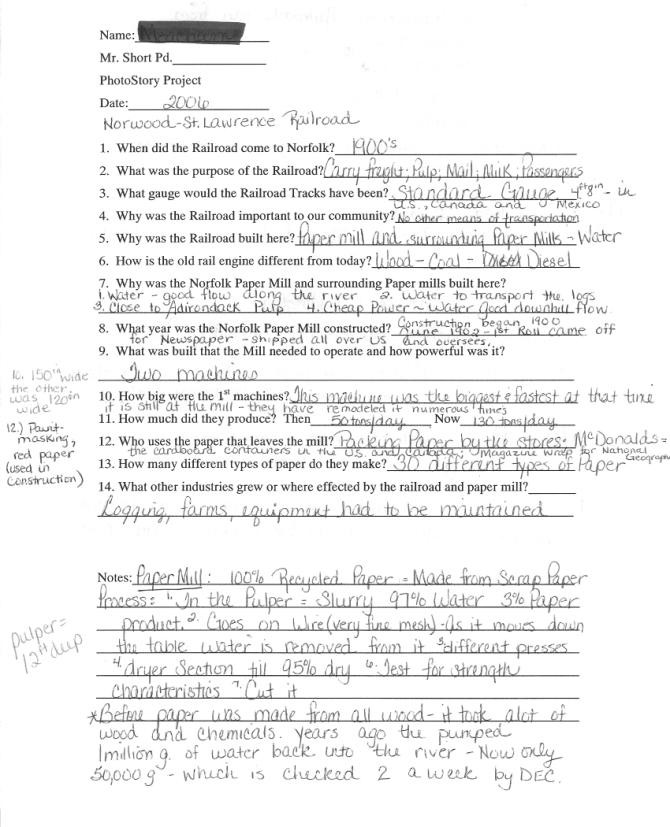
Related Resource
Textbook by Prentice Hall The American Nation Civil War to Present (0-13-181765-5)
Digital Cameras (Recommend at least 3)
Computer Lab
Photo Story 3 (free www.microsoft.com
download for Windows XP)
Laptop computer with projector
Microphone
Headphones