Assessment
Project Rubric
Learning Context/ Introduction
This unit is grounded in color theory and graphic design. It features American quilt design as inspiration. This unit culminates in a painted example of a quilt design with a specific color scheme that will be displayed at an open house.
Duration
This unit will take 10-13 periods of 42 minutes each.
Essential Question
How does color choice change the pattern or emotional mood of a quilt?
Instructional/Environment Modifications
Instructional/Environmental Modifications include all those, which are stipulated by student recommendations. I find that all students of varied skills and abilities are able to complete all work as assigned. Color blindness may create difficulties but frequent checking of work by the teacher will eliminate any problems.
Procedure
Day 1 Introduce color by watching a video called "Color For The Artist" -EVN Film, or something similar. Explain the Color Wheel and draw diagram. (See Related Resources) Review the additive system used in computers and the subtractive system used in paint. Note that the primary colors are red, yellow and blue in paint but explain that the correct set of hues is magenta, cyan and yellow.
Draw a color wheel diagram and label. There are many ways to draw one. (See Related Resources) Label the colors: primary, secondary and intermediate colors. The value scale diagram for painting tints and shades.
Day 2 Continue from Day 1 and explain the process of painting including how to properly wash a brush, mix colors.
Paint the primary color triad in the labeled areas. Check for accuracy. Use newspapers on the table.
Day 3 Demonstrate how to mix any two primaries to create a secondary color. Review the primary colors and explain that secondary colors should be painted between the correct primaries. Point out how to paint a clean line, clean up procedures and suggest that left over paint could be used for an extra credit painting or for experimentation.
Day 4-5 Demonstrate mixing intermediate colors. Each of the twelve hues should look distinct. Explain how the intermediate colors are hyphenated colors, which are mixed from a primary and a secondary color. In the name, the primary color is always written first. For example Red-Orange. Have the students paint in the intermediate colors.
Day 5
Finish color wheel completely. Then, pick your favorite color and paint it in the center shape on the diagram below. Mix tints two steps lighter and shades two steps darker. It is recommended that tints are on the right, and shades on the left. Remind students that they must have a clean brush to mix a tint or a shade. If white and black is mixed with a color the result is a tone, or a grayed color.
Day 6 Review work and give quiz. (see Related Resources)
Day 7 Present the Colorful Quilt PowerPoint.
Discuss colors and encourage questions. {Point out color emotions and color symbolism)
Day 8 Assign the color work sheet. Review colors by coloring in the diagram with colored pencils and then color the six quilt squares in with the six required color schemes. (see Related Resources) This could be homework.
Day 9 Show the quilt painting examples including a blank template and three variations.
Allow the students to draw their own quilt example. The assignment requires the student to draw a design and then paint it in using a specific color scheme.
Day 10-12 Design and paint the quilt pattern. Label the back with name and color scheme.
Day 13 Present quilts to class and fill out the grading rubric. Display.

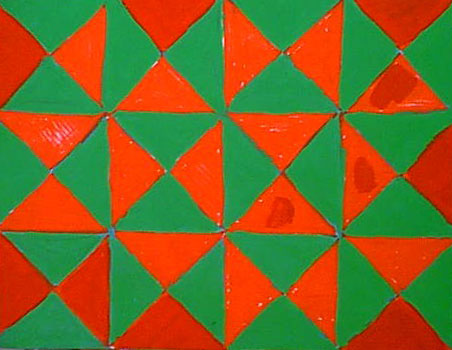
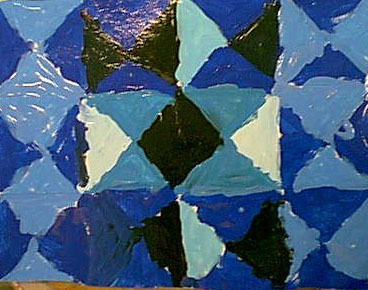 Quilt PowerPoint
Reflections and Feedback
I think that this project fulfills several of my goals in the seventh grade curriculum. Both color and light are discussed in the movie presentation. Color mixing and labeling with definition of both emotional and symbolic color are covered. Basic triads and color schemes are demonstrated and reviewed at several levels and the culminating painting is both abstract and an example of applied art. The work will be displayed at a K-12 Open House in May.
Student Work
Here are two examples of student work:
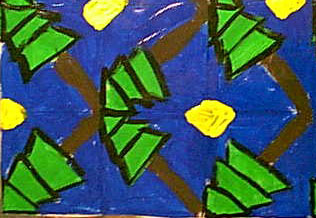
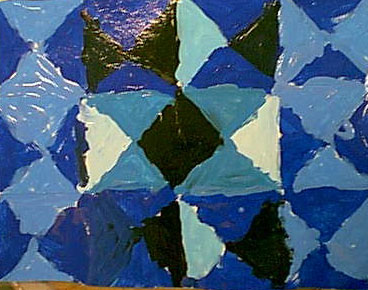
Related Resource
"Color For The Artist" -EVN Film
Educational Video Network 1401 19th Street, Huntsville, Texas 7730 Phone 1-800762-0060
Colorful Quilt PowerPoint
Handouts and Worksheets
Color Wheel DiagramColor WorksheetQuilt Block PatternColor_Quiz.doc
Description
J. Paul Getty Museum teacher resource.