Assessment
Knowledge of cultural differences assessed using Classroom Performance System (CPS).
Rubric for assessment of structured accompaniment versus improvised drumming: see attached
CPS test questionsDrumming rubric scoring definitionsDrumming Rubric Template
Learning Context/ Introduction
Students will listen to music from The Gambia, while seeing pictures of the culture and everyday life. Students will sing a Gambian song in Wolof and English, accompanying it with African drums.
Duration
Three class periods of one half hour each
Essential Question
What are some of the similarities and differences between our culture and the Gambian culture?
How do we play the African drums differently for a structured accompaniment versus improvisation?
Instructional/Environment Modifications
Preferential seating
Use of aide assistance if needed
Video projector and computer with PowerPoint
djembe and tubano style drums
Procedure
Day 1
Tell students to "buckle their seatbelts" because we are going on an imaginary trip to the tiny country of The Gambia, in West Africa. Show a world map, pointing out where your students go to school and where the airplane will have to fly to reach The Gambia. Proceed with the PowerPoint presentation:
Slide 1: The Gambia: Visiting a Country in West Africa
Slide 2: The Gambia is known as "The Smiling Coast" because people are warm and friendly.
Slide 3: Moms carry babies on their backs. Tap space bar for "Same or different?" and discuss this with the students.
Slide 4: Donkey carts are used to move stuff. Tap the space bar for "Same or different?" and discuss this with the students.
Slide 5: People also walk, ride bicycles, and take taxis. Tap the space bar for "Same or different?" and discuss with the students.
Slide 6: The market is for shopping. Tap the space bar for "Same or different?' and discuss with the students.
Slide 7: She is carrying eggs home. Tap the space bar for "Same or different?" You may want to comment that young children practice carrying an item on their heads and use one hand to steady them.
Slide 8: Children go to school
Slide 9: Students wear uniforms to school. Tap the space bar for "Same or different?" and discuss with the students.
Slide 10: Children study English. Tap the space bar, creating an arrow, which travels up to point at the word "xylophone" on the wall. Tap the space bar again for "Same or different?" and discuss with the students.
Slide 11: Fishing boats are painted bright colors.
Slide 12: Men fish on the ocean. Tap the space bar for "Same or different?"
Slide 13: People carry the fish back to shore. Tap the space bar for "Same or different?" Explain that people wade into the water up to their shoulders with a bucket and then carry the fish back to shore, where it is bought and sold.
Slide 14: The fish are dried... This slide shows baskets of fish that have been dried in the sun.
Slide 15: or smoked... This slide shows fireplaces with the fish positioned above so the smoke will rise and preserve the fish.
Slide 16: or salted. The woman is showing how she salts the fish to preserve them.
Slide 17: The kora is a large instrument with 21 strings. The photograph shows Deborah Nikkari, a music teacher in Potsdam, New York, receiving a lesson on playing the kora, a popular instrument in The Gambia. Play a recording of kora music.
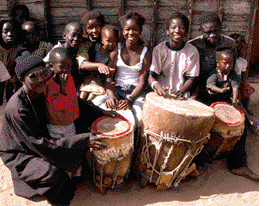
Slide 18: African Drums This photograph shows African drums in a museum.
Slide 19: Another African instrument is the balaphone. The teacher may want to discuss how this is similar to a xylophone. Play a recording of balaphone music for the students to hear.
Slide 20: Goodbye from the "Smiling Coast" of The Gambia
S
Slide 21: Acknowledgements
Slide 22: The End
Use the remaining time in the class period to show and have the students try out some African instruments. Show them the djembe, the tubano (made by the Remo company and resembling a conga drum), the talking drum, and the kora. Play more recordings of the talking drum and the kora.
Day 2
Ask students if they can remember the name of the country they "visited" in the previous music class. After repeating the name of the country, The Gambia, tell the students that they are going to learn to sing a song in Wolof, one of the languages spoken in The Gambia. The song lyrics are about fishing on the ocean. When the men get enough fish to fill the boat, then they can go home to Kombo, the name of their home region. Have the words to the song written on two posters, one in Wolof and one in English. Hang them in front of the class. First echo speak the words: Gal gange rebi, gal gange rebi, Eleg soubotell den deme Kombo. Then echo sing the words with the students. Finally sing the entire song. Sing it again and add three patsches (lap pats) at the end of each phrase in the rhythm of two eighth notes and a quarter note. Then echo sing the song in the English version, substituting the name of your own town for Kombo. "Fish are jumping, fish are jumping, Early in the morning we'll go back to ___________." Sing the English version again, adding in the patsching at the ends of the phrases.
You can explain to the students that the children in Kombo sing this song when they are coming home victorious from a soccer game. Have them imagine that they have just won an important soccer game and have them sing the song with pride.
Next, demonstrate to the students how you would like them to play the djembe or the tubano as an accompaniment to the song, substituting the drum sounds for the patsching. Then have a volunteer student demonstrate for the rest of the class. Have the student sit down and then ask the class if they can tell you what it means to improvise. (My class had previously improvised on the djembe and tubano drums)
Review that improvising means making up your own rhythms and patterns on the instrument. Have the students count out from one to sixteen in steady beats while the teacher demonstrates improvising on the djembe or the tubano. Then have a student improvise on the drum while the rest of the class counts to sixteen. Ask students to use both hands on different parts of the drum head and avoid playing only on the beat. They are to improvise their own rhythms. Take turns having students play and improvise while the rest of the class sings the song in Wolof and in English. Videotape the drumming for future assessment.
Day 3
Review the PowerPoint presentation on the Gambia, without spending too much time on each slide. Have the students tell the rest of the class what is happening in each slide. Explain the use of the "remote" in the Classroom Performance System. Indicate to students where the remote should be pointed and emphasize the need to think before choosing an answer. Also, remind students there should be no talking during a test. Administer an easy pretest to give students a chance to practice. Then administer the actual CPS test to the class.
 Gal Gange Rebi (Fish are Jumping) sheet musicThe Gambia Powerpoint
Reflections and Feedback
The students really enjoyed "visiting" another country through the use of PowerPoint.
One student said she wanted to visit China next.
When I do it again, I might choose to assess the memorization of the lyrics and melody of "Gal Gange Rebi" rather than assess the drumming.
I wrote the English lyrics for the song in this lesson, but the actual translation from Wolof to English is: "Boat is hunting, boat in hunting, tomorrow early in the morning we will go back to Kombo."
Student Work
Answers to CPS questions.
Demonstration of structured accompaniment and improvised play on drums. See attached sample
Student Sample Video 1Student CPS sample resultsStudent Sample Video 2Student 1 RubricStudent 2 RubricStudent 3 Rubric
Related Resource
djembe
tubano or conga type drums
CD: "True West African Sounds" Produced by Mformula, P.O. Box 2735 S/K The Gambia
CD: "Tama Talking Drum" Produced by Mformula, P. O. Box 2135 S/K the Gambia
Acknowledgements
The traditional song, "Gal Gange Rebi," taught to Deborah Nikkari by kora player, Jalikebba Kuyateh, Tanje Museum, The Gambia, on April 22, 2005