Learning Experience/Unit
Phases of Matter by St. Lawrence-Lewis BOCES
Course, Subject
Chemistry, Math, Science & Technology
Grade Levels
Commencement, 9th Grade, 10th Grade, 11th Grade, 12th Grade
Assessment
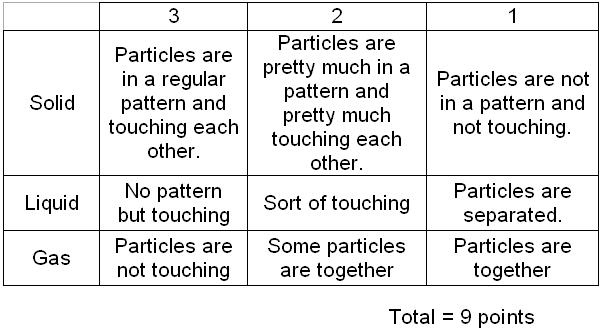
A rubric will be used to evaluate student drawings that depict the three phases of matter.
Learning Context/ Introduction
This lesson is focused on helping the students understand the phases of gas, liquid and solid on the molecular level. Phase changes and intermolecular attraction are necessary components.
Duration
Day 1: 40 minutes
Day 2: 40 minutes
Essential Question
How can you compare and contrast the states of matter (gases, liquids, and solids) by how the particles are arranged?
Instructional/Environment Modifications
None
Procedure
Day one:
- PowerPoint will be used to introduce the topic.(20 minutes)
- Video of molecular movement will be used to reinforce concepts (20 minutes) (World of Chemistry-States of Matter 1990).
Day two:
- Students will be assigned to groups and each group will have a phase to draw. Each student draws their assigned phase individually (10 minutes).
- The group determines the best drawing using "Spend a Dollar." In this activity, each student is given 10 dimes. They must spend their dimes on at least two drawings. The spending occurs all at one time. The drawing with the most dimes is selected for projection (5 minutes).
- The student selected projects their drawing using the Interwrite for the class to see (15 minutes).
- Quiz: Each student draws each phase individually on a quiz paper. These are collected for evaluation (10 minutes).
States of Matter.ppt
Reflections and Feedback
This lesson seemed to work quite well.
Student Work
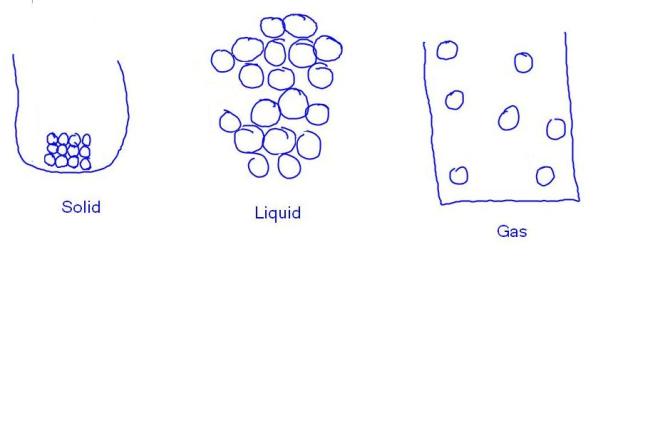
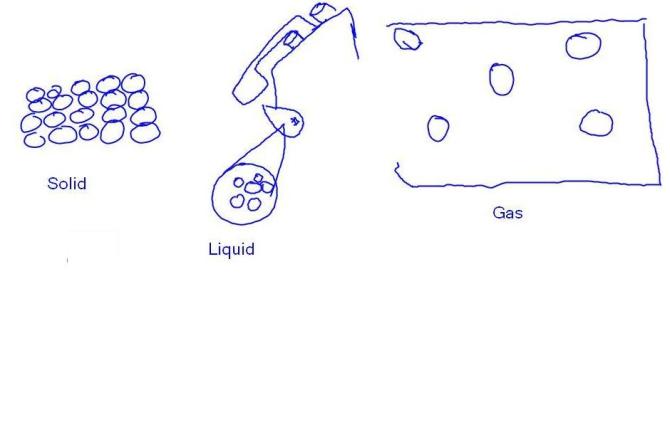
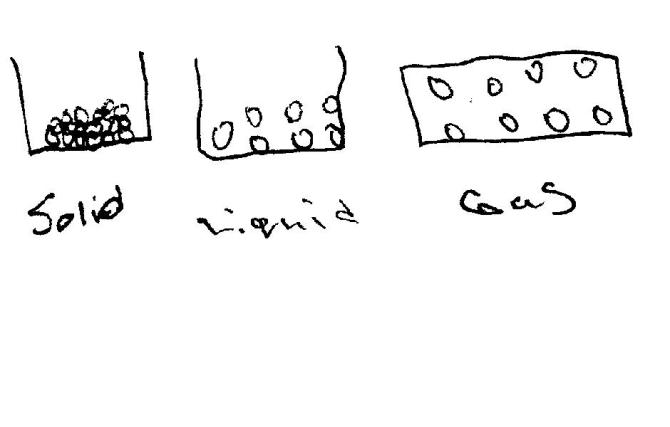
The following are examples of student work
Related Resource
The World of Chemistry for High School video series - States of Matter