Learning Experience/Unit
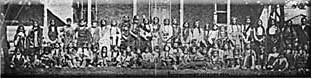
Indian Boarding Schools: Civilizing the Native Spirit
Grade Levels
Intermediate, Commencement, 6th Grade, 7th Grade, 8th Grade, 9th Grade
Assessment
Completion of Student Research Worksheet on boarding schools.
Completion of the Photograph Analysis Worksheet.
Completion of the Document Analysis Worksheet.
Completion of "My Gallery" Activity Worksheet.
Completion of "My character believed..." Worksheet.
Completion of written journal entries.
Completion of student evaluation form.
Evaluation of the journal entries by a rubric.
Learning Context/ Introduction
In the late 1800s, the United States supported an educational experiment that the government hoped would change the traditions and customs of American Indians. Special boarding schools were created in locations all over the United States with the purpose of "civilizing" American Indian youth. Thousands of Native American children were sent far from their homes to live in these schools and learn the ways of white culture. Many struggled with loneliness and fear away from their tribal homes and familiar customs. Some lost their lives to the influenza, tuberculosis, and measles outbreaks that spread quickly through the schools. Others thrived despite the hardships, formed lifelong friendships, and preserved their Indian identities.
Through photographs, letters, reports, interviews, and other primary documents, students explore the forced acculturation of American Indians through government-run boarding schools.
Part One (2 days)
- Discuss with students the subject, activities, and expected outcomes for this activity.
- Introduce the American Memory collections to the students.
- Introduce students to primary sources by using What are Primary Sources?
- Use What Do You See? to model photo analysis. Students complete Photo Analysis Worksheet as teacher models.
- Use How Does It Read? to model text analysis. Students complete Document Analysis Worksheet as teacher models.
Photo Analysis WorksheetDocument Analysis Worksheet
Part Two (2 days)
- Have students research the establishment and implementation of Indian boarding schools by completing the Student Research Worksheet.
- Direct students to the annotated Resource Page.
- Encourage students to search the American Memory collections for additional information.
- Have students use Suggested Search Words that would have been used during that time period.
Part Three (1 - 2 days)
- Using the Gallery of Pictures on the Student Page, direct students to view pictures from Appearances, Dwellings, and Daily Life and Customs.
- Students select a picture from Gallery A and its corresponding picture in Gallery B to analyze using the Photo Analysis Worksheet.
- Students select a document from Journal Resources and analyze it using the Document Analysis Worksheet.
- Students create their own gallery to illustrate the change that was expected of the children when they attended the boarding school.
Photo Analysis WorksheetDocument Analysis Worksheet
Objectives
While completing this unit, students will:
gain respect for differences in cultures;
be active questioners and critical readers while analyzing primary documents;
develop an understanding of issues related to the forced acculturation of American Indians into the American culture; and
examine different perspectives of the "Indian problem" in relation to the education of American Indian children.
Procedure
The procedure for this learning experience consists of six parts. This project is intended to encourage students to reflect on the multiple facets of an historical event such as the forced acculturation of the Native Americans during the late 19th and into the 20th century. There were many differing points of view on the "Indian problem," and how it could be solved.
Students learn to view photographs and text with a critical mind. They research issues involved in creating and administering Indian boarding schools. Finally, they investigate an individual or group of individuals who participated in these schools.
After exploring the pictures and written records of the individual(s) chosen, students assume the identity of the person(s) and write in a journal, and exchange their journals with other students who respond as their person would have responded.
Part Four (1 - 3 days)
- After completing the text analysis, students again use the Journal Resources to research the various individuals or groups of individuals who were associated with Indian boarding schools.
- Students select one person or group of people on which to focus.
- More can be learned by students about their choice by selecting the text and reading the source material in more depth.
- Students should also search the American Memory collections for more information on their chosen people.
- To record the language, opinions, and beliefs of their person students complete the worksheet "My character believed..."
- In order to accurately portray their person(s) remind students to determine the following:
- What was the person's view and opinion on the value of boarding schools?
- What would they have had to say concerning a solution to civilizing the Indian?
- Would they have supported or discouraged the establishment of these schools?
- What terms, phrases, opinions, and justifications would have been used by their person(s)?
Part Five (1 - 2 days)
- Students assume the role of their character and write in a journal responding to a teacher selected question. See Selected Questions
- Students must stay 'in character' as they write.
- It is helpful for students to have their research materials and "My character believed..." worksheets available to use as reference when they write.
- Allow students time to reflect and compose.
- After writing, students exchange their journal with another classmate and respond to their journal entry.
- Exchange as many times and with as many different individuals as time allows. It is more interesting if new questions are introduced periodically during the exchange.
- On the final entry each student steps out of character and writes his or her own opinion of the attempt to "civilize the Native Spirit."
Part Six (1 day)
- This time may be used for reflections and student evaluation.
- Students complete the Student Evaluation Form.
- Students turn in their Exchange Journals for teacher evaluation.
- Student Evaluation
- Exchange Journal Rubric
Resources/Materials
See the Resources Page for a complete list of the online, print, and media sources used for this lesson.
See the Student Page for a complete list of student resources.
Extension
- Read more about the history of the American Indian in Immigration...The Changing Face of America on the Learning Page's "Features" section.
- Design a yearbook for an Indian boarding school of your choice. Choose a school year from 1887 to 1945.
- Debate the following statement. Native Americans benefited from attendance at boarding schools.
- Write a letter home as a boarding school student.
- Investigate past or present attempts of forced assimilation in other cultures.
- Map the locations of American Indian boarding schools in the United States.
- As a boarding school superintendent, design an annual school report to be sent to the Commissioner of Indian Affairs.
- Write an essay as if you were the director of a boarding school today. How would you operate it? Include subjects taught, daily schedule, and extra-curricular activities. Compare your school to Native American boarding schools in existence today.
Duration
10 class periods of 45 minutes each
Author
Niki Childers and Gayle Lawrence
Source
Reproduced from the Library of Congress web site for teachers. Original lesson plan created as part of the Library of Congress American Memory Fellows Program.