Assessment
Informal feedback of Session 2 using the Classroom Performance System (CPS) unit.
Rubric used for student worksheet - see attached.
Learning Context/ Introduction
“Putting Pitch In Its Place” is a group of lessons which focus on reading musical notation. Students will see, hear, practice, and write notation in these lessons to become more independent readers of music.
Because of such limited time in the music classroom and chorus rehearsals, I am guilty of teaching music mostly by rote. My hopes are that my 4th grade students will begin to make visual and aural connections to the progression of pitches and its placement on the music staff. They will then become more independent readers of music before 5th grade where they have the opportunity to participate in instrumental music.
I have purposefully eliminated the rhythmic values in the written work because these introductory lessons deal only with pitch placement. It would be beneficial at some point of the follow up lessons to reintroduce the rhythms. Further lessons should also add different placement of the scale (as in different keys), and actual letter names of the written notation.
Duration
Each of these sessions was designed for about 10 to 15 minutes of four consecutive classes. Because I see these students once every six day cycle, I spent additional time reviewing our previous week's lesson.
Essential Question
How do you signify changing pitch within the musical notation of a song?
Procedure
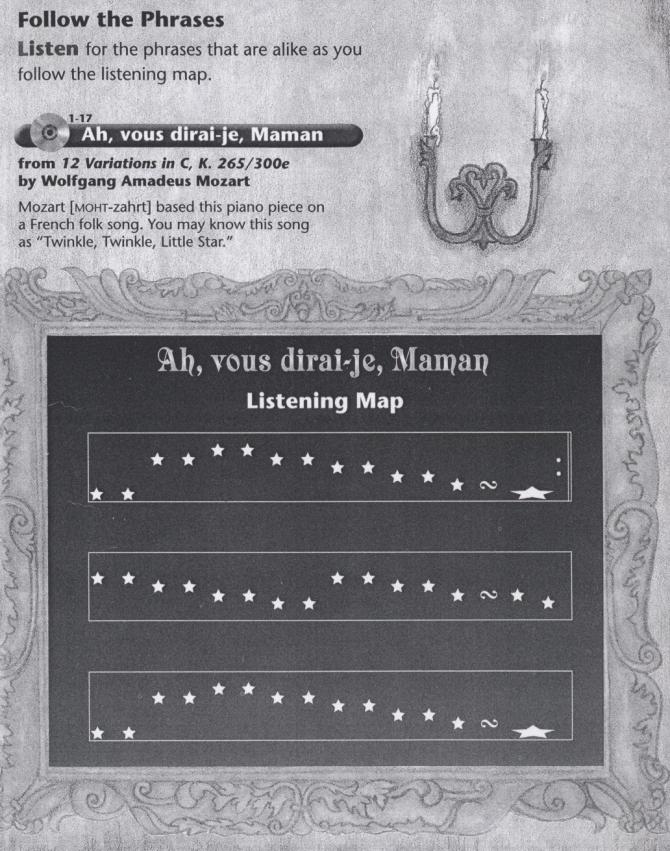
First session: SEE IT! A musical map of “Ah, vous dirai-je, Maman”
Students will listen to Mozart’s arrangement of “Twinkle, Twinkle Little Star” and follow the musical map in the textbook. Students will notice that each sound receives its own star. Also, the stars move across the page in a fashion to match the direction of the melody (moving up, down, or across).
Second session: HEAR IT! A task for CPS
Students will complete an aural exercise on the Classroom Performance System (CPS) unit. The questions ask the students to determine the direction of sounds between specified words or syllables to the songs “Buffalo Gals” and “Erie Canal”. (Using the CPS unit allows the students’ answers to remain anonymous, yet it provides immediate feedback to them as to what the answer is).
Third session: PRACTICE IT! Playing dulcimers
Students work in pairs strumming both upward and downward scale passages on the classroom dulcimers. We use the numbers one through seven to designate each tone of the scale (the top pitch of the scale is named “high one”).
Students are then reminded that melodies are made up of tones of the scale that follow upward and downward pitch patterns, and sometimes stay the same. They are shown on the chalkboard what some tonal patterns of familiar choral warm-ups look like on the staff. The class identifies and applies numbers to each note head. Because we are focusing all our lessons on melodic pitch movement, rhythms are omitted from any of the written music.
Then students are provided with our chorus piece, "African Praise Noel", which is rewritten to show numbered pitches on the music staff corresponding to the melodies. Students practice the melodies on the dulcimer.
Fourth session: Putting Pitch in its Place! Writing note heads
Students will identify pitch number and draw note heads on the music staff using the melody of "Dry Bones" (see attached worksheet). First, as students sing, they identify the pitch number of each syllable, placing the number next to that syllable. Next, the student draws the note head on the staff directly above the syllable. (A key is given at the top to show the placement of the note heads on the staff.)
The first three phrases are done as a class activity, while the last phrase is done independently. This activity will be assessed by a rubric based on accuracy and neatness.
dulcimer practiceCPS lesson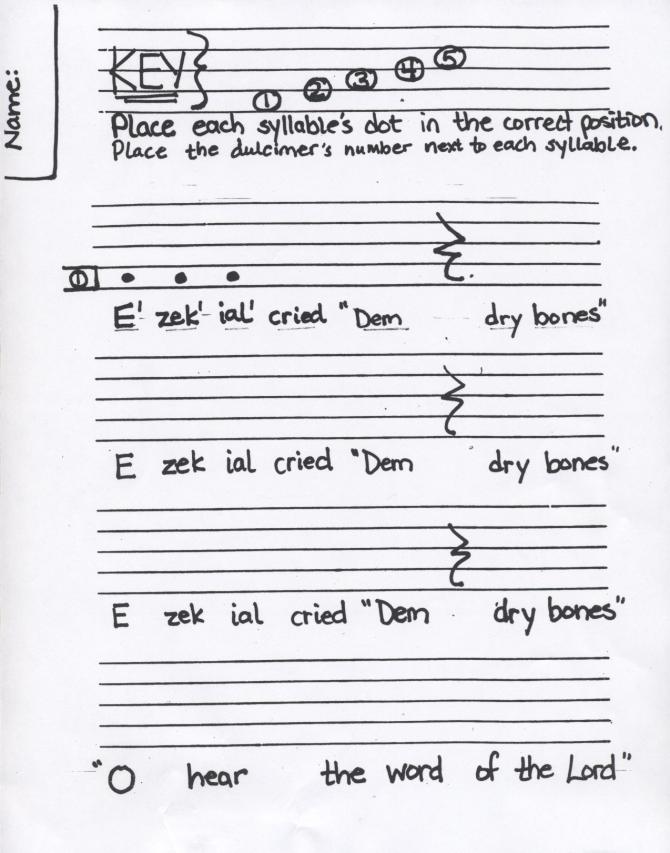
Reflections and Feedback
This learning experience is only a beginning to note reading. Note reading needs to be reinforced each and every music class and chorus rehearsal. In future lessons, I intend to introduce students to different placements of the pitch on the staff (different keys) and actual pitch names. Also, when we finally look at actual sheet music or examples from the book, rhythm will be reintroduced into the actual notation.
I find the dulcimer is a unique tool which offers a fun, hands-on means of learning music. My students really enjoy using the dulcimers. They are expected to play and sing at the same time, and the partner that is not playing is instructed to sing along and give helpful advice to the one who is playing. Because the dulcimer is a diatonic instrument that sounds a drone, I find my students develop a great ear for the tonic and dominant pitches in any music.
Using the CPS unit was a fun way for the students to check their own work. Because I was learning the CPS unit along with the children, I did not formally assess their answers, but it did provide the students with instant feedback. I would like to use the CPS in the future for assessment purposes, even with different units of study.
Student Work
Students will complete the worksheet by naming each syllable with the proper number correlating to the scale, and by drawing the corresponding note head. The worksheet is completed phrase by phrase, first with guided practice and finishing with independent work. See attached samples.
Student 1Student 2Student 3Student 4
Related Resources
Classroom Performance System (CPS unit) manufactured by eInstruction. Each student has a wireless device that remotely inputs their own personal answer and is recorded through the computer. Go to the web site for further description.
Silver Burdett and Ginn "World of Music" Grade 3 and Grade 5
Silver Burdett "Making Music" Grade 3
"African Praise Noel". A Liberian Folk Song arranged by Cristi Cary Miller and published by Hal Leonard.
"Dry Bones". A Traditional Spiritual arranged by Dave and Jean Perry and published by Alfred.
Website(s)
eInstruction