Learning Experience/Unit
To Kill a Mockingbird: A Historical Perspective
Subject
English Language Arts (2005), Social Studies
Assessment
Student evaluation will be based on:
- Completion of all writing assignments:
- town poem
- found poem
- editorial
- response to oral history interview
- comparison/contrast thesis-based essay;
- An objective test on the novel;
- Active participation in all class discussions.
Learning Context/ Introduction
Students gain a sense of the living history that surrounds the novel To Kill a Mockingbird. Through studying primary source materials from American Memory and other online resources, students of all backgrounds may better grasp how historical events and human forces have shaped relationships between black and white, and rich and poor cultures of our country.
This unit guides students on a journey through the Depression Era in the 1930s. Activities familiarize the students with Southern experiences through the study of the novel and African American experiences through the examination of primary sources.
Objectives
Students will:
- learn about the history of African Americans in the South through analysis of historical and literary primary source photographs and documents;
- demonstrate visual literacy skills;
- master research skills necessary to use American Memory collections;
- be able to distinguish points of view in several types of primary sources;
- be able to identify literary devices and figurative language in historical documents and personal narratives;
- demonstrate the technique of recording oral histories; and
- write creative works that reflect the themes of racism, compassion, and tolerance in To Kill a Mockingbird.
Procedure
The procedure for this learning experience consists of the following parts:
Part I: Navigating American Memory (1 day) - developing search strategies.
Part II: Historical Understanding of Setting (2 days) - visual literacy activity with photographs of Alabama during the Great Depression.
Part III: Exploring Oral History (3 days) - analysis of oral histories from Alabama collected between 1936-40.
Part IV: Writing Connection (1 day)- create a town poem based on photographs in Part II.
Part V: Getting into the Novel (3 days)- reading first 10 chapters with activities building on Parts II and III.
Part VI: Mob Justice (4 - 5 days)- continued reading of the novel with parallel primary source readings on mob behavior and lynching.
Part VII: Justice in the Courts - continued reading of the novel.
Part VIII: Pulling it all Together - students complete one or more culminating activities.
Student Work
An example of the timeline.
Part I: Navigating American Memory
- Familiarize the students with computer lab policies and introduce them to American Memory.
- Broad Search Activity
- Ask students to do a search of American Memory using the keyword "The Great Depression" and list which collections contain information. Select "Match all these words" to search on the entire phrase.
- Ask students to evaluate whether the resources returned in the search cover the Great Depression of the 1930s.
- Narrow Search Activity
- Ask students to do a search of America from the Great Depression to World War Two: Photographs from the FSA-OWI, 1935-1945 and identify photographs documenting the African-American experience of 1935-1940.
Note:The collection has two sections: color and black and white. Each section has its own search page, although the collections can be searched together. It is usually better to search each section separately since the subject terms for the two groups of photographs were assigned at different times and used different conventions.
The color section has a subject index that will list images under the subject heading, African Americans. The black and white section does not have this subject term. To find items, students must brainstorm other words for African American and use the Search by Keyword function. The keyword "negro" will find 100 'hits' in the section.
Part II: Historical Understanding of Setting
- Students view photographs from America from the Great Depression to World War Two: Photographs from the FSA-OWI, 1935-1945 in American Memory. (Students should be given time to browse this collection, then select one photo for careful analysis.)
- Direct students to go from the main home page to the home page for the black and white photographs. From there they should select the State and Country Index. From the State and Country Index, they should browse through photographs from three locations:
Alabama-Dallas County-Selma
Alabama-Eutaw
Alabama-Greensboro
- After browsing through these images, students should select one photo for careful analysis. They should use the "Visual Literacy Guide" (see below) for their analysis. If time allows, students should browse some of the other photographs in this collection.
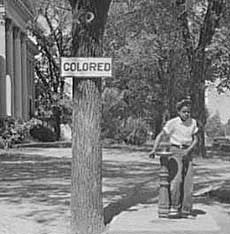
- The Prints and Photographs Division of the Library of Congress also has a collection of images entitled Photographs of Signs Enforcing Racial Discrimination: Documentation by Farm Security Administration- Office of War Information. (A link to this collection is in the descriptive text on the America from the Great Depression to World War Two: Photographs from the FSA-OWI home page for the black and white photographs.) Ask students to read the information explaining the nature of the photo collection then review the photographs. They should select one and use the Visual Literacy Guide for their analysis.
Part III: Exploring Oral History
- Ask an oral historian to speak to the class on the value of oral history as a research tool and as a vehicle for passing history from one generation to the next.
- Review with students the concepts of open and closed questions and what kinds of questions best serve the oral historian.
Note: Folklife and Fieldwork: A Layman's Introduction to Field Techniques, by the American Folklife Center at the Library of Congress, has pointers for conducting oral history interviews.
- Take the students online to American Life Histories: Manuscripts from the Federal Writers' Project, 1936-1940 and read about the collection.
- Take the students through the Special Presentation: Voices from the Thirties. Begin with the Introduction: "Who Were the Federal Writers and What Did They Do?"
- Download and print I's Weak an' Weary from American Life Histories, 1936-1940. The class should read this document and determine voice, time, and place.
- Working in groups of 2 to 3 students, ask students to read oral histories from WPA Life Histories from Alabamaand complete the Oral History Guide.
Suggested readings:
- From the oral histories reviewed, ask students to create an original work, either a found poem or an interpretive reading, from the materials they have reviewed. They may use one or a combination of readings. They must capture the voice of the selection and perform their original material in an open mike setting.
Part IV: Writing Connection
Students create a "Town Poem" from their observations of the photographs in Part II. The Town Poem handout below provides directions for the assignment.
Note: For more information on Town Poems, consult The Triggering Town: Lectures and Essays on Poetry and Writingby Richard Hugo.
Part V: Getting into the Novel
- After reading the first three chapters of the novel, students should refer back to their notes on the photographs they viewed from America from the Great Depression to WWWII, Photographs from the FAS-OWI in American Memory and Photographs of Signs Enforcing Racial Discrimination: Documentation by FSA-OWI Photographers
- Review Harper Lee’s descriptions of Maycomb and discuss pictures from the collection that could be scenes from Maycomb.
- Ask students to reflect on the oral histories studied in Part III and compare the language, colloquial expressions, and the vocabulary unique to the Depression Era and the Deep South to the style and dialogue in To Kill a Mockingbird.
- The first ten chapters of the novel focus on the Arthur (Boo) Radley story line with only hints of the racial unrest building around the Tom Robinson story line.
- Ask students to identify examples of discrimination against Arthur Radley.
- Draw contrasts and parallels between that discrimination and the discrimination directed toward African Americans in earlier readings.
- Begin a list of the foreshadowings of racial tension that will grip Maycomb during the Tom Robinson trial.
Part VI: Mob Justice
- Prior to reading Chapter 15, view the Emmett Till story from the Eyes on the Prize I : The Awakeningcollection.
- Students should draw parallels between the treatment of Emmett Till and the treatment of Tom Robinson regarding the charges and capture of each man.
- Follow up with a discussion of vigilante justice.
- Read Chapter 15 of To Kill a Mockingbird.
- Read an excerpt, Clippings from Some of our Leading Southern Papers, from A Sermon on Lynch Law and Rapingpreached by Rev. E.K. Love, D.D., at the First African Baptist Church, Savannah, Georgia.
- How are Love's comments on mob behavior reflected in Emmett Till's tragedy and in Tom Robinson’s experience?
- Read an excerpt from The Blood Red Record: a review of the horrible lynchings and burning of Negroes by civilized white men in the United States, as taken from the records with comments by John Edward Bruce from African American Perspectives, 1818-1907.
- Students should discuss how this article emphasizes the danger that Tom is in and the hopelessness of his case.
- Optional Timeline Activity:
- At any time during the study of To Kill a Mockingbird, creating a timeline can enhance students’ understanding of the story’s sequence of events. In addition, the timeline gives students an opportunity to physically organize historical events and people mentioned in the novel.
- The timeline can span from 1890 to 2000. It should be large enough to be seen from any part of the room. For our purposes, our timeline was positioned horizontally across the front of the room, divided into decades, and color-coded so that literary happenings could be distinguished from historical events.
- During the portion of the book that recounts Tom Robinson’s wait for his trial and the formation of a mob outside the jail, the timeline is especially effective for demonstrating to students how pervasive and longstanding the record of violence against African-Americans has been.
- Students should use African-American Perspectives, 1818-1920 and enter the Timeline of African American History, 1852-1925 for 1881 - 1900 and 1901 - 1925.
- Ask students to note the number of lynchings that occur during those years on black cards with white tags and attach them to the timeline. When the students have attached all the cards to the timeline, ask them to calculate the total number of lynchings that took place between 1880 and 1925. Ask students how the crime of lynching relates to the story and how it affects Tom Robinson.
- Ask students to read Eleanor Roosevelt's letter against lynchings from Words and Deeds in American Historyin American Memory. They should consider the following questions:
- What is her position on the issue of lynching?
- What is the tone of her letter?
- What words or phrases strengthen her argument?
- After students have read passages from Love's sermon, the Chicago Tribune's accounts of violence at the turn of the century, and Eleanor Roosevelt's letter of 1936, and have seen the documentary of Emmett Till's death in 1955, ask them to compose a "Letter to the Editor" to express their own perspectives regarding prejudice and violence.
- If their letter is in response to one of these historical documents, they should assume the writing style and tone of that specific time period.
- If students prefer, their letter could explain how they feel about recent occurrences of racial violence. As an example they could refer to Dr. Raymond Crump Howard's letter to the editor published in The Independent Record in Helena, Montana on November 14, 1996. Dr. Howard expresses his response to an incident on Halloween night when young people dressed as Ku Klux Klan members assaulted a couple on the street.
Part VII: Justice in the Courts
- After students read through Chapter 22 in To Kill a Mockingbird, ask them to read The Scottsboro Boys. They can compare and contrast the trial of the Scottsboro Boys and the trial of Tom Robinson.
- They can create a chart listing similarities and differences between:
- the charges
- the accused
- the defense
- the prosecution
- the community response
- the outcome
- media coverage
- They should then write a comparison/contrast thesis-based essay.
Part VIII: Pulling it all Together
Students should complete one or more of the following activities:
- Newsletter
Create a newsletter covering the trial of Tom Robinson, prepared by students in small groups. The newsletter should chronicle the events of the Robinson trial as well as cover related articles on similar issues of actual occurrences during the same time period.
- Oral History Interview
Observe an oral history interview of a member of their community conducted by an experienced oral historian. After the interview the students can write an account of the interview. (This exercise prepares the students to launch into a research project in which they will be taking oral histories of community members.)
The power of To Kill a Mockingbirdhas much to do with the authentic voice and simple honesty of its narrator. As a culmination to the study of this novel, it is helpful for students to realize that the intolerance described by Scout exists in every community and in every era.
Consider whether there are people in your community who have experienced prejudice during their lifetime. Look for individuals with an historical perspective on social attitudes and behaviors regarding prejudice. Invite them to take part in an oral history interview conducted in front of the class and ask their permission to tape the interview.
Prior to the oral history interview date, arrange for someone who has a background in oral history to explain the interview process to the students and to help generate questions for the interview. The day of the interview make both an audio and video recording of the interview.
Leave time for students to ask the community member any follow up questions that arose while they listened to the interview. If you plan to retain the tapes for future viewing or for creative writing opportunities, be sure to obtain written permission from the interviewee.
Resources/Materials
- African American Perspectives: Pamphlets from the Daniel A.P. Murray Collection, 1818 - 1907
- America from the Great Depression to WWWII, Photographs from the FAS-OWI
- American Life Histories: Manuscripts from the Federal Writers' Project, 1936-1940
- Words and Deeds in American History: Selected Documents Celebrating the Manuscript Division's First 100 Years
- The Scottsboro Boys Trial
- Southern Poverty Law Center
- A View from a Helena Black by Dr. Raymond Howard
- Brown, Sterling A. "Strong Men" from Collected Poems of Sterling A. Brown. Evanston, Ill.: TriQuarterly Books, 1996.
- Chura, Patrick. "Prolepsis and Anachronism: Emmett Till and the Historicity of To Kill a Mockingbird." Southern Literary Journal. (June 2000): 1-26.
- Douglass, Frederick. A Child's Reasoning, Chapter VI of Life and Times of Frederick Douglass. Hartford, Conn.: Park Publishing Co., 1881. Documenting the American South, University of North Carolina at Chapel Hill Academic Affairs Library.
- DuBois, W.E.B. The Souls of Black Folk. New York: Bantam Classic, 1989. University of Virginia Electronic Text Center.
- Eyes on the Prize: America's Civil Rights Years, Part I: The Awakening. New York, NY: Viking, 1987.
- Feelings, Tom. Middle Passage: White Ships and Black Cargo. New York: Dial Books, 1995.
- Haley, Alex. Roots. Garden City, N.Y.: Doubleday, 1976.
- Hughes, Langston. The Negro Mother and Other Dramatic Recitations. Freeport, N.Y.: Books for Libraries Press, 1971.
- Hugo, Richard. The Triggering Town: Lectures and Essays on Poetry and Writing. New York: Norton, 1979.
- Jacobs, Harriet A. Incidents in the Life of a Slave Girl. Boston: Published for the Author, 1861. Documenting the American South, University of North Carolina at Chapel Hill Academic Affairs Library.
- Juneteeth Pictorial: Middle Passage
- Lee, Harper. To Kill A Mockingbird. Philadelphia: Lippincott, 1960.
- Mr. Lincoln's Virtual Library, American Memory.
- Northup, Solomon. Twelve Years a Slave: Narrative of Solomon Northup, a Citizen of Newark, Kidnapped in Washinton City in 1841. Auburn, N.Y.: Derby and Miller, 1853. Documenting the American South, University of North Carolina at Chapel Hill Academic Affairs Library.
- Randall, Dudley. "Booker T. and W.E.B." in Danner, Margaret and Dudley Randall. Poem Counter Poem. Detroit, MI.: Broadside Press, 1969.
Extension
Multidisciplinary enrichment activities:
The Roots of Slavery - readings in primary sources to provide multiple pictures of slavery and the slave trade.
The Emancipation Proclamation: Unfulfilled Promises - Using drafts of the proclamation and a speech at an Emancipation anniversary celebration, students compare promise and reality.
Opposing Perspectives on the Race Problem - Using a speech by Booker T. Washington and an excerpt of a text by W.E.B. DuBois, students debate the positions held by both men.
Struggle for Equality - Using readings from African American Perspectives, 1818-1907, students prepare a 60 Minutes-style news program.
Duration
Four to five weeks, depending on the time allowed for reading the novel. Activities range from 1 to 4 days. Several optional extension activities can affect the length of the To Kill a Mockingbird unit.
Author
Kathleen Prody and Nicolet Whearty
Source
Reproduced from the Library of Congress web site for teachers. Original lesson plan created as part of the Library of Congress American Memory Fellows Program.