Learning Experience/Unit
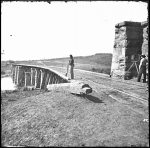
Photojournalism: A Record of War
Subject
English Language Arts (2005), Social Studies, The Arts (1996)
Grade Levels
Intermediate, 5th Grade, 6th Grade, 7th Grade, 8th Grade
Assessment
Students will be evaluated on:
- photographs they selected;
- their analysis of those photographs;
- their ability to work with a partner; and
- the completed essay "Why Photograph War?".
All photographs and observation forms can be compiled into a scrapbook as a class record of photojournalism during the Civil War.
Learning Context/ Introduction
Photography has been used to record war since the Crimean War in 1855. This unit will explore how and why war has been photographed and will also give students an opportunity to see the bias within the recording/reporting of war.
Objectives
- Explore who has photographed war and why
- Learn about Mathew Brady's process for photographing the Civil War
- Learn how photographic equipment has improved through time
- Analyze primary source war photographs from Selected Civil War Photographs, 1861-1865 and other resources
Procedure
- Introduce the unit by using a slide show of war photographs from American Memory collections or the "Civil War Slide Show ". Students will then write a rough piece (2 - 3 paragraphs) entitled "Why Photograph War?"
- Discuss the progress of the process of photography. Start with Taking Photographs at the Time of the Civil War. Mathew B. Brady: Biographical Note has information on his work photographing the Civil War. Other American Memory collections with information are:
- Model photograph analysis using [Johnsonville, Tenn. Camp of Tennessee Colored Battery] from Selected Photographs from the Civil War, 1861-1865. Students will need a copy of the photograph and the Photograph Analysis Guide . Use these techniques with students:
- Read the photograph the same way you would read a book - left to right and top to bottom.
- Look at the picture up close, then hold it farther away.
- Cover up part of the photograph to focus in on one area.
- Write down your observations, not your conclusions. For example, if you see snow on the ground, write down snow. Don't write winter. Why? You don't know that it is winter. That is a conclusion.
Ask students, "What can you conclude about photojournalism from this photograph?" After 5 - 10 minutes, students can share their findings with the entire class.
- Brainstorm categories for searching for war photographs. Some possibilities are artillery, uniforms, medical aspects, battlefields, casualties, camps, camplife, transportation, hospitals, uniforms and forts. Put students in pairs. Model searching strategies and keywords to use in searching. Demonstrate how to search American Memory photograph collections. For information on searching American Memory, see Finding Items in American Memory . See Synonym List and Search Tips for suggestions on keyword selection.
- Allow sufficient time for searching. Each group will choose 2 - 3 photographs from the collections that they will use for further analysis. For this lesson, two class periods in a computer lab were devoted to searching. Students kept a list of keywords they used that were related to their topic. They kept track of how many hits they found and what other subjects were listed for the photographs found. Selecting and printing photographs were done at the end of the second computer lab period. As enrichment, pairs could use other resources to find photographs from their category in different wars.
- Provide time to analyze the selected photographs. This should be done as pairs.
- Following analysis in pairs, students share their results with the class. Plan more than one class period.
- After listening to all groups, students return to their initial written piece "Why Photograph War?" and edit this into a finished piece, adding knowledge gained from the search activity and sharing to this essay.
Resources/Materials
Resources
- American Memory, Library of Congress
- Bradford, Mary M. "Make a Pinhole Camera" in "The Battle of Antietam, September 17, 1862." Cobblestone Magazine, 18 (October 1997), no. 7: 24-25.
- Catton, Bruce. The American Heritage New History of the Civil War. New York: Penguin Books, 1996.
- Fox, Robert. Camera in Conflict: Armed Conflict. London, England: Hulton Betty Picture Collection Limited, 1996.
- Pritzker, Barry. Mathew Brady. Avenel, New Jersey: Crescent Books, 1992.
Materials and Preparation
- Create a slide show of war photographs from American Memory collections. A slide show can be a series of photographs on overhead transparencies, or a series of Web pages linked together. For an example of Web pages linked together, see Civil War Slide Show. For information on creating such a slide show, see the How Did You Do That? GIF Animated Slide Shows workshop on the Learning Page.
American Memory collections containing war photographs are:
Choose several photographs from among the collections that depict various aspects of war or use Civil War Slide Show, composed of photographs from Selected Civil War Photographs, 1861-1865.
- For the photograph analysis activity (Procedure, step 3), copy for each student:
Extension
As an extension, this activity could be used with photographs from other wars with students comparing and contrasting what was photographed during each war.
Use this lesson as a starting point for students' own photo essay. Students use disposable cameras and take twelve pictures that would describe to the world who the student is and what is important to him/her. Since many students spend a lot of time composing some shots for their photo essay, preface this activity with a discussion about whether the Civil War photographs were posed or candid. "Does the Camera Ever Lie? ", a Special Presentation in Selected Photographs of the Civil War, 1861-1865, discusses this topic.
Duration
2 - 3 weeks, in 45 - 60 minute class periods, depending on how intensively you structure the unit
Author
Chris Fricke and Glenda Ritz
Source
Reproduced from the Library of Congress web site for teachers. Original lesson plan created as part of the Library of Congress American Memory Fellows Program.