Learning Experience/Unit
Marvelous World Of Magnets by St. Lawrence-Lewis BOCES
Subject
English Language Arts (NYS P-12 Common Core)
Grade Levels
Elementary, Intermediate, 3rd Grade, 4th Grade, 5th Grade
Assessment
Student Participation in Assessment:
Students had to complete task sheets for their research data collection and experiment results. Daily review discussions allowed the students to reflect on their collected information and make any corrections before they began their final projects. Final projects were self-assessed using a checklist.
Teacher Assessment Techniques:
The teacher made daily observes and wrote these on the students task sheets. The teacher also evaluated the students based on their participation in the group review discussions.
Final Poster Project and Writing Piece was teacher assessed using the following rubrics:
Learning Context/ Introduction
This unit was developed to expand and enrich the understanding of the science concepts of magnets and magnetism. By using technology/hyperlinking as a motivation to do research, the students accessed more in-depth information and gained a deeper understanding of magnetism. Students then used what they learned to explain the results of their
“hands on” experiment. The students also demonstrated their understanding by completing a writing piece using research vocabulary, and informational poster.
Duration
- Planning: 1 - 2 hours to organize the hyperlink site for the students, and to download “Technology At Work Two” from www.unitedstreaming.com. 1 - 2 hours to organize necessary materials/tasksheets for magnet experiments and research data collection.
- Lesson Implementation: 10 days at approximately 45 minutes per day.
- Assessment: 1 hour to rubric assess final projects.
Instructional/Environment Modifications
Teacher determines partners based on individual needs.
The computer lab needs to be organized for partners.
Final project could be partner completed to accommodate students with disabilities.
Procedure
Days 1 – 3: What is the Marvelous World Of Magnets?
- Teacher introduces the magnet unit with a KWL chart. All responses are recorded as a class. The KWL chart will be used throughout the unit as a reference for identifying accurate and inaccurate information.
- Class brainstorms a list to gather information and use of different resources.
- Teacher introduces the computer hyperlink search as a beginning step to collecting data. (SmartBoard demonstration for accessing teacher made hyperlink file is useful here for review of file retrieval.)
- Teacher assigns computer partners, and reviews with class the research task sheet titled, “Marvelous World of Magnets Project Sheet”.
- Using computers, student partners are to follow task sheet hyperlink directions and begin their magnet fact research and data collection (This may be 2 days, depending on the amount of time students have on the computers.)
- Teacher collects data sheets to assess completion and accuracy.
Day 4: What is Attracted and Not Attracted to Magnets?
- Teacher returns research sheets to students and discusses their results as a class.
- Teacher refers to the class KWL chart and asks class to identify any changes or additions that need to be done.
- Teacher introduces and reviews the magnet exploration worksheet titled, “Discover For Yourself”.
- Student partners complete the predictions and experiments and fill in data results.
- As a class, review results and have students refer to class KWL chart to identify any new additions or changes.
- Students keep data sheets in their work folders or teacher can collect them.
Day 5: How do Magnets Attract and Repel? Do Magnetic Fields Travel Through Solids and Liquids?
- Teacher reviews the poles of a bar magnet by having the students sketch and label a bar magnet.
- Teacher introduces the vocabulary of attraction and repulsion (Attract and Repel).
- Student partners make predictions, experiment and record their results using the task sheet titled, “”What Can Those Magnets Do?”
- As a class, review results and refer to the KWL chart to identify any new additions or changes.
- Students keep experiment sheets in their work folders or teacher can collect.
Day 6: Where in The World are Magnets Found?
- Teacher introduces the topic of magnet use in the world. After posing the question "How can we use magnets in the real world?," the class brainstorms a list that is recorded on a chart or the board.
- Teacher introduces a movie for the last research day and encourages students to list any additional information about magnets that they learn from the movie.
- Watch a movie on the SmartBoard entitled, “Technology At Work, Part Two”, WPBS, Discover School Channel, 2001. This movie was downloaded from the subscription site www.unitedstreaming.com, and it is appropriate for Grade 3-5, with a 28 minute running time. The movie describes the Earth as a giant magnet creating a powerful force that people can use in many ways. The movie also covers how magnets can help store info on computer disks, convert electricity into sound etc.
- Discuss movie content with reference to the class brainstorm list and the KWL chart.
- Students are to add their notetaking/research sheets to their work folders.
Day 7-10: Can You Explain The Wonderful World Of Magnets?
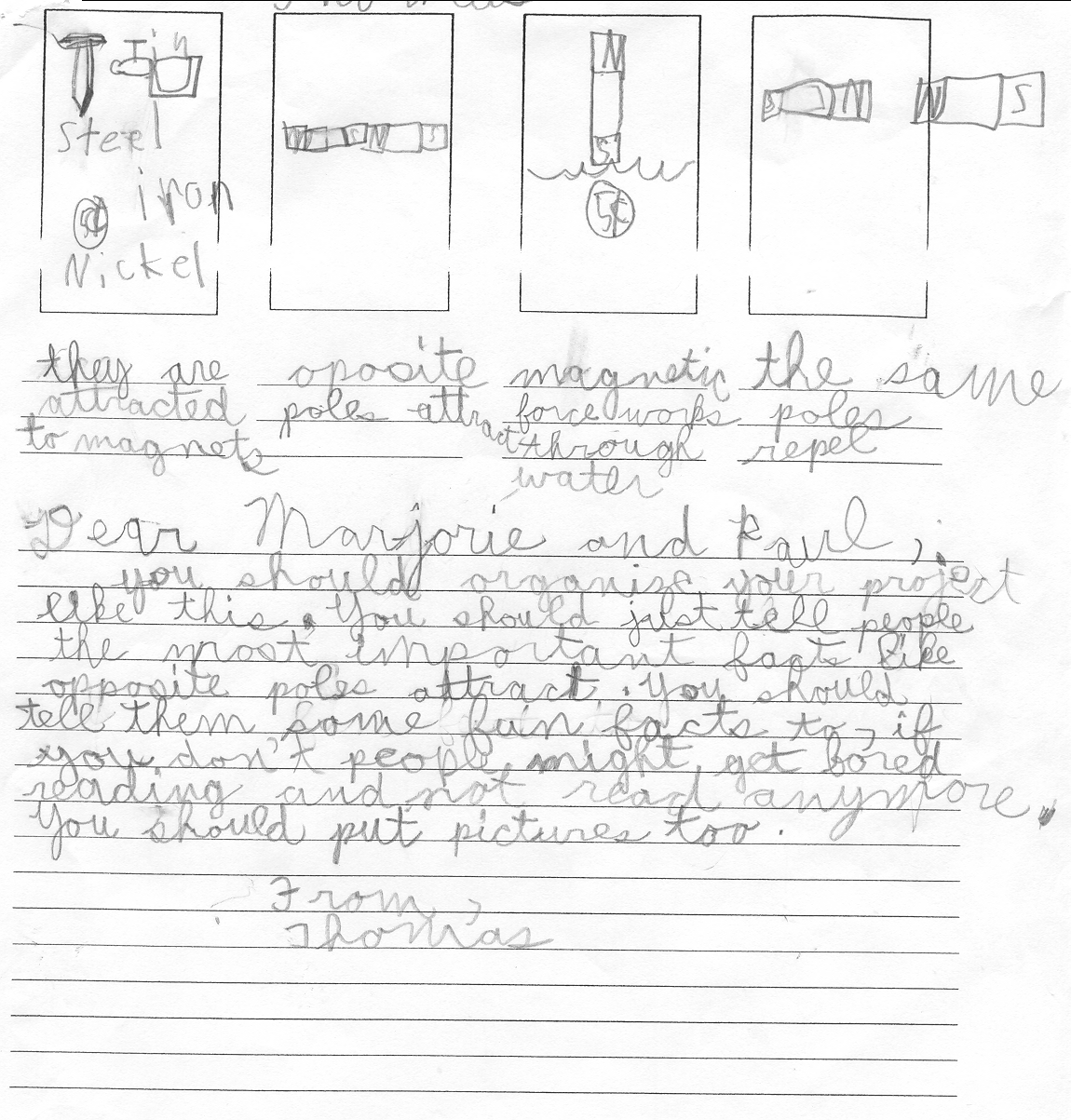
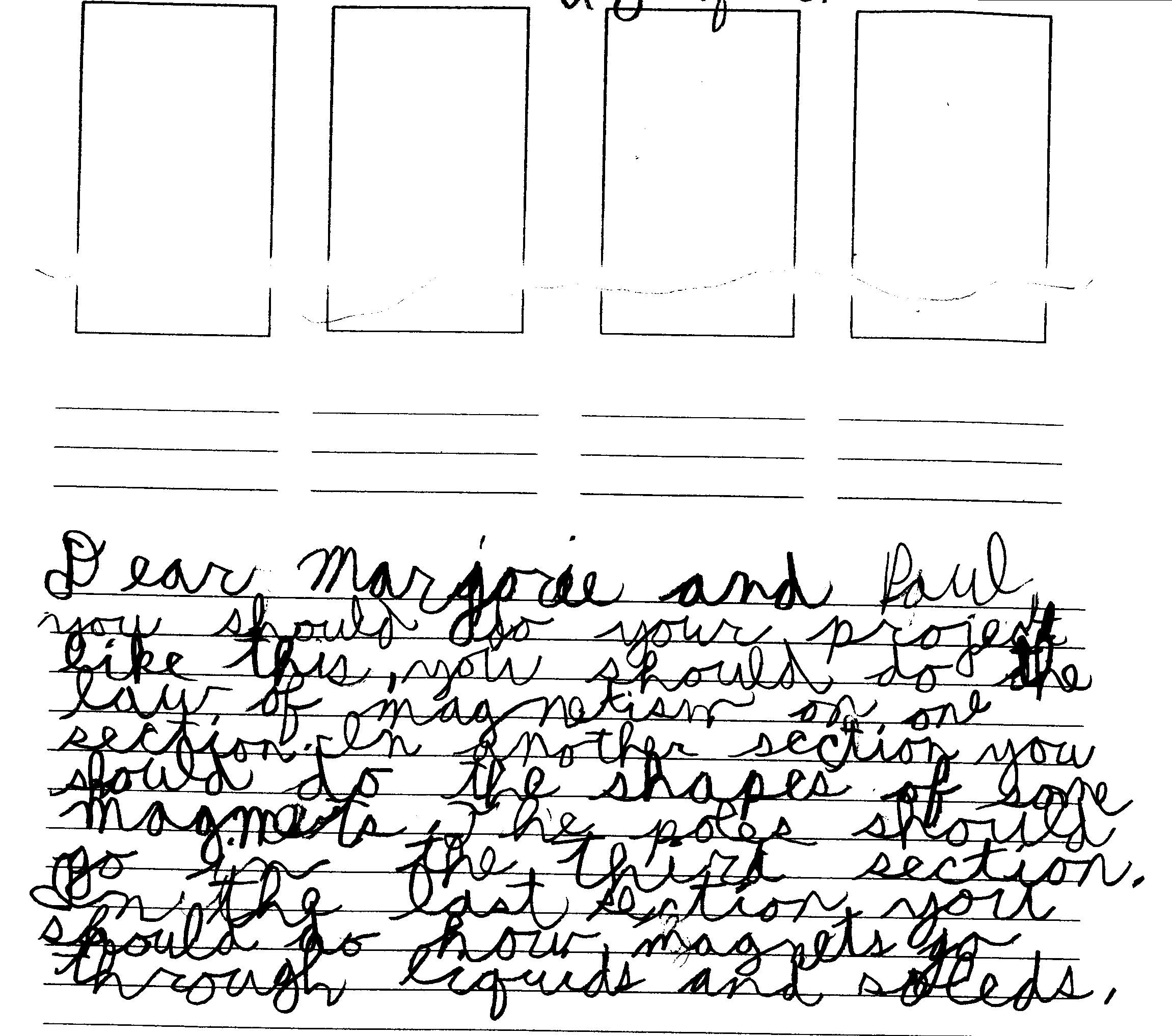
- Teacher introduces the final task sheet titled “Time To Help Marjorie and Paul Finish Their Magnet Project."
- Students are to independently follow the project completion list that begins with an
organizer of their magnet facts, a writing task and a final poster.
- Students are to finish all parts of the project sheet and upon completion, share their posters with the group.
- Students are to turn in all their project materials for the teacher to assess using a rubric.
Reflections and Feedback
Though the hyperlink format took a lot of front end time, I found it to be a wonderful experience for myself and for my students. Their posters demonstrated a more detailed level of understanding than in past years of science journal responses. I think the hyperlink format allowed the students to quickly become engaged and work independently, since the most important steps required them to read and record. The students were able to access the file and, as partners, they accurately shared the gathering of pertinent data. I liked the hyperlink feature because it allowed for quick access to information, but the students still had to read to select the appropriate information. I think I would allow an extra computer day with the hyperlinks, since there was much more they could have explored after they gathered their initial data.
I enjoyed observing the “real” discussion of information at all stages of this project. My only disappointment was the quality of the writing pieces. I would have liked to have seen a more detailed piece with a clear topic and conclusion. I think a little class discussion time and a review of the rubric for self-assessment would make the purpose of the writing pieces more clear. Overall, this was a new experience, and my students were excited and very responsive to each task.
Student Work
These are samples of student work:
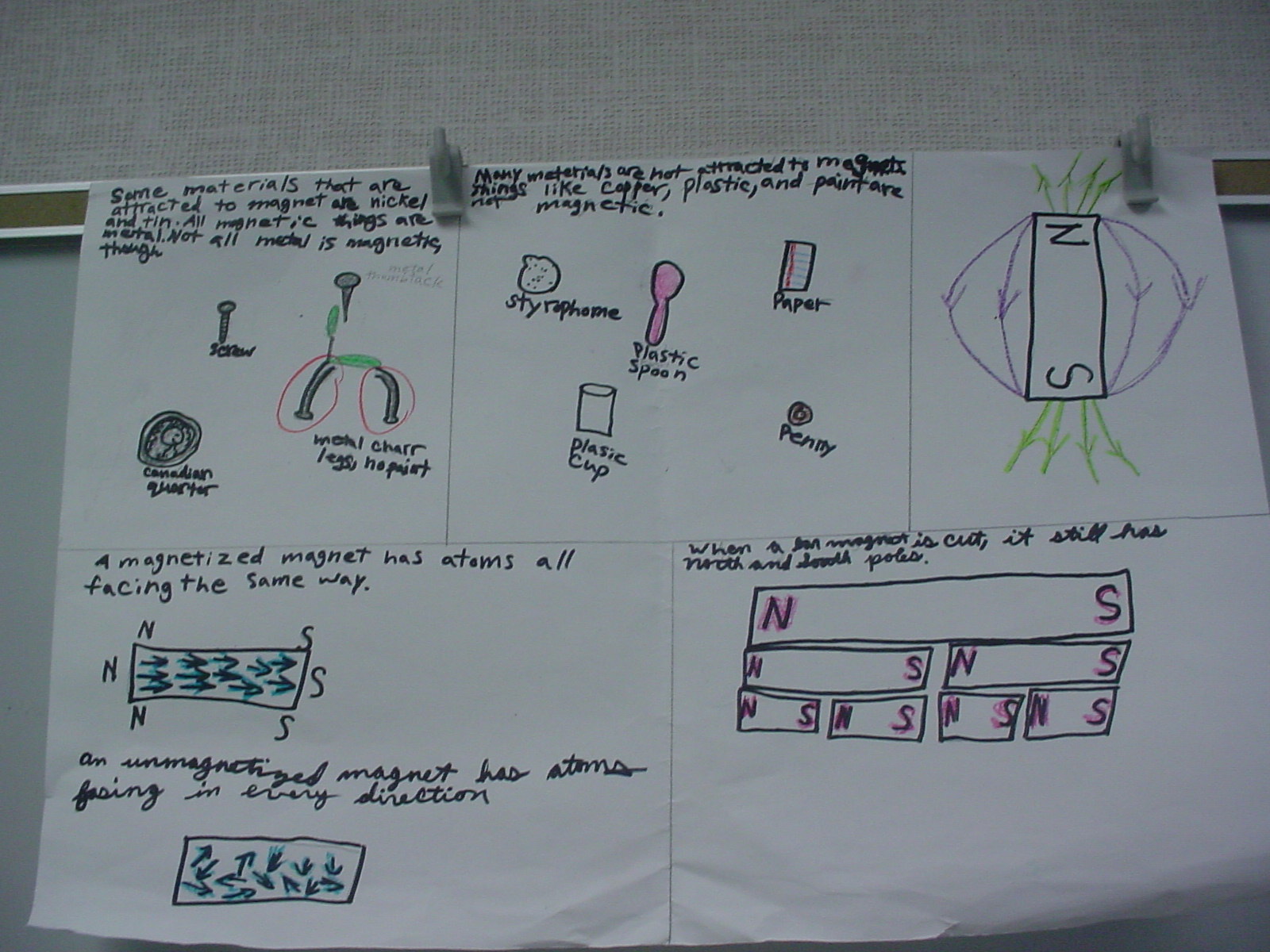
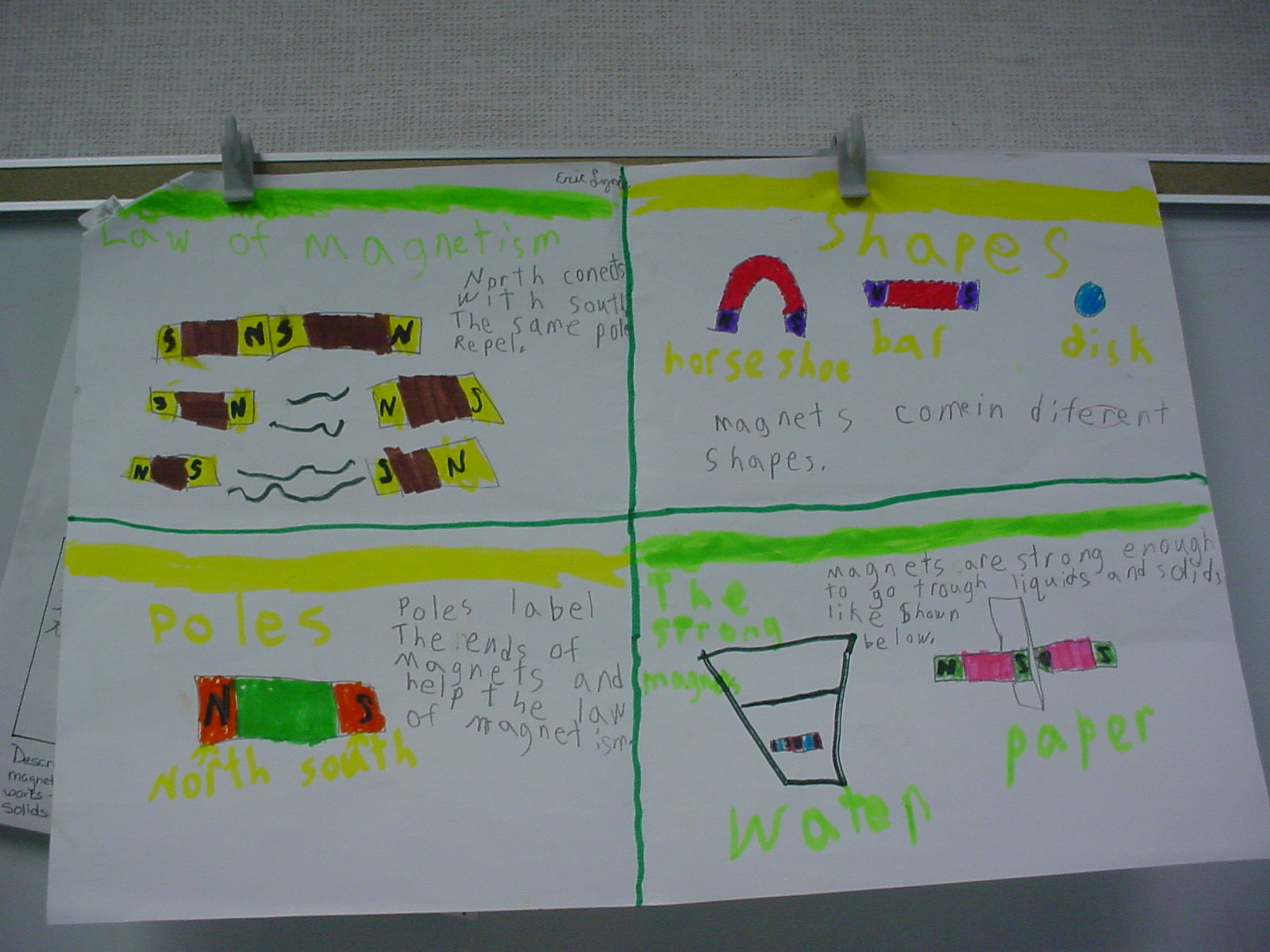
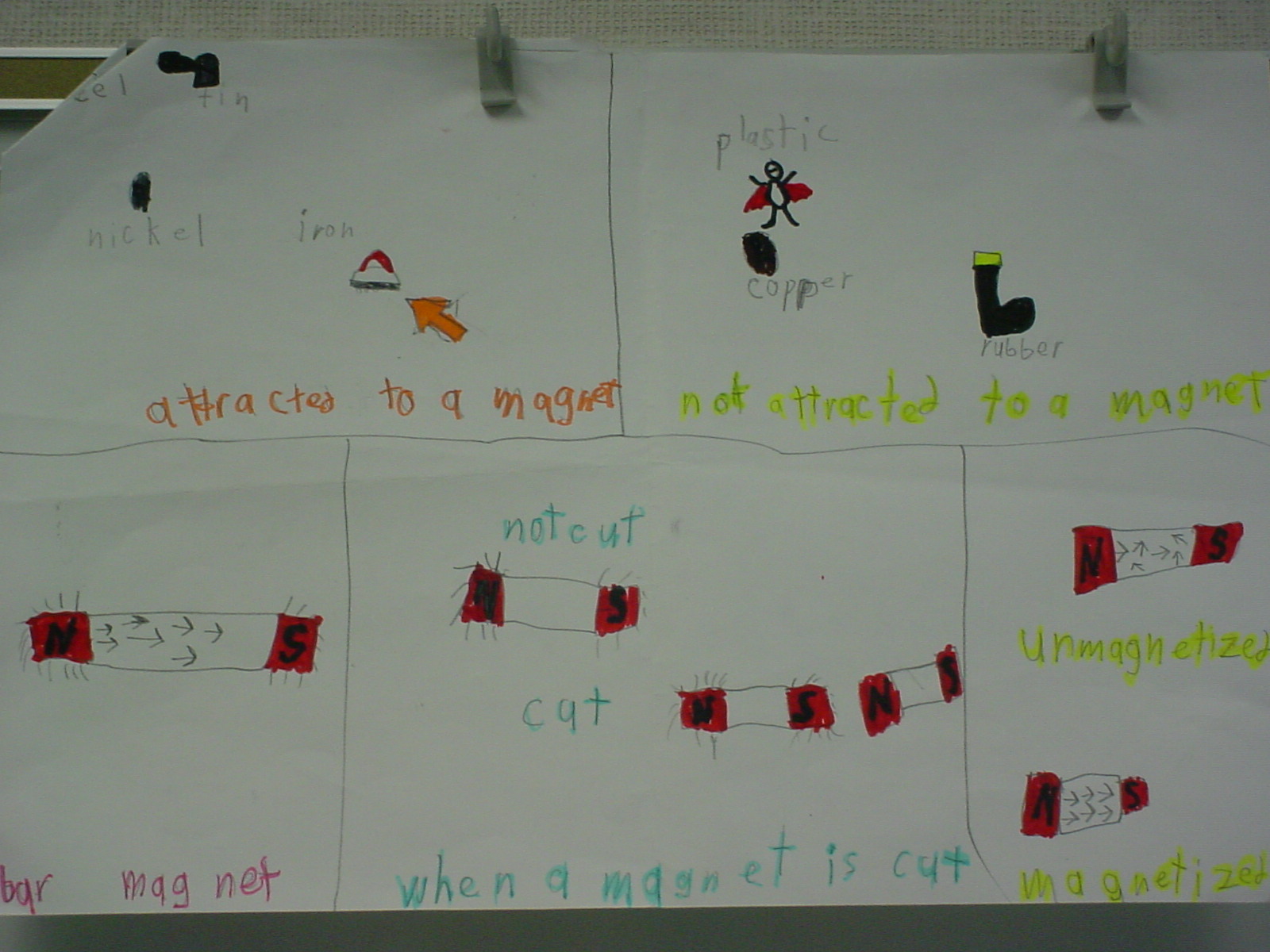
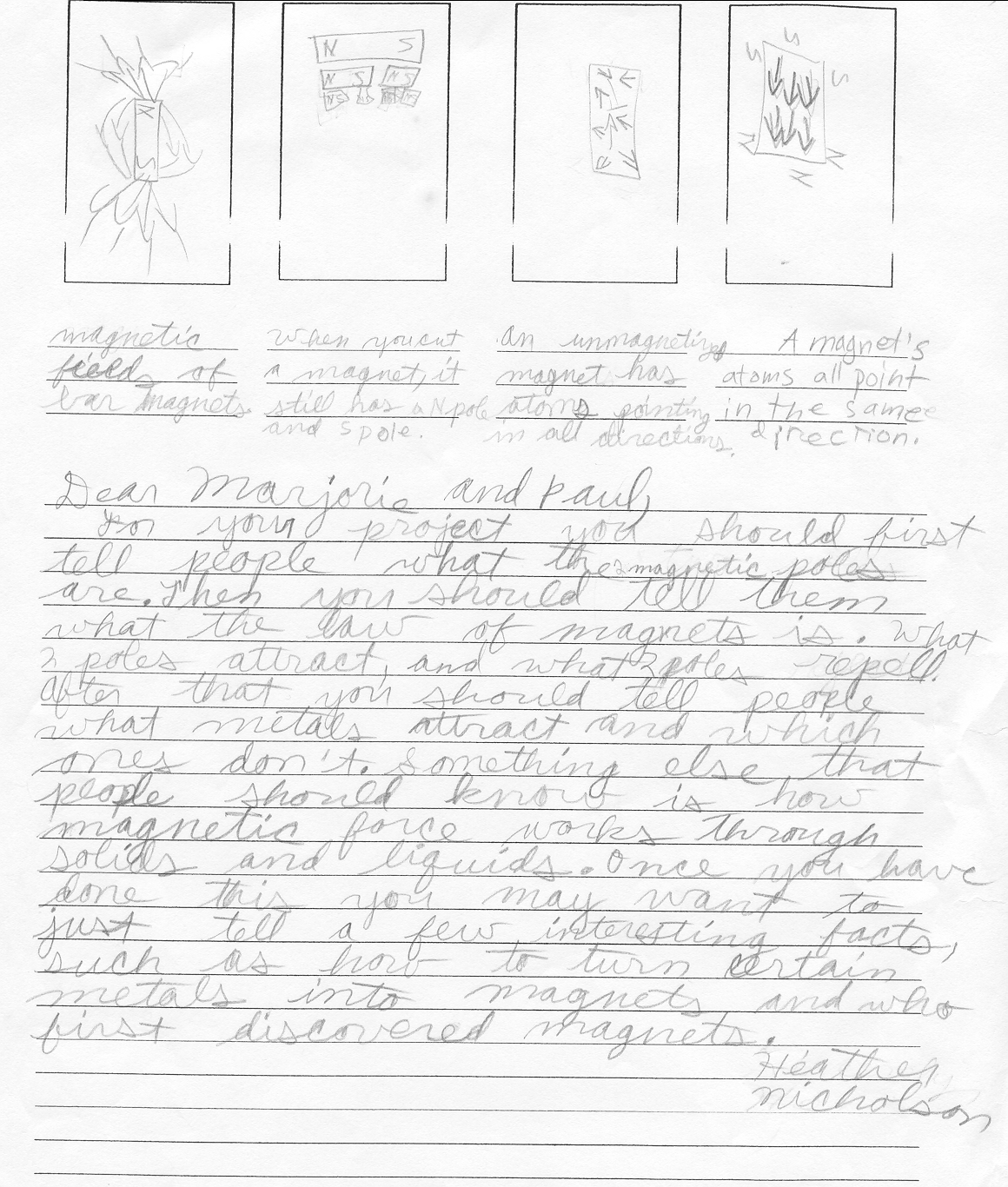
Related Resource
- Teacher made a hyperlink file to the following sites:
Magnets and Magnetism
Magnets
- Downloaded movie titled “Technology At Work, Part Two” from www.unitedstreaming.com
- Chant, A.E., Science Level D. Modern Curriculum Press, 1987. ISBN 0-8136-2510-6
- Supply of horseshoe, bar and cylinder shaped magnets
Materials and Resources
worksheets