Assessment
Reality Store RubricReality Store EvaluationReality Store ReflectionScoring Guidelines
Learning Context/ Introduction
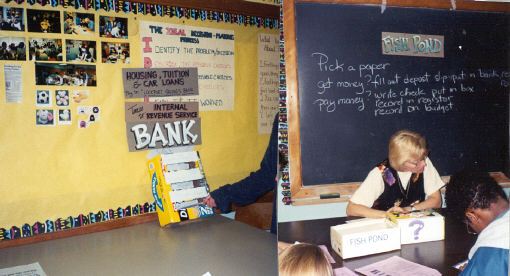
In this Learning Experience, students plan a budget and pay bills when they visit the "Reality Store," a series of classroom learning stations (see Overview handout below).
The Reality Store is a place where students pay bills after planning their budget for a level of income based on a predetermined level of education. Students apply decision-making, problem-solving, and management processes to develop and follow a spending plan to meet established goals with a degree of accuracy. The goal is to develop the knowledge and skills needed to use these processes in practical, real-life situations involving the use of money. They visit a series of learning stations that require making budgeting decisions.
Guiding Questions:
- How does an adult make decisions when formulating a spending plan?
- What is the relationship between education and employment, and one's quality of life?
- Why is mathematics important in everyday life?
Eighth grade Home and Career Skills students are familiar with the Reality Store concept from fifth grade when they selected a career and paid for household expenses as they took a walk through life. Unlike fifth graders, who keep a simple tally of household expenses, the middle school students receive a salary and plan a budget based on an inventory of projected education and lifestyle at age 28. They use checkbooks donated by a partnership with Lockport Savings Bank to pay their bills. The planning of a budget and calculations for check writing are perhaps the most challenging parts of this project.
The Reality Store is used as a culminating assessment for units on consumerism and money management in 8th grade Home and Career Skills classes about the third week of a 13-week course.
Prior Knowledge
- Identify individual lifestyle needs and wants.
- Identify possible educational and career choice with corresponding income.
- Formulate a personal spending plan for age 28.
- Make decisions; solve problems.
- Spend and save money wisely.
- Add and subtract with or without a calculator.
- Write checks properly.
- Reason, evaluate, and communicate about personal spending choices.
- Identify their own abilities and interests as possible guides to career choice.

 Overview
Duration
Planning and preparation for teacher:
- Copy materials—1 hour
- Arrange for event room, support staff—1 hour
- Set up room—1 hour
- Assess student work—1 hour per class
Planning and preparation for students:
- Eleven 45-minute class periods, two homework assignments ½ hour each
The event:
The assessment:
Instructional/Environment Modifications
This project reflects "best" classroom practice because it is a real-world simulation rooted in each child's personal goals. The project may be simplified for elementary classrooms and expanded for high school classrooms. It is interdisciplinary in nature, and may be repeated at each educational level to track the progression of goals and skills for students individually.
A large room with several tables and a few chairs is needed to accommodate the payment stations and payment officers at some of the tables. Signs and decorated payment boxes (shoeboxes) make the room more inviting. A table of catalogs, poster ads, and flyers add to the excitement of the luxury table. Calculators should be available for students throughout the planning and execution of the activity.
The "help" table is available for students needing extra assistance. Budgets are planned and checks are written BEFORE students enter the Reality Store during class time and at home. Before the reality event, students requiring tutoring when writing checks and using math skills are provided with the needed support in school or by parents at home.
Table Descriptions:
- Table 1: Bank to deposit check for income taxes, student loan, savings, and housing. ADULT CONSULTANT necessary to help with loans if needed.
- Table 2: Station to deposit food, clothing checks
- Table 3: Station to deposit childcare check
- Table 4: Station to deposit utilities, cable checks
- Table 5: Station to deposit transportation checks for car, gas, bus, etc.
- Table 6: Station to deposit insurance checks
- Table 7: Station to deposit optional donation check
- Table 8: Life Surprises fishpond table to select a life surprise and pay or receive a surprise. ADULT CONSULTANT necessary to monitor selection and pay or receive checks for students as per the surprise.
- Table 9: Luxury table with posters, catalogues, newspapers, to buy items. This table should have a consultant to keep order. This needs a larger area since students enjoy looking at what they could buy. If they buy an item, they deposit the payment in a box at the table.
- Table 10: Help table. ADULT CONSULTANT necessary to assist students with calculations and financial advice. Calculators, paper, pencils and a math teacher are found at this table.
Procedure
What Teachers Do
- Money management lessons are taught on the following topics: use of credit, savings, check writing, money management principles, consumerism, social service system taxation, and the decision making process. Students are then introduced to the Learning Experience. Teachers can use the Unit Plan: Reality Store as steps for the activity and the Teacher Resource packet (see below).
- Introduce the Learning Experience and the Reality Store Rubric. Students may offer suggestions to edit the rubric but not create the rubric.
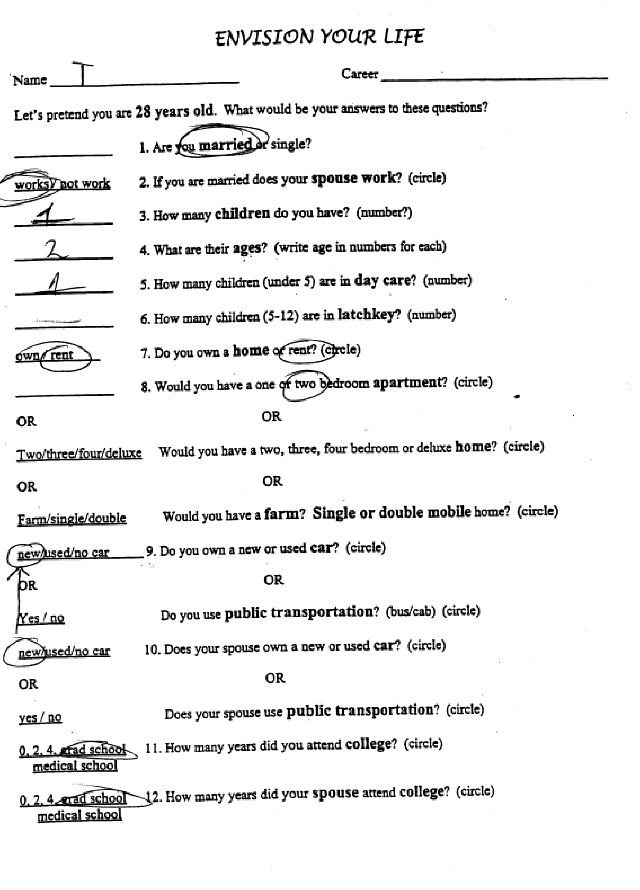
- Students complete an Envision Your Life Form, predicting their life at age 28, by recording key lifestyle choices concerning marital status, family composition, housing, transportation, and education. It is important to encourage realistic predictions or the students will be disappointed later that they did not make this experience more personally valuable. The teacher keeps the forms to use at a later date so that students do not change information.
- To calculate the savings each students will receive, multiply the numbers of days a student attended class prepared by $5. One dollar is subtracted for every unprepared day. Some students will have completed an interest inventory and career project in another subject area and will use that information to make a more exact career choice leading to a more exact income level.
- Students sign out checkbooks by number since students sometimes see an opportunity to play and use the checks in the real world. This is a good time to teach about fraud. Students also need to know how to void a check.
- Assist students in creating a spending plan using the Checking Account Information and Spreadsheet and Student Reference Packet (see below).
- Set up the Reality Store with payment booths for each item on the budget. Depending on the size of the room and class, the following setup can be simplified or elaborated upon. I found that each time I ran the project, I added more decoration to increase the fun and excitement in the room.
I decorated 10 shoeboxes with a slit in the top for the checks and with a title on the top and side of the box; the title specifies which payment(s) are to be placed in the box. I placed the boxes on tables around the perimeter of the room. Signs hung from the ceiling with the same titles that appeared on the shoe boxes directly below. There were consultants at some of the tables (see below). Stations 2-7 could be consolidated by placing more items in one box to save space. However, the ideal would have been to have a separate box for each of the expense categories. Three stations must have adult consultants; the luxury station needs a person of any age who can keep order (See Table Descriptions below).
- The teacher supervises the general operation of the room. A support person is needed for the help table, fishpond, bank, and auxiliary space for students who finish early and wish to work on the evaluation and reflection. If a student finishes the event in one day, he/she may begin the evaluation and reflection. Most students take 1¼ periods, but absent and slower students take two periods. Also, some students make mathematical errors, which takes a second period to correct. Using two days builds in a safety net for unforeseen situations.
- The guiding questions and the NYS Standards are posted and referred to throughout lessons to help keep the unit focused on the Standards.
- During the event, situations will arise that were not planned for and the teacher will have to become a financial advisor, helping students see choices. For example, a student may need a loan to pay a medical bill from the fishpond. Sometimes students want loans to buy a product at the luxury table. These are teachable moments on credit and savings. The goal should be for students not to take out loans.
Note: THE TEACHER WILL NEED TO UPDATE COSTS, AS NECESSARY, FOR BUDGET ITEMS AND FOR LUXURY TABLE ITEMS.
What Students Do
- Students examine the Occupational Handbook for jobs/careers requiring the following educational requirements before selecting their personal choice for the Envision form.
- High school diploma
- 2 year associate’s degree
- 4 year bachelor’s degree
- +2 years master’s degree
- +3 years law degree/PhD
- +6 years MD, not specialist
- Students examine utility bills, mortgage statements and real estate ads.
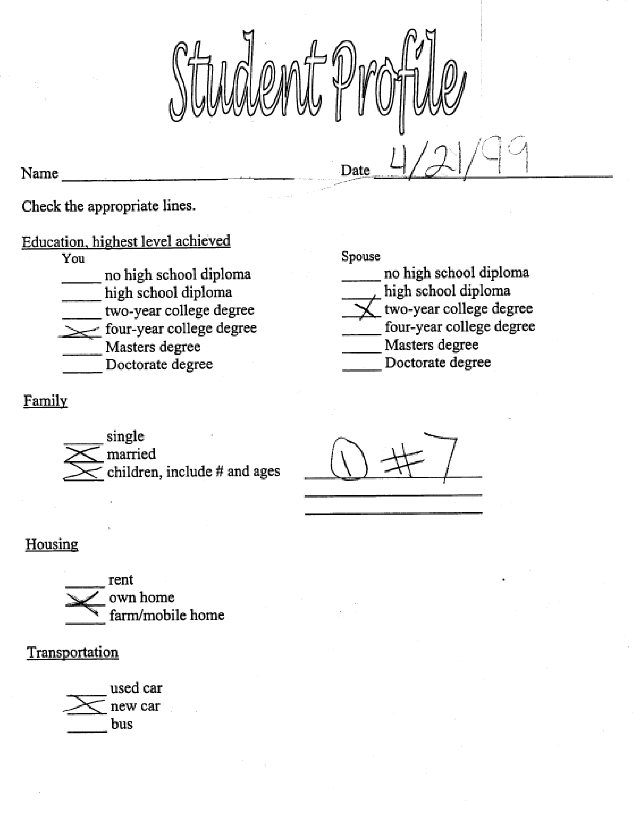
- Using the Student Reference Packet, students convert the information from the Envision Your Life form to the Student Profile Form. Some students may try to change the predictions now that they know that the forms will be used to make purchases. The teacher needs to reinforce the rule not to change the information.
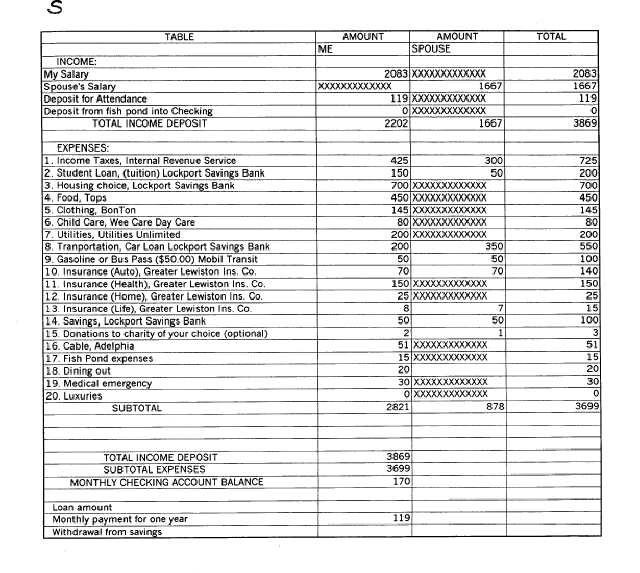
- Students create a spending plan on the Checking Account Spreadsheet using the Student Profile form and the reference packet with costs for items needed. The reference packet will need to be updated as costs rise and fall. A computer may be used for spreadsheet calculations or students may pencil in the costs and use a calculator to tally amounts.
- Students write a check to pay for each expense but leave a checkbook until they visit the Reality Store room. The check register is to be completed accurately as well as the information on the spreadsheet form.
- On the event day, students will enter the Reality Store, a room with payment booths for each item on the budget. They will deposit a check for the amount of the item on the budget. In addition, they will select a "life surprise" ticket indicating an unexpected gift or bill. When all their bills are paid, the students may visit the luxury table to purchase additional items from dinner to a vacation, clothes to electronics. In the event of a lack of funds, students may visit the bank to ask for a loan or they may change some of their flexible bills (ex: car choice) but they may not change the Student Profile. The check register and all forms must be completed properly and balance. A "help" table is provided for math and advice counseling by a volunteer parent.
- Students turn in the Student Profile, Spreadsheet, Evaluation, Reflection and Rubric. Students circle their score with a pen first and then the teacher uses a marker on the same rubric. Discrepancies are discussed between the student and teacher.
Unit PlanEnvision Your Life FormChecking Account InformationStudent Reference PacketStudent Profile FormTeacher Resource Packet
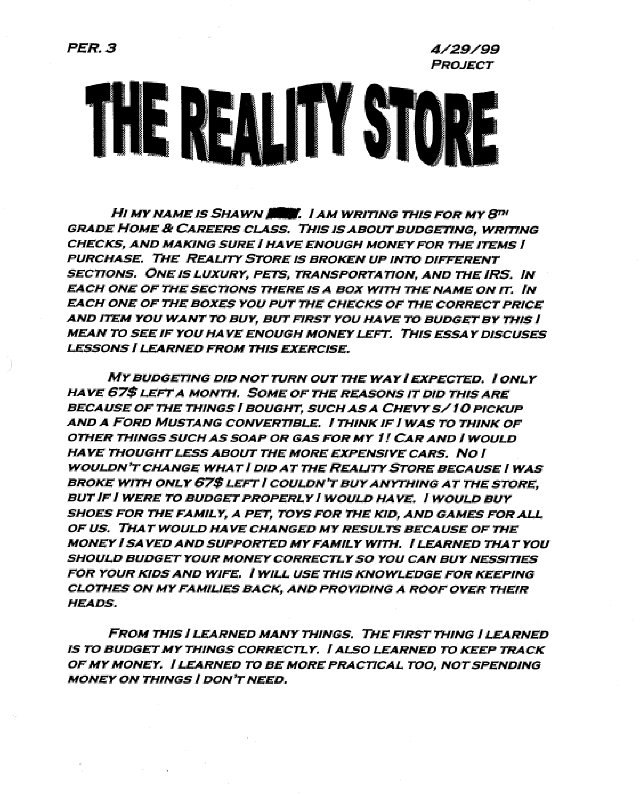
Student Work
Assessment
In this Learning Experience, students plan a budget and pay bills when they visit the "Reality Store," a series of classroom learning stations.
Students are asked to review the rubric together with the teacher, which will be edited before being used. At the end of the simulation, students will again be asked for feedback.
Students will be asked to review the teacher-developed task and rubric, which will be edited accordingly before being used. At the end of the simulation, students will again be asked for feedback for continuous editing purposes.
Reality Store Evaluation
Evidence of meeting the learning standards' performance indicators will be achieved through a practice activity, and observation and conferencing during the budget planning periods, and the day of the Reality Store event.
A rubric and reflection essay will document student achievement. One random check will be selected for each student. Each student will turn in a student packet.
Reality Store Reflection
I do not accept late or illegible assignments. Therefore, a "0" is given on the rubric for each dimension missing or illegible.
Support Materials:
Reality Store RubricReality Store EvaluationReality Store ReflectionScoring Guidelines
Student Work
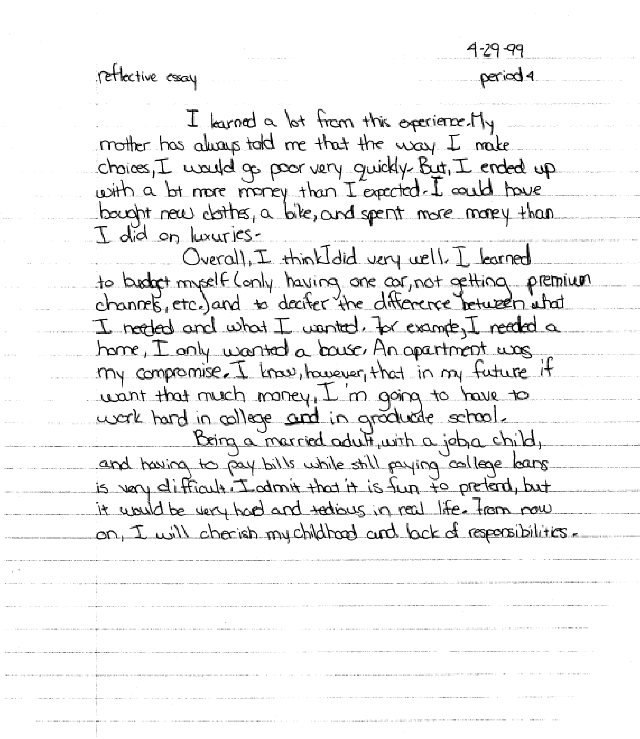
The following are samples of Student Work for the Reality Store:
Author
Patricia Loncto, Lewiston-Porter Central School
Reflection
The Reality Store concept was first developed for elementary school children by Gretchen Varney through a VATEA grant in the early 1990's. With the help of Barbara Gallucci and Gail McMahon, I adapted the activity for the Middle School Home and Career Skills classroom.
My overall goals are to encourage students to stay in school, make wise choices, know the difference between needs and wants, and to recognize the importance of math skills. Because Home & Career Skills is only 13 weeks long, I had difficulty creating an interdisciplinary unit with my academic team when I first tried this activity.
The consumer unit is not included in this packet, however the money management unit is included. I use mini-role plays to explain Credit Price Tags with the students being borrowers. I also use student role-plays to show how a check goes from buyer to seller, to bank, and back to buyer. Individual teachers could add or subtract information depending on time allotment. Sometimes I begin the next unit before the Reality Store event, depending on available volunteers.
The Reality Store activity can be chaotic at times. The first time through can be confusing for the teacher. The second time, the teacher can make his/her own rules based on the student composition and personal theory.
The level of excitement of those students with money, and the frenzy of those without money, can be felt by everyone in the room. The students take this simulation seriously once they begin to plan the budget. The Reality Store presents students with an age-appropriate, real-life experience that helps them learn home and career skills they will use in their future. The Reality Store motivates students to learn.
The best way to see the value in the Reality Store activity is to hear from the students:
"An important factor in applying for a job is education." (Alexis)
"I realized that one little mathematical error can make a big difference in a checkbook." (Kristie)
"When I first started to do the checkbook thing, I thought it was a waste of time, but once I learned how hard it was to do all that stuff, I realized why they were teaching it." (Jerry)
"The thing that surprised me the most was all of the insurance." (Mario)
"I learned I need to take care of bills before I spend all my money on luxuries." (Shane)
"My daughter cost me tons of money, my hand hurts from writing checks, and my budget is not balancing." (Danielle)
"It helped me understand how hard it is to be grown up and have to pay for everything." (Christine)
"My mother always told me that the way I make choices, I would go poor very quickly. But I ended up with a bit more money than I expected." (Theresa, Reflective Essay)