Learning Experience/Unit
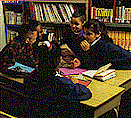
English Literature Circles
Subject
English Language Arts (2005)
Grade Levels
Intermediate, 4th Grade, 5th Grade, 6th Grade, 7th Grade, 8th Grade
Assessment
Rubric, Worksheets, Reading Logs, and Participation
Learning Context/ Introduction
In this learning experience, the primary objective is helping students learn to develop self-expression, inter-personal skills, and an appreciation of literature. This is accomplished through small groups, ideally located in a library setting where the teacher and the librarian act as facilitators.
There is no one right way to do Literature Circles; it is open-ended and adaptable to meet the teacher/librarian/student needs. The intellectual challenge of the learning experience may be increased by choosing a variety of reading levels and encouraging each student to stretch to his/her next level. Students break up into their assigned groups (of 4-6 children) and take on different roles in order to talk about what they have been reading. This provides a way for students to think critically and reflect on what they have read. Lit Circles are a facilitator of communication and comprehension. There are many different possible roles to play, depending on what the teacher is looking to accomplish. These roles aid the students in exploring unique ways of expressing themselves. Each time a meeting is scheduled, the students will receive new roles. This will help students learn to convey their thoughts and ideas in different ways. To ensure a dynamic, thought-provoking discussion, the students must have their assigned portion of the book read before the meeting starts. They will also be given their assigned groups and roles in advance, along with a worksheet to complete. The worksheets are geared to help and prepare each student to effectively carry out their assigned role. In addition, each student is to keep a reading log, where they can write down thoughts, ideas, and questions they may have.
Duration
One class period designated to explain how Lit Circles work, and how the groups will be broken up. The teacher will also give a book talk to highlight important themes and characters in the book. 4 Class Periods - two meetings per week for two weeks. Meetings may take place in the classroom and the library.
Essential Question
How can we help students show an understanding and develop a comprehension of what they have read?
Instructional/Environment Modifications
- Visually impaired students will receive an unabridged book on tape/cd (if available).
- Students who have not read and completed their assignment sheets should not participate in the Literature Circle meetings. Instead send them to another classroom to work on their reading and/or assignments.
- ESL students may receive a copy of the book written in their language or an unabridged book on tape/cd in their language (if available).
Procedure
- The book is chosen and assigned by the teacher, along with the librarian giving a book talk and explaining Literature Circles to the class.
- The readings will be broken up in parts as homework assignments.
- Students are told which group they are a part of, with no more than 4-6 students per group.
- The members of each group take a turn spinning the wheel to find out what role they have for the upcoming meeting.
- Assignment sheets given out based on their role as homework to do the night before the meeting, and the students will complete a reading log of what they read.
- Before scheduled meeting, the students must complete their reading, write in their reading log, and finish their assignment sheet.
- Meetings scheduled in the library twice a week for two consecutive weeks.
- In the meeting, students will take on one of the five roles assigned (Summarizer, Discussion Director, Investigator, Illustrator, Connector, Travel Tracer, or Word Wizard/Vocabulary Enricher.
- Roles will rotate for each scheduled meeting using the Spinning Wheel. No student plays the same role twice. Role Card with corresponding description is passed out to each student. Note: These merely provide examples for the teacher. Depending on the roles given to students, modifications are needed to these existing handouts.
- This goes on for four meetings until book is completed.
- Assignments and reading log handed in for teacher review.
Reflections and Feedback
Literature circles help promote interest in reading in the hopes of creating life-long readers. Students will be graded for this project based on their participation in groups, completed worksheets, and reading logs.
Related Resource
- One copy of book per student
- Dictionary and Thesaurus
- Assignment sheets with designated role
- Reading Log
- Laminated cards with role descriptions listed
- Spinning wheel to make role selection random
Website(s)
Choosing Books for Literature Circles
Authors
Rhiannon Law
Luis Davila
Picture citation
LiteratureCircles.com. http://www.literaturecircles.com/. 28 October 2004.