Duration
The following is the time it took to plan and implement the learning experience, including the Stress Clinic.
Planning
About 3 hours:
- Plan small groups for each class.
- Make a list of stressors for the Panic
Button activity.
- Get materials like poster board, paper and markers for "Top Ten".
- Collect 30 local telephone books.
Implementation
Number of class periods to be determined by the teacher
- Faculty support/presence for supervision or actual participation during stress clinic.
Assessment
- BIOPOEM Scoring Rubric (Time depends on number of students)
- Using Community Resources Scoring Rubric (1 hour/class)
- My Response to Stress Reflections Scoring Rubric (1 hour/class)
Learning Context/ Introduction
The statement "Teens don’t know what stress is!" is FALSE! Today youth must deal with everyday stress in their personal lives. The topic is relevant to the times as we raise academic expectations. The goal is early detection of stress symptoms before stress has an opportunity to escalate.
In this Learning Experience, students learn about preventing and relieving stress. They conduct self-assessments, plan a stress clinic, research community resources, and write a reflective essay.
These lessons are the stress management segment of a high school mental health and wellness unit in the required ½ credit 10th grade health course. It is meant as a "summative assessment" to follow health and wellness lessons.
Guiding Questions:
- How can stress be recognized?
- What are some human and non-human resources that can relieve stress?
Prior Knowledge
(Taught during the course before the learning experience, or acquired during the learning experience.)
- Definition of health/wellness/personal values.
- Needs (Maslow's Hierarchy).
- Physical and psychological stressors.
- "Eustress"/"Distress".
- Identify physical, emotional and behavioral symptoms of stress.
- Identify personal support people.
- Locate resources to solve problems.
- Contact a community resource for help.
- List possible healthy methods for reducing stress.
- Prioritize healthy ways that they personally reduce stress.
- Compare personal stress reduction methods to those used by others.
- Work in functional role within an organization.
- Advocate for a health issue.
Procedure
What Teachers and Students Do
In this Learning Experience, students learn about preventing and relieving stress. They conduct self-assessments, plan a stress clinic, research community resources, and write a reflective essay.
- A most important detail of this unit is to allow student input into the dates of class time that will be used to plan a culminating event, a stress clinic for students and staff. Attendance is part of the grade.
- Distribute a Blank Calendar, explaining that good stress managers plan ahead.
- Review the long-term plans with the students and have them circle the crucial days that they need to be in class for. See the Unit Plan.
- Activities that introduce the topic and provide a foundation:
- Use Type B Personality/Type A Personality and Stress Self-Inventory.
- Ask students to respond to a sign, "Young people don't know what stress is!" Discussion that includes a definition of stress follows.
- Complete sheet What is Stress? graphic organizer. Your textbook will include a list of psychological stressors that students can use to rate themselves.
- Use Stressed Out? graphic organizer.
- Make signs and hang around the room: #1, #2, #3, #4, and Panic Button. Students can silently get up and stand near the sign that indicates the degree of stressfulness of each stressor you read from a list of assorted stressors, such as homework, upcoming dance, important athletic event, playing music, end of school day, etc.
- Volunteer students can wear electronic heart rate monitors to demonstrate stress levels in a more concrete way. The number of heartbeats per minute is indicated on the watch face. The teacher tells them what the current pulse number is and the resting heart rate in the morning before the stress began. The pulse is a physical stress level clue.
- The teacher can lead a Progressive Muscle Relaxation exercise and follow-up with checking heart rates of relaxed volunteers.
- Debriefing: include discussion of relaxation as a healthy habit; alcohol and drug abusers are often seeking an escape from emotional pain and move away from the natural ability to enjoy the simple pleasure of relaxation.
- A crossword puzzle Healthy Ways to Deal with Stress can also be used and follow-up with checking heart rates of relaxed volunteers.
- In a single class session small groups:
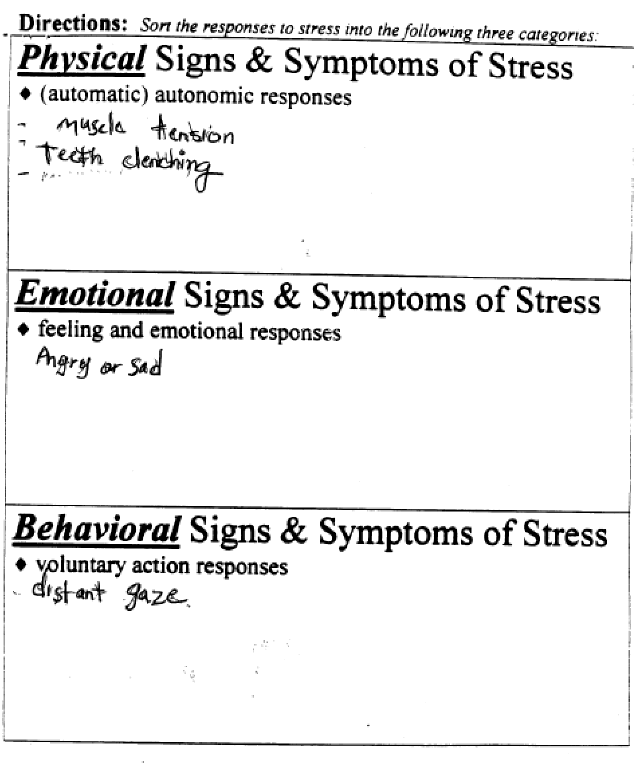
- Cut out and sort into categories, an assorted collection of Responses to Stress using the graphic organizer Physical, Emotional and Behavioral Signs & Symptoms of Stress.
- Groups will discuss and compare viewpoints
- Individually complete the Physical, Emotional and Behavioral Signs & Symptoms of Stress and complete the graphic organizer.
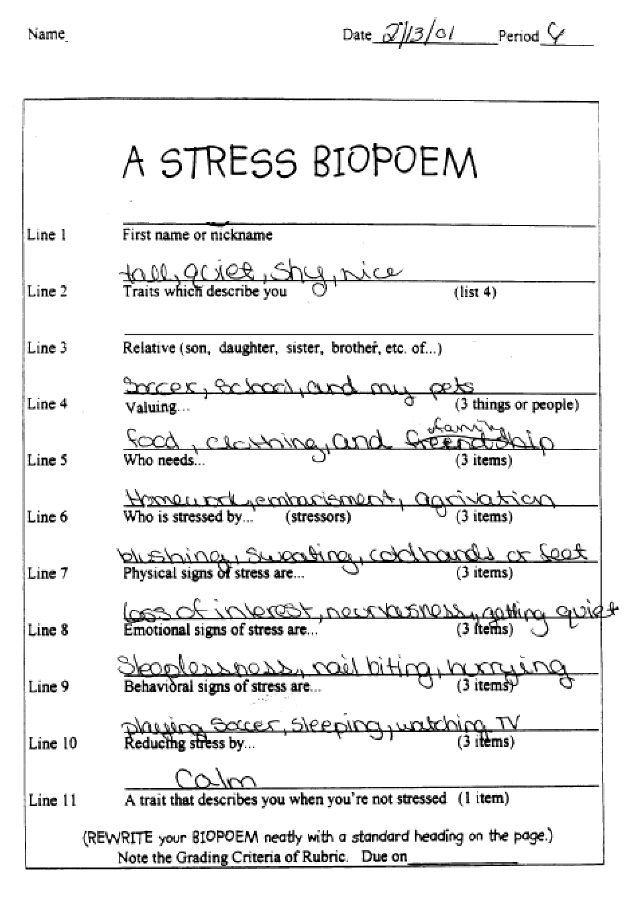
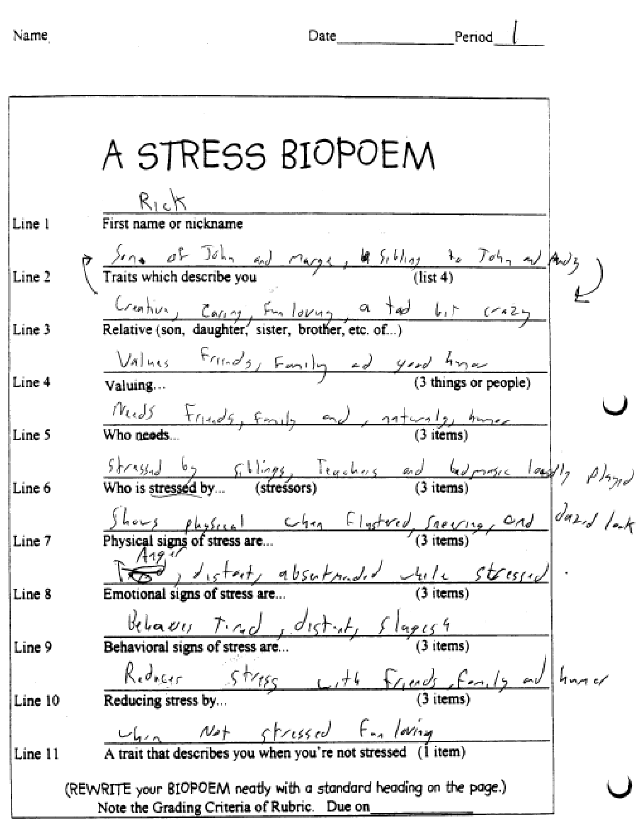
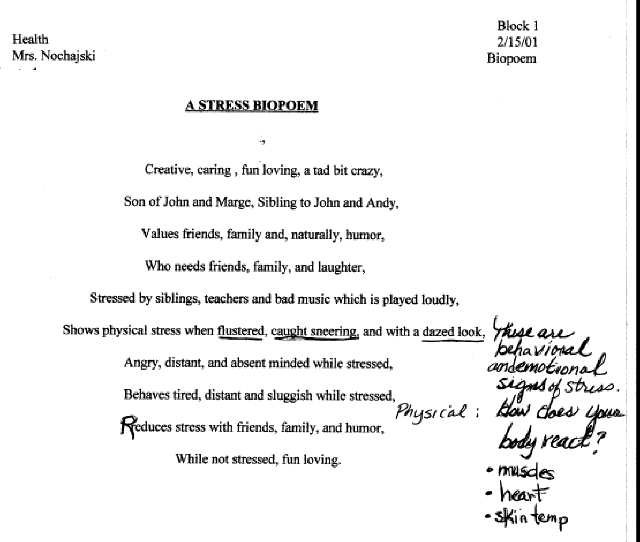
- Create a personal poem, a Stress BIOPOEM using a structured form as a guide. The poem form requires students to write about their stressors and their reactions to stress. Students are encouraged to word process the final copy using a computer outside of class. When the poem is introduced, model BIOPOEMS are read to give them examples of a quality product. (See samples of Student Work below.)
- Individually, complete exercises:
- Given twelve stressful problems, students are asked to predict who/where they would go for support for each problem. Afterwards, students look for a pattern in their responses. People I Can Count On
- Community Agencies That Can Help is an activity where students are purposely put in somewhat of a stressful situation, struggling alone using a telephone book to get help, within a time limit (with a clicking timer and a crying baby), locating numbers for community organizations or agencies. Problems to find multiple alternatives for are:
- a friend who may have a sexually transmitted disease
- is drinking regularly
- is thinking about suicide
- may be pregnant
- is being sexually abused
- If time is short, allow students to work as a team. A blank business card is a great place to record important emergency numbers for the wallet.
- Using Community Resources is a follow-up homework assignment that requires students to actually visit or conduct a telephone interview to gather information about a community resource/agency.
- Plan authentic stress clinic:
It is very important to have the dates for clinic planning decided and have students construct a calendar of the lessons at least a week ahead to give students an opportunity to reschedule music lessons, dental visits, etc. because the group advocacy experience is very difficult to make up if missed.
- As a class:
- Introductory activity: Keeping Cool: Positive Ways to Calm Down When You're Upset graphic organizer is a list that students must individually complete with positive ways to reduce stress. In a whole group, students help each other add to their list until the sheet is full. Individually, star their Top Ten and later prioritize their Top Ten using the same graphic organizer.
- Review the expectations
- Review the Planning the Stress Clinic Scoring Rubric
- The Organizational Chart, and Resume and Job Application for stress clinic volunteers are available in student packets. Date, location and method of stress clinic registration are needed for group work.
- Small groups:
- Each small group will be given a specific graphic organizer that provides a job description and a place to record progress of work done on one of the following tasks:
- Accountants (Top Ten)
- Public Relations Staff (name the clinic, PA announcements, advertisement)
- Interior Designers (Rx for Coping, other ideas)
- Research and Development (planning a relaxation activity)
- Office Administrators (prepare organization position name/computer)
- Stress clinic volunteers meet after school within the next few days to discuss the progress in the planning of the stress clinic event to occur in about a week.
- Hold actual stress clinic (Date was previously determined by the class.)
- Write a reflective essay about the My Response to Stress Learning Experience (See Rubric).
Support Materials:
Assessment
In this Learning Experience, students learn about preventing and relieving stress. They conduct self-assessments, learn about community resources, and plan a Stress Clinic.
Assessment is ongoing and carried out in a number of different ways:
- Biopoem Scoring Rubric to document student achievement
Supported by the following activities:
- Type B Personality/Type A Personality?
- Stress Self-Inventory
- What is Stress?
- Stressed Out?
- Push the Panic Button activity
- Progressive Muscle Relaxation activity
- Responses to Stress and the Key Responses to Stress
- Physical, Emotional and Behavioral Signs & Symptoms of Stress
- Using Community Resources Scoring Rubric
- Supported by the following activities:
- People I Can Count On
- Community Agencies That Can Help
- Planning The Stress Clinic
- Supported by the following activities:
- Keeping Cool: Positive Ways to Calm Down When You’re Upset
- The Organizational Chart
- Resume and Job Application
Supported by the following records of work completed (graphic organizers):
- Accountants
- Public Relations Staff
- Interior Designers
- Research and Development
- Office Administrators
- My Response To Stress Reflections Rubric
A reflective essay addresses how being aware of personal responses to stress can affect:
- Decision making and your control over what happens to you.
- Accepting and taking on personal responsibility.
- How much value you place on helping others.
- Future life situations.
Calculating Grades:
The 4 rubrics are graded individually. I convert each total to percentage grade.
Supporting Rubrics:
Resources
For the teacher:
- Back-up relaxation materials to have on hand (relaxation music, stress balls, plastic bubble packaging, crayons, clay, information about hand and neck massage, mats).
- Possible guest speaker for stress clinic (if students plan it).
- Heart rate monitor.
- Fetro, J., 1992. Personal Social Skills. Santa Cruz, CA: ETR Associates.
For the students:
- Approximately 30 telephone books, scissors, paper, blank business cards.
- Computer in classroom—technology.
- Student Sheets Packet with all handouts to be used.
- The Search Institute, 40 Developmental Assets, 1997.
- The Search Institute, Healthy Communities—Healthy Youth, 1998.
Author
Carol A. Nochajski
Instructional/Environment Modifications
Students with disabilities relate very well to this activity. Stress and how to deal with it are not new topics for students living with disabilities. I have not had a need to modify the task. If necessary, the list of telephone numbers to be located in the telephone books could be shortened for some students.
Student Work





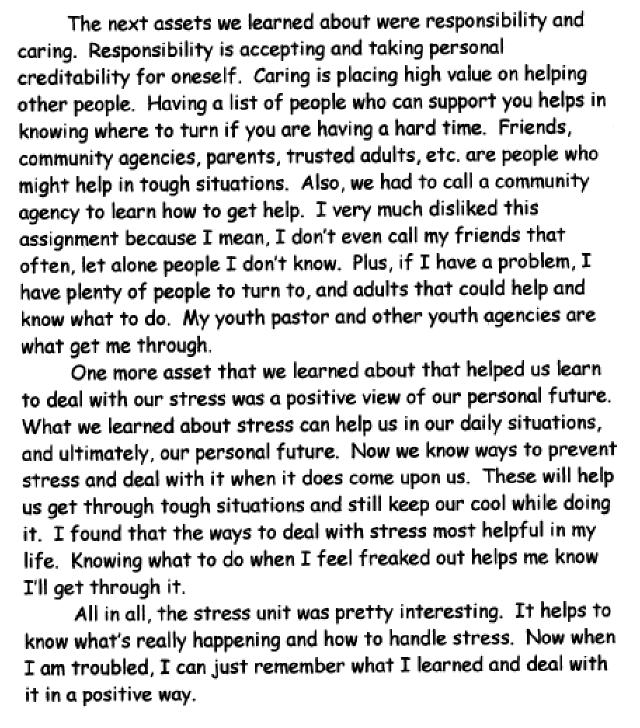

Reflection
Comments from Carol A. Nochajski:
One of the strong positive characteristics of this learning experience is that it supports the Language Arts curriculum. Students use information learned in a self-awareness activity as material for writing a poem. (see A Stress BIOPOEM in Support Materials)
There is a carryover to future units as students write more poems, and talk and write about stress in their reflections.
Listing personal support people seems to be especially helpful to the males in the class. Many males tend to report that when they have a problem they rely on "Just me", or maybe just their girlfriend. Through personal teacher comments and general classroom observations, I like to suggest that guys attempt to open up to more than one permanent person in their lives for support. The females tend to have a broad network of people they could call on. As students come to realize that there are agencies that they might go to for support, their community is increasingly perceived as safe and caring. I consider this learning experience a foundation for other health issues. The developmental assets targeted are actually listed on the reflection sheet.
Actually, visiting or making a telephone call to a health agency and interviewing a resource requires that students step out of their comfort zone. Often, the resource person contacted doesn’t have time to talk and promise to call back later, frequently failing to do so. Discussion of the difficulty of being patient follows, comparing the student’s struggle to a person trying to get help for an authentic life problem.
Planning the stress clinic was a positive stress event. Multiple directions to groups working on very different simultaneous tasks were hectic. I found that the graphic organizers were a great help and revisions have improved the process.
The clinic was a culminating activity, a celebration of learning. The clinic was a public event that showed getting help in a very positive light.
Student quotes:
"There are many ways to react to and reduce stress without turning to alcohol and drugs for the solution." (Alishia)
"People can help you in stressful situations when you cannot help yourself, by going to support groups or community agencies or organizations." (Sarah)
"It’s important not to hold stress in, but instead find an activity that relaxes you or talk to someone about what is bothering you." (Curtis)
"Creating those top ten cool down ideas was a neat thing to do. It actually got you to think how you could become more in touch with yourself." (Kelly)
"Another idea that I never heard of before was community agencies. I knew they were there, but was not sure what they were there for." (Randy)
"Knowing about stress and having an ‘escape route’ for yourself to follow if you ever run into an emergency is a good idea." (Roy)
"People care about what happens to me, I know how to get help for myself and I am not the only person who has to deal with these problems." (Eric)