john Locke
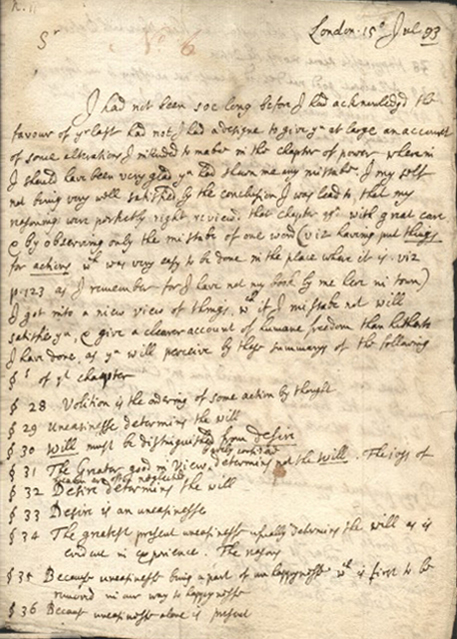

Transcription
London 15 of July 93
Sir
I HAD not been so long, before I had acknowledged the favour of your last, had not I a design to give you at large, an account of some alterations I intended to make, in the chapter of power, wherein I should have been very glad you had showed me any mistake. I myself, not being very well satisfied, by the conclusion I was led to, that my reasonings were perfectly right, reviewed that chapter again with great care, and by observing only the mistake of one word (viz. having put “things” for “actions,” which was very easy to be done in the place where it is, viz. p. 123, as I remember, for I have not my book by me, here in town) I got into a new view of things, which, if I mistake not, will satisfy you, and give a clearer account of human freedom than hitherto I have done, as you will perceive by the summaries of the following sections of that chapter.
- § 28. Volition is the ordering of some action by thought.
- § 29. Uneasiness determines the will.
- § 30. Will must be distinguished from desire.
- § 31. The greater good in view, barely considered, determines not the will. The joys of heaven are often neglected.
- § 32. Desire determines the will.
- § 33. Desire is an uneasiness.
- § 34. The greatest present uneasiness usually determines the will, as is evident in experience. The reasons.
- § 35. Because uneasiness being a part of unhappiness, which is first to be removed in our way to happiness.
- § 36. Because uneasiness alone is present.