Learning Context/ Introduction
Students follow the life of a typical Civil War soldier, using local historical research.
This learning stations document-based activity is designed for use in an eighth grade heterogeneous classroom studying Unit Six: Division and Reunion, of the core curriculum: United States and New York State History. Through the use of primary sources, students can fully understand the experiences of a soldier during the Civil War. Up to this point, the students have studied the underlying and immediate causes of the Civil War and the advantages and disadvantages that both sides had in the war. In addition, the study thus far would have included a look at the geographic factors, which influenced the war, and the major campaigns of the Civil War. This activity, which is one of the components of a five week study of the Civil War, begins with recruitment and follows a typical solider through the war. History comes alive using primary source documents!
Goals:
- Students will develop an appreciation and become aware of the importance of local records and primary source documents related to the Civil War.
- Students will use local records from the County Clerk's office, the Tompkins County Historical Society, the Town of Groton Historical Society, and local residents to prove or disprove their hypothesis as to the life of a soldier during the Civil War.
- Students will be able to write about the experiences of a Civil War soldier.
- Students will appreciate personal letters as one type if primary source for historical research.
Learning Objectives: At the end of this activity, the students will be able to:
- Write about the physical hardships endured by soldiers of the Civil War from New York.
- Compare the losses between two communities during the Civil War.
- Analyze personal letters to understand what it was really like in the midst of battle.
- Draw at least ten conclusions of the life of a volunteer soldier from New York.
Resources
I have included a list of possible websites. If the teacher would like to localize the learning stations, time will need to be spent finding local documents. County historical societies are a good place to start. It does not hurt to visit neighboring county historical societies especially if your school district is on the borderline. The county clerks’ offices will have census information - number of soldiers from the town and death records if not more. Town offices might also have Civil War records or may know if the town historian has useful information (see Websites listed below).
Assessment Plan
The assessment piece asks the students to "describe historic events through the eyes and experiences of those who were there" (Social Studies Standard 1 United States and New York State History). Students are requested to include specifics from not less than five primary sources that they reviewed.
Students are given a choice of three different evaluation activities.
- Students are asked to write a letter home about your life as a soldier in the Civil War.
- Students are given a picture and are asked to describe the experience of one of the soldiers in the picture.
- Students become a field reporter and are asked to write an article for the newspaper about the experiences of the Civil War soldier.
I use the Civil War Writing Assignment - Grading Sheet as well as Civil War Writing Assignment Rubric that follows.
Grading SheetWriting Assessment Rubric
Student Work
Selected Examples:
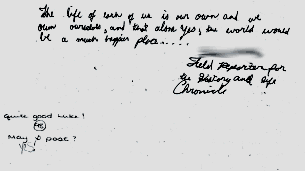
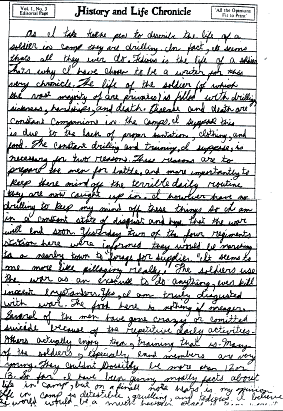

Author
Constance A. Miller,
Groton Central School District
Duration
Planning - If the materials provided are used and the guidelines to the Internet websites followed, planning time will be shortened. Time should be taken to glue the documents and the directions to poster board or construction paper. Arranging the room will take about five minutes. Planning will take longer if the teacher prefers to use local documents or to create different learning stations. Depending on which way the teacher proceeds, this step could take a day to a week.
Instructions - This activity is based on forty-three minute class periods. It will take the students at least two to two and one half class periods to complete the ten stations. Discussion time also varies depending on the questions the students may have, the feedback the teacher heard as he/she circulated around the classroom, and the type of questions the teacher prepares for discussion. These are some of the possible questions for discussion:
- What did you expect to learn?
- What did you learn?
- What was the hardest thing about this activity?
- What were the hardships encountered by the soldiers?
- What can you conclude about life of a Civil War solider?
- What do the personal letters tell us about the war and the feelings of the soldiers?
Assessment - It will take the students three days outside of class (homework nights or study halls) to do a good job on the assessment. If the students are asked to type the assignment, the teacher may want to give them more time. If class time is used to complete this assessment, the students are able to complete the rough draft in one period and the final draft in another.
Instructional/Environment Modifications
This activity is geared to students of all ability levels. Students are challenged to carefully examine and interpret primary source documents. Some teachers may want to arrange groups so that each group contains a class member who has a keen sense of how to read and/or analyze documents. Given the challenge, most students will rise to the occasion and will try their best to examine the documents. As previously stated, the teacher should circulate around the room assisting where and when necessary.
The classroom modifications are discussed under Procedure.
Procedure
Procedure for a Learning Stations Activity:
- Prior to the beginning of class, the teacher needs to arrange the classroom into separate work areas or stations. Desks can be grouped together. There needs to be at least three chairs at every station. The classroom should be arranged to provide easy movement from one station to another.
- At each station, the students will find a poster containing a primary source document or documents as well as directions as to what they need to do at that station. It is best to have multiple copies of the documents available for student use. The directions include a list of questions to answer about the documents, a question sheet or worksheet or instructions for an activity.
- Students work in small groups and move from station to station completing the tasks. Students should be given between 5 to 15 minutes at each station. Some stations will take longer than others depending on the task. The teacher may want to set up a duplicate copy of materials at the stations that will take longer.
- Students move from station to station when they are done with the work. They should only move when the previous group is done. Teachers may want to have the students stand to indicate that they have completed the task. Raising hands works also. The students should sit quietly while waiting to move from one station to the next. The teacher can also go to the group that is done and quiz them on the material they just completed. He/she could review the answers or ask for generalizations as to what the students learned at that station. Answer sheets could be available for the students to check their work while waiting also. Most of the stations take about the same amount of time so there is very little down time.
- It will take the students two class periods, sometimes three depending on the make up of the class. The amount of time at the learning station depends on the task. It is important to instill the idea that they need to move right along in order to complete all the stations. Distractions cannot be tolerated.
- The teacher circulates to provide encouragement and provides assistance when and where necessary.
- Teachers might want to visit local historical societies, town clerk offices, and any other archival centers to find local documents.
For this lesson, there were ten learning stations. However, that number may vary. Students are given a brief overview and explanation of what they will be doing for the next two to three class periods. It should be emphasized that they will become historians and will be analyzing primary source documents. Explain that each station contains a poster with at least one document and a specific task that they are asked to complete to the best of their ability.
Class discussion follows after the students have completed each of the stations. Discussions vary from class to class.
The Teaching Materials for the Ten Learning Stations:
Handouts as a PDF fileHandouts as a Microsoft Word Document
Student Work
Website(s)
The Emancipation Proclamation
John Brown Homepage
"The Valley of the Shadow: Living the Civil War in Pennsylvania and Virginia"
Civil War Person Papers, Diaries, and Reminiscences
A large collection of women’s diaries, letters, and person accounts, etc.
Civil War Photographs
American Civil War Resources
Poetry and Music of the War Between the States
The Civil War Letters of Galutia York
Reflection
The students enjoy moving from station to station. Some find it a challenge to complete the stations in the prescribed time frame. I have streamed lined the type of activities and the number of activities since the first time the students did this station activity. It is imperative that multiple copies of the documents are at each station. In order to complete all the stations, the teacher might have to allow two or more groups of students at each station. Some stations can easily accommodate multiple groups.
WNY Community Resource
If you live in Western New York, contact the Buffalo and Erie County Historical Society’s Education Coordinator. The Museum has an educational loan kit on the Civil War entitled “Rally ‘Round the Flag.” It contains some replica artifacts and other educational resources. To reserve a kit, call 716.873.9644 or visit bechsed.nylearns.org